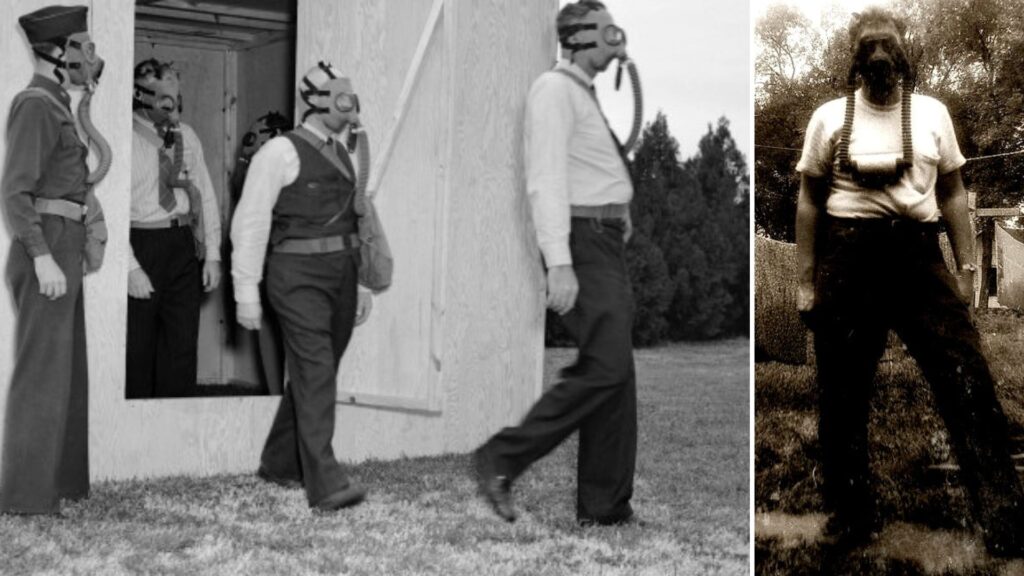
In late August and early September 1944, residents of Mattoon, Illinois began reporting a series of strange nighttime incidents. People woke up to a sharp or sweet odor in their homes, then complained of nausea, weakness, and temporary paralysis in their arms or legs.
Mattoon was a small industrial town of around sixteen thousand people in central Illinois. Factories supported the war effort, freight lines cut through town, and many local men were away in uniform. Women often worked shifts, kept homes running, and followed war news closely.
The first case linked to the later scare occurred during the early hours of 31 August 1944 on Grant Avenue. Urban Raef woke to what he described as a peculiar heavy odor in the bedroom, initially thinking it might be a domestic gas leak from the stove.
Raef felt weak and nauseated and began vomiting. His wife tried to get up to check the kitchen but found she could not move properly and felt partially paralyzed. Visitors sleeping in other rooms of the house did not notice the smell and reported no symptoms.
Later that night, or early the following morning depending on the account, a nearby young mother reported a similar experience. She woke to her child coughing, smelled an unusual odor, and found she could not leave her bed. The incident drew little immediate outside attention.
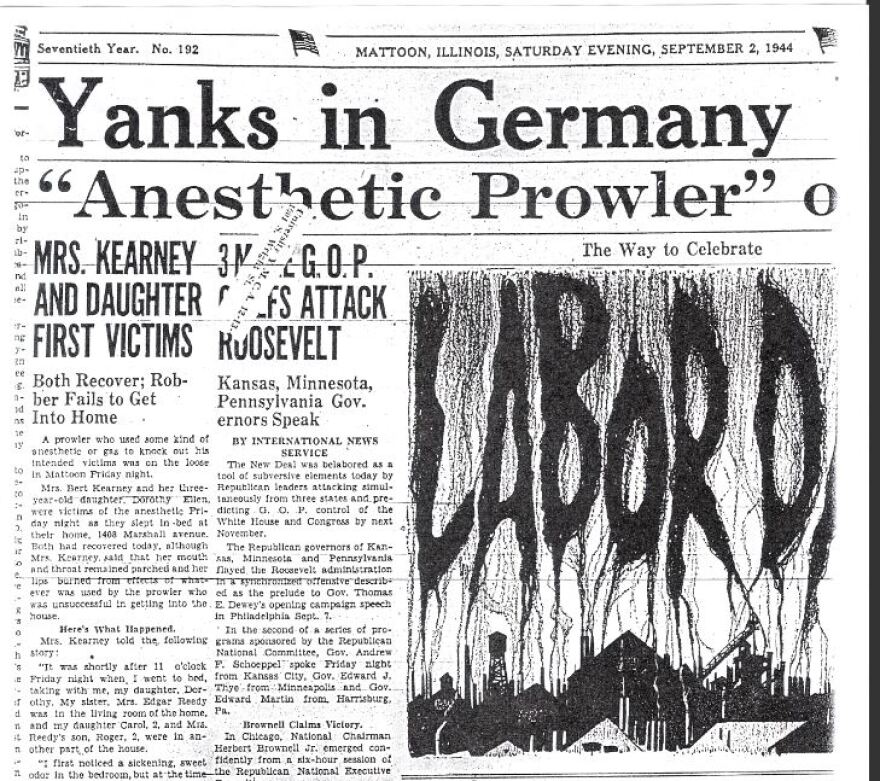
On the evening of 1 September, another incident took place on Marshall Avenue at the home of Aline Kearney. Around eleven at night she noticed what she called a strong, sweet smell, which she at first dismissed as coming from flowers outside the bedroom window.
As the odor seemed to grow stronger, Kearney reported losing feeling in her legs and being unable to get out of bed. Her calls brought her sister, who was staying in the house. The sister decided the smell seemed to be coming from the open window beside the bed.
Police were contacted and searched around the house but did not find any obvious prowler or physical evidence. Around half past midnight, Kearney’s husband, a local taxi driver, returned home and said he saw a man standing near a window. The figure ran when challenged.
Kearney later said the man was tall, dressed in dark clothing, and wore a tight-fitting cap. That description, once printed in local papers, became the standard image of the supposed attacker. She also reported a burning sensation on her lips and throat after the incident.
At the time, the Kearneys kept a substantial sum of money in the house, and newspapers suggested robbery might have been the motive. Journalists also labeled Kearney and her daughter as the first victims, even though at least two incidents had already occurred nearby.
In the days after the Kearney case, several more residents contacted police with similar complaints. Most were in the same general section of town. People reported smelling gas or a sickly sweet odor, then feeling numbness, dizziness, or difficulty moving their legs.
Some families said their screens looked disturbed or slightly cut and that footprints appeared beneath windows. None of these traces yielded firm evidence when police examined them. Officers seldom found an intruder, and no one managed to give a consistent, detailed description.
By the first week of September, the Mattoon Daily Journal-Gazette was running front-page stories about a “gas spraying prowler.” Headlines described a “mad anesthetist,” counted new victims, and treated the events as a developing local emergency.
Other newspapers in the region, including the Daily Illini in Urbana, picked up the story. One article on 12 September reported that thirty-three people claimed to have smelled the gas over roughly twelve days, highlighting how quickly the number of complaints had grown.
Late on 5 September, Carl and Beulah Cordes returned to their home on North 21st Street and noticed a white cloth lying on the porch near the screen door. The cloth was roughly the size of a man’s handkerchief and appeared damp.
Beulah picked up the cloth and held it to her face. She later said she immediately felt ill, describing the sensation as similar to an electric shock. Her lips and face began to swell, her mouth and throat burned, and she vomited. The symptoms lasted for nearly two hours.
Police collected the cloth and submitted it for testing. Accounts differ on exactly which laboratory examined it, but reports published later state that analysts found no clear trace of any chemical that could explain the violent reaction Beulah described.
Around the same time, other households reported finding signs they believed were connected to the prowler. Some mentioned footprints under windows, others small tears in screens or misplaced objects on porches. None of this yielded a suspect or a confirmed delivery method for gas.
As reports mounted, Mattoon police increased patrols in residential areas, particularly after dark. Officers responded to calls about suspicious figures in yards, unusual smells, and people collapsing or complaining of numbness after waking from sleep. Many calls turned out to be false alarms.
Residents began keeping watch on their own streets. Some armed themselves and patrolled neighborhoods, worried that the prowler might move from house to house. The police chief urged people to be cautious with weapons and not fire at shadows or imagined threats.
Throughout the first half of September, the number of reported incidents continued to rise. Later counts by researchers suggest that police received nearly thirty separate reports of sickness attributed to gas attacks over roughly two weeks, with additional calls about prowler sightings.
The cases shared several common features. Most came from residential streets rather than the industrial district. Many victims were women or children at home at night. Symptoms usually appeared quickly and faded within a few hours, leaving no lasting medical damage.
City authorities also consulted medical and public health officials. Thomas V. Wright, the local Commissioner of Public Health, reviewed the complaints and concluded that some real incidents likely occurred, but he believed many later reports were triggered by anxiety once the story spread.
Wright suggested that residents who had read about previous attacks might interpret any unfamiliar smell or minor physical discomfort as evidence of gas. He described the situation as a mixture of genuine events and people frightening themselves after hearing alarming news.
On 12 September, Chief of Police C. E. Cole addressed the public and press. He stated that investigations had uncovered no solid proof of a gas-wielding assailant. He proposed that some reported odors might come from industrial solvents drifting from local plants at night.
Cole mentioned chemicals such as carbon tetrachloride and trichloroethylene, which have sweet smells and can cause dizziness or nausea in high concentrations. At the same time, he argued that fear and suggestion likely amplified people’s reactions and helped generate additional reports.
One plant, Atlas-Imperial, was mentioned in connection with fumes. Company representatives responded that they kept only small quantities of carbon tetrachloride in firefighting equipment and insisted that any solvent releases would not have reached homes in concentrations strong enough to sicken residents.
State health officials had previously certified the plant as safe. There were no documented cases of factory workers suffering the same pattern of symptoms at work, which complicated attempts to attribute the entire episode to an industrial leak carried on the night wind.
Cole’s statement marked a turning point. After the press conference, the police downgraded the priority of “gas calls,” treating many new complaints as routine odors or nervous reactions unless officers could find clear evidence at the scene. The volume of reports quickly began to fall.
A small number of later incidents still drew attention. In one case, a woman named Bertha Burch claimed she saw a figure she believed was the gasser and thought the person might actually be a woman disguised in men’s clothing. Her account remained an isolated report.
By mid-September, newspapers were already summarizing the affair in past tense. Articles described a short-lived town scare, listed the total number of alleged victims, and printed editorials debating whether a dangerous prowler had ever existed in the way early headlines suggested.
In immediate official terms, the case ended without an arrest. Police identified no suspect, recovered no gas-spraying device, and received no confession. The cloth from the Cordes porch and other minor traces remained ambiguous, providing neither clear support nor a definitive alternative explanation.
Within a year, the events in Mattoon attracted attention from psychologists. In 1945, Donald M. Johnson published a field study in the Journal of Abnormal and Social Psychology, characterizing the episode as a textbook example of mass hysteria shaped by rumor and suggestibility.
Later writers, including sociologist Robert Bartholomew, used the Mattoon case when discussing collective anxiety and media-driven panics. They noted that many symptoms, such as choking, tingling, swelling, and temporary weakness, also appear in documented episodes of psychogenic illness.
Other authors continued to treat the Mad Gasser as a possible real attacker, pointing to early incidents like the Raef and Kearney cases and the experience of Beulah Cordes as reports that seemed harder to dismiss as misinterpretations or anxiety. Their arguments remain speculative.
Over time, the story moved into popular culture. It appears in books on unexplained mysteries, mass panic, and paranormal topics, sometimes with dramatic artwork that shows a masked intruder outside bedroom windows. These representations usually go beyond what contemporary records actually describe.
For Mattoon itself, the 1944 scare occupies a particular niche in local history. University and regional library collections preserve clippings, editorials, and letters to the editor that document how residents followed unfolding reports and argued about the cause even while incidents were still being logged.
Modern summaries generally agree on a few core facts. Over roughly two weeks in late summer 1944, more than two dozen people in Mattoon reported smelling a strange odor at home followed by short-term weakness, numbness, or nausea. Police investigated and found very little concrete evidence.
Authorities ultimately attributed the situation to a mix of routine smells, industrial fumes, and anxiety, while some residents remained convinced someone had deliberately sprayed gas into homes. No further outbreaks with the same pattern have been documented in the town since that period.
Eighty years later, the Mad Gasser of Mattoon remains unresolved in a narrow but important way. The chronology, official responses, and medical outcomes are well recorded in newspapers and later research, yet the identity and even the existence of any attacker have never been firmly established.