




Gabriel Daniel Fernnandez was born into a world of instability. His mother, 21-year-old Pearl Sinthia Fernandez reportedly stated she did not want other children, and even left him at the hospital after his birth on February 20, 2005.
His father, 23-year-old Arnold Contreras, was not in the picture. Right after he was born, Gabriel was placed in the care of his uncle, Michael Lemos Carranza, and his partner, David Martinez. The same sex couple raised him for the first four years of Gabriel’s life.
In 2009, Gabriel’s maternal grandfather, who heavily objected to this arrangement, took custody of the boy. He lived with his grandparents from the age of four until he was seven. By all considerations, his grandparents seemed to have given him a healthy childhood and a stable home.
Gabriel himself was described as a sweet child who liked to be helpful and sought his family’s love.
Pearl suddenly announced she would be reclaiming custody of Gabriel in 2012. This was concerning to other family members because of her previous baggage.
Pearl had been under investigation by the Los Angeles County Department of Children and Family Services for actions going back to 2003. She had been reported for severe neglect following a car accident that left one of her children with a head injury because he was not wearing a seat belt.
A relative also filed a complaint in 2004, claiming she was beating the same child. Social workers closed the case due to insufficient evidence.
According to another complaint in 2007, Pearl had threatened to break one of her daughter’s jaws for crying. She also withheld food from the child. That year, she was also tried and convicted in Texas for reckless use of a weapon. Pearl went to jail for two weeks.
Her background prior to Gabriel’s birth was also riddled with trauma. Pearl came from an unstable home as her father, Robert, was frequently incarcerated, and her mother, Sandra, was often neglectful. Pearl began experimenting with drugs by the time she turned nine.
She ran away from home two years later and dropped out of school. Pearl’s mid to late teens were filled with traumatic experiences and criminal activities. On one occasion, she was held against her will by a group of men, who assaulted her over the course of several days.
These events caused Pearl to be suicidal and worsened the emotional issues caused by the abuse in her childhood. Doctors would later diagnose her with potential depressive disorders, personality disorders, and post-traumatic stress.
She entered a relationship with Arnold Contreras, and they had four children. Gabriel was the secondborn. Arnold often got arrested due to his gang affiliations and was imprisoned for assault with a firearm. They split and Pearl began dating 31-year-old Isauro Aguirre.
The Eight Months of Terror
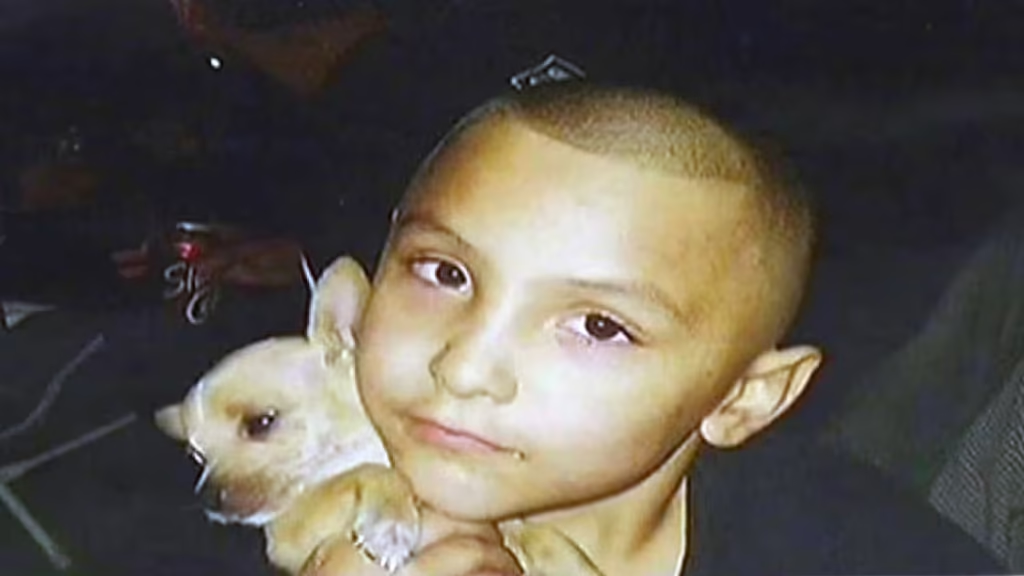
Aguirre was working as a caregiver and driver at the Woodland Park Retirement Hotel. He had no criminal record at the time.
In the time between October 2012, and May 2013, Gabriel went through sadistic torture, which was carried out by both Pearl and Aguirre. He was beaten, kicked, hit with a belt, and a hanger.
They also shot him with a BB gun in the face and in his groin. The shots often left pellets embedded in his skin.
Gabriel was made to eat rotten food and cat feces. He was even forced to eat his own vomit. Interestingly, none of the other children were made to go through these indignities.
Gabriel was made to sleep, while bound and gagged in a small cabinet. The boy was also forced to wear girl’s clothing. His siblings testified that both Pearl and Aguirre laughed while they were implementing this abuse.
Gabriel’s older brother, Ezequiel Fernandez, later described in his trial testimony that a typical day began with Aguirre hitting Gabriel with his fists. He kicked and struck Gabriel’s naked body with a belt buckle, and a metal hanger.
His brother watched this happen over, and over with no power to stop it. Gabriel often went to school with visible wounds.
The Teacher’s Attempt to Intervene
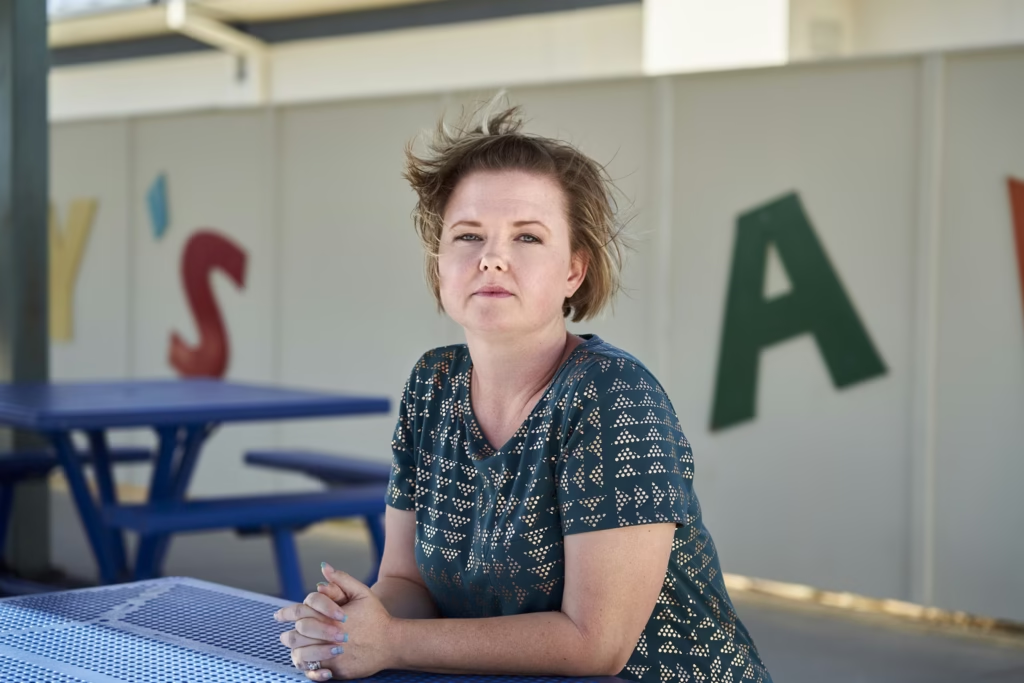
Jennifer Garcia, Gabriel’s teacher was the first person living outside the home to notice that something was off. This was just after Gabriel moved in with Pearl.
Gabriel came to Garcia with questions like if it was normal for a mother to hit her children with a belt until they bled. Gabriel was also beginning to become increasingly anxious about homework and showed some behavioral issues.
She made an initial report to the child welfare hotline after Gabriel asked questions about being whipped. As the weeks passed, she noticed that Gabriel was coming to class with escalating injuries. Now it was bruises, or missing teeth. She kept calling the hotline multiple times.
Garcia would later testify that Gabriel had confessed to her that his mother punched him, and shot him in the face with a BB gun.
Each of the calls was received and logged. There were three recorded visits from the calls. On October 31, 2012 after Garcia reported a case of abuse, the Los Angeles County Department of Children and Family Services opened a case.
Social worker Stephanie Rodriguez, 27, was assigned Gabriel’s case. In the first visit which was in late 2012, Pearl denied the insinuations she had abused Gabriel. She also claimed the injuries came from falling or during roughhousing with his siblings.
Gabriel also retracted his statement that he was being abused because these conversations were often done in the presence of his mother.
In January 2013, DFCS supervisor Kevin Bom signed off a case transfer to 62-year-old Patricia Clement. This was despite the documented high risk potential for neglect and physical abuse.
Clement took over the case and conducted a visit. She reported that Gabriel and the other siblings appeared to be healthy. She determined that Pearl appeared to be a fit parent and the home was a safe environment. This conflicted with reports from an in-home counselor, who had observed a high risk potential for abuse.
Clement claimed the risk of neglect was far lower and recommended for a closure of the investigation in March 2013. Her supervisor, Gregory Merritt, approved this request in April 2013. Gabriel would die three weeks later.
May the 22nd
Pearl called emergency services on the evening of May 22, 2013. Her voice was calm as she told the dispatcher that Gabriel was not breathing following what she labeled a simple accident. Pearl said Gabriel fell from his bed onto the floor, landing on his head.
The operator immediately patched the call to the Emergency Medical Services, and Aguirre’s voice could be heard. A paramedic could be heard guiding him on what to do. Aguirre began with a different story though. He said Gabriel had been fighting with his other son, and he walked in to find the boy unconscious.
Paramedics found Gabriel naked on the floor. He was also unresponsive. Initial observations showed his condition was a bit more complex than what his parents had described, but they focused on trying to save his life.
Gabriel had multiple broken ribs and a skull fracture. BB pellets were embedded all over his body. Two of his teeth had been knocked out, and his body had burns. There was swelling in the brain, neck, and he had internal injuries.
Gabriel was rushed to Antelope Valley Hospital, where he was declared brain dead. One of the nurses noted how the marks, and overall presentation presented immediate questions. The injuries seemed to have accumulated over time.
Pearl, who had gone with the ambulance, maintained her story of the tumble from bed. She also appeared too calm, further rousing suspicions considering the gravity of the matter. Aguirre arrived later at the hospital and aligned his story with Pearl’s.
But the way he responded to questions about the sequence of events that evening showed inconsistencies. A fall also failed to account for the bruises at various stages of healing. The mismatch between the alleged claims of an accident, and Gabriel’s injuries was too much to ignore, so the hospital alerted the authorities.
Pearl Fernandez and Isauro Aguirre were taken into custody. They were charged with extreme neglect, abuse and attempted murder. When Gabriel died on the 24th of May, the charges were upgraded to first-degree murder with special circumstances of torture.
The Charges, Trial, and Sentencing

Isauro Aguirre pleaded not guilty to the charges. He was kept in custody awaiting trial until October 2017, when the trial began.
The prosecution was led by Jonathan Hatami and Scott Yang, the Deputy District Attorneys. Ezequiel Fernandez, who was 12 at the time of Gabriel’s death, gave some of the most direct eyewitness testimony during the trial.
Medical examiner findings and other evidence illustrated the deliberate nature of torture that occurred within the home over the eight months.
The defense team argued that Aguirre was a gentle person before he met Pearl Fernandez. They pointed to his employer’s sentiments in the time Aguirre worked as a caregiver at the Woodland Park Retirement Hotel. Other co-workers also described him as a warm personality.
The jury found Aguirre guilty of first-degree murder on November 15, 2017. Following a brief stalemate, they also approved a death verdict, which was approved by Judge George Lomeli.
In February 2018, Pearl Fernandez pleaded guilty to murder with the special circumstance of torture. It was part of a plea deal to avoid the death penalty. This was probably motivated by the result of Aguirre’s trial.
During the sentencing hearing in March 2018, she told the court, “I want to say I’m sorry for what happened. I wish Gabriel was alive. Every day I wish that I would have made better choices.”
Judge Lomeli sentenced Pearl to life in prison without the possibility of parole. He called the case the most aggravated and egregious case of torture his court had ever witnessed.
Lomeli stated, “You want to say that the conduct was animalistic, but that would be wrong because even animals know how to take care of their young. It’s beyond animalistic.”
Both Isauro Aguirre and Pearl Fernandez are currently incarcerated. Aguirre is currently at the Richard J. Donovan correctional facility in San Diego, while Pearl is at the Central California Women’s facility in Chowchilla.
Aguirre was initially on death row in San Quentin, but launched an appeal to the California Supreme Court. The appeal is pending.
However, in March 2019, Governor Newsom placed a moratorium on the death penalty in California, so Aguirre will probably not be executed any time soon. Due to this policy change, his execution date remains undetermined.
Pearl also filed two resentencing petitions claiming that changes to the California state law meant she could no longer be convicted of murder. Judge Lomeli denied both petitions.
In the first one in 2021, Lomeli stated her guilty plea established that the murder was intentional, and it still involved the infliction of torture of a minor over months.
Judge Lomeli also rejected Pearl’s second petition in 2026. In the recent one, Pearl argued that she had the verbal comprehension of a second grader. Pearl alleged that she did not understand the plea agreement she signed. Judge Lomeli rejected the factual and legal basis of the claim.
The Social Workers
In April 2016, Los Angeles County District Attorney, Jackie Lacey charged four DCFS employees in connection with Gabriel’s death.
The four included Stephanie Rodriguez, Patricia Clement, and their supervisors, Kevin Bom and Gregory Merritt. All were indicted under criminal charges. Each of them was facing one felony count of child abuse and another count of falsification of public records.
An investigation into their actions found that some of the case notes appeared several months after the claimed dates when the events happened. For example, one of the files shows many entries from late January 2013. These were added to the system after Gabriel’s death in May.
The four of them had already been fired by DCFS following an internal investigation, but the prosecution claimed they had shown disregard for Gabriel’s well-being. They also failed to initiate the right protocols and falsified records concerning his case.
Judge Lomeli did not dismiss the charges, claiming the victim’s death was entirely foreseeable, and the DCFS did not properly document the abuse or Pearl’s refusal to enroll in counseling. The social workers appealed the case to the California courts.
In January of 2020, California’s second district court of appeals issued a majority ruling in favor of dismissing the charges. They concluded the social workers did not have the duty to control the abusers, nor did they have custody of Gabriel.
However, Judge Victoria Gerrard Chaney filed a dissenting statement. While agreeing that child abuse charges could not be implemented against the social workers, she maintained that the falsification charges should have continued.
She stated, “We have, in effect, encouraged DCFS and its social workers to cover their tracks if they stumble on the cracks in the system.”