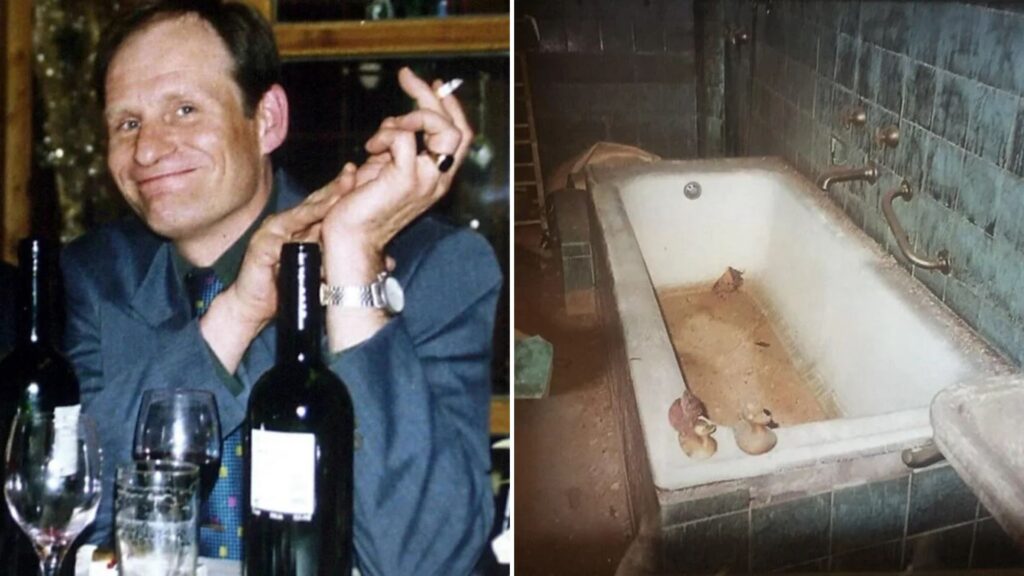
Armin Meiwes was born on December 1, 1961, in Essen, Germany. He later lived in Wüstefeld, a tiny hamlet near Rotenburg an der Fulda in the state of Hesse, on a large estate his family owned.
Meiwes grew up in a home environment that later became central to how investigators and experts described him. His mother, Waltraud, was described as highly controlling, and Meiwes lived with her well into adulthood.
In 1980, after his older brothers moved out, Meiwes and his mother moved to the Wüstefeld property. The estate included a large house and stables, and the location was quiet enough that outsiders rarely had reason to visit.
From 1981 to 1993, Meiwes served as a contractual soldier in the German Army and rose to non-commissioned officer. He was stationed near Rotenburg and continued living with his mother, commuting rather than moving away.
After leaving the military, he worked in information technology. Neighbors often described him as polite and functional in daily life, the kind of person who blended into a rural community without drawing attention.
Meiwes later told investigators that his interest in cannibalism started in adolescence and grew into a persistent sexual fixation. He described fantasies focused on consuming another person as a way to “become one” with them.
He also used an online identity tied to the name “Franky,” a figure he described as an imaginary younger brother from childhood. In online spaces, that identity was part of how he framed his interests and approached potential contacts.
His mother died in September 1999, and Meiwes later described that period as one where his fixation intensified. After her death, he lived alone at the Wüstefeld property, with full privacy and space.
By 2000 and 2001, Meiwes was participating in internet forums where people discussed violent sexual fantasies, including cannibalism. He posted advertisements seeking a “willing” participant for what he called a slaughter scenario.
One person who responded was Bernd Jürgen Brandes, a telecommunications engineer born January 19, 1958, in Berlin. Brandes was 43 at the time and lived in Berlin, with a job and an established adult life.
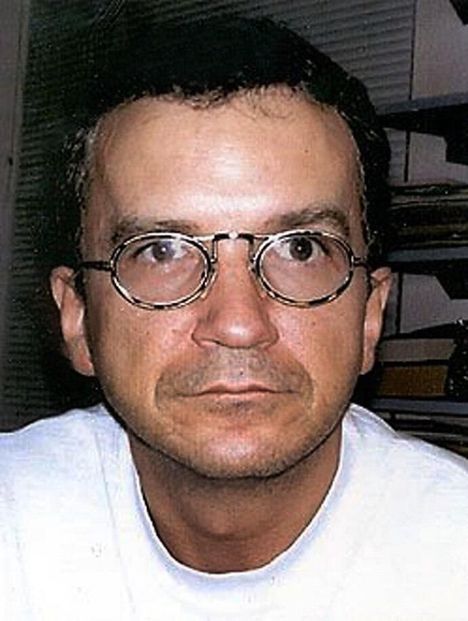
Brandes and Meiwes exchanged frequent emails for roughly a month, discussing details and boundaries. Their messages focused on a shared plan that included genital mutilation, death, and post-mortem consumption.
Brandes’s preparations before traveling later stood out in the file. He sold his car, wiped files from his computers, took time off work under a pretext, and left a handwritten note assigning his property to his boyfriend.
On March 9, 2001, at about 10:40 a.m., Meiwes met Brandes at Kassel-Wilhelmshöhe station. Meiwes later said he expected a longer meeting, but Brandes insisted the planned act should happen that day.
They drove from the station to Meiwes’s house in Wüstefeld. Inside, they spent hours together, including sexual contact, and set up video equipment because they intended to record what was about to happen.
Meiwes had prepared tools in advance, including multiple knives, a hatchet, and a meat grinder. Investigators also found evidence that he had obtained and translated a step-by-step butchering guide before the meeting.
Brandes consumed substances intended to reduce anxiety and dull sensation, including alcohol and sedatives. Later summaries of the case described heavy intoxication by the time the mutilation began.
In the evening, Meiwes carried out the planned genital mutilation. The act was recorded on video, and later court proceedings treated the recording as crucial evidence for both the planning and Meiwes’s intent.
After the mutilation, Brandes did not die immediately. Accounts presented in court described a prolonged period in which Brandes remained alive, weakened, and drifting in and out of consciousness while Meiwes stayed nearby.
In the early hours of March 10, 2001, Meiwes killed Brandes by stabbing him in the throat. The killing was recorded as part of the same multi-hour videotape, which has never been released publicly.
After the killing, Meiwes dismembered the body in what investigators later described as a designated “slaughter room.” He kept parts of the remains in his freezer and handled disposal on the property.
Over the next ten months, Meiwes ate portions of Brandes’s flesh. Investigators later estimated he consumed up to around 20 kilograms of flesh, while other parts, including bones, were buried on the estate.
Meiwes also kept Brandes’s head frozen for a period before burying it months later. The property’s rural layout gave him space to bury remains without immediate detection, and no one nearby reported suspicious digging at the time.
Brandes’s family did not immediately report him missing. His boyfriend made a missing person report on March 12, 2001, but early inquiries produced no leads that pointed investigators toward Wüstefeld.
After Brandes’s death, Meiwes returned to online forums and continued posting. Between 2001 and 2002, he arranged dozens of meetings with other men, describing them as “slaughter meetings,” though most did not progress to lethal violence.
Some of those meetings involved staged bondage or role-play scenarios, and some participants backed out once they realized Meiwes was serious about his stated interests. Investigators later viewed these contacts as part of a broader pattern.
A turning point came from outside Germany. On July 9, 2002, a 23-year-old Austrian university student browsing online found one of Meiwes’s advertisements and contacted him to ask if he had actually killed anyone.
Meiwes replied that he had. The student reacted with disgust and eventually reported Meiwes’s email address to authorities on October 27, 2002, believing the exchange indicated a real homicide.
German police worked to identify the person behind the online identity. Investigators later described a process that took roughly two months, eventually linking “Franky” to Armin Meiwes.
On December 10, 2002, police searched Meiwes’s home. Meiwes agreed to go into custody for questioning, and investigators located the “slaughter room” along with packaged remains stored in the freezer.
Investigators initially did not recognize the frozen packages as human remains at first glance. The bags were seized and sent for analysis at a forensic medical institute, where testing confirmed they were human.
During interrogation that day, Meiwes admitted to the exchange with the Austrian student and acknowledged he would kill someone with explicit permission, as his ads described. He refused to answer detailed questions about the meat found in his home.
Because the forensic confirmation was still pending, authorities initially charged him with an offense tied to the representation of violence and released him due to insufficient grounds for remand on a homicide charge at that moment.
After his release, Meiwes contacted his lawyer and confessed to the killing. He then repeated that confession to police and arranged to surrender, shifting the case from suspicion to an admitted homicide supported by physical evidence.
Police seized a large number of videotapes from the property. Only a portion were treated as directly related to the case, and investigators documented that they focused on evidence necessary to prove killing and dismemberment.
A second search using sniffer dogs was conducted to make sure no additional body parts were buried in other locations on the estate. Authorities also formed a special investigative commission as the case became national news.
Investigators examined Meiwes’s online contact list and identified hundreds of users connected to the cannibal forum. People living in Germany were questioned, and investigators also reviewed whether anyone had aided Meiwes.
One contact, Jörg Buse, drew attention for discussions about supplying victims. Legal action followed, but the case did not end in a murder conviction for him, and the outcome focused on penalties tied to his online conduct.
Another person connected to the forum was prosecuted for receiving photos of Brandes’s body by email. Investigators treated those photo transfers as part of how the crime circulated within a small, disturbing online subculture.
Meiwes was held in custody and evaluated by mental health experts. He was diagnosed with a schizoid personality profile but was considered mentally fit to stand trial, which meant criminal responsibility remained intact.
The first major trial concluded in January 2004 at the regional court in Kassel. A snippet of the videotape was shown in court, and the judges accepted that Brandes had participated without physical coercion.
The legal problem was that German law did not treat consent as a defense to homicide in the way Meiwes argued. Still, the court convicted him of manslaughter rather than murder and sentenced him to eight years and six months.
That verdict reflected how the court interpreted motive and the role of consent in the killing. Prosecutors argued for murder, pointing to sexual gratification and the detailed planning, including filming and the prepared “slaughter” setup.
The case did not end with the 2004 sentence. Prosecutors appealed, and in April 2005 Germany’s federal court ordered a retrial, stating that the original judgment had not properly weighed the video’s significance.
The retrial began in January 2006. The prosecution again argued the killing was driven by sexual gratification and that this motive placed the act within the legal definition of murder, regardless of Brandes’s participation.
In May 2006, the higher regional court in Frankfurt convicted Meiwes of murder and sentenced him to life imprisonment. The conviction also included a charge tied to disturbing the peace of the dead, reflecting the post-mortem acts.
The life sentence shifted the case from a sensational manslaughter verdict to the harshest standard penalty available. The court treated the planning, the killing method, and the post-mortem conduct as part of one continuous criminal act.
Meiwes’s incarceration continued in the Kassel prison system, including placement in a sociotherapeutic facility for years. Courts later assessed parole eligibility with reference to risk, and requests for early release were denied.
A Frankfurt court ruling in 2018 stated he would not be eligible for release after the standard 15-year mark unless psychiatrists concluded he no longer posed a danger. Subsequent efforts for early release were also rejected.
The house where the killing occurred became infamous and drew repeated trespassing and vandalism over the years. In April 2023, the building burned down in an arson attack, ending the site as a physical landmark.
The central case facts remain fixed: Meiwes sought a “willing” victim online, Brandes agreed and traveled from Berlin, the mutilation and killing occurred on March 9 to 10, 2001, and Meiwes stored and consumed remains for months.
The investigative breakthrough came from an online exchange with a university student in Austria, which led police to the Wüstefeld house, the freezer evidence, the videotape, and Meiwes’s confession after initial questioning.
Legally, the case became a benchmark for how courts handle consent in extreme violence. The final outcome held that consent did not erase murder liability when the killing was motivated by sexual gratification and carried out as planned.
Meiwes remains imprisoned under a life sentence for murder, with additional conviction related to the treatment of the body. No evidence has produced a confirmed earlier homicide tied to him, and Brandes remains the single proven victim.