




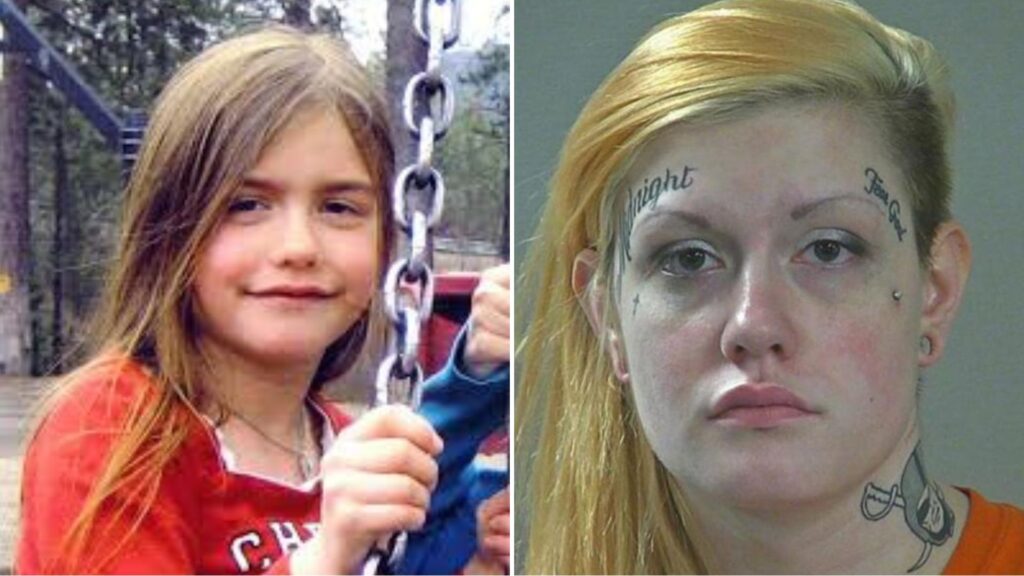
What Happened Inside the Groene Home
On May 16, 2005, authorities found the bodies of 40-year-old Brenda Groene, her 37-year-old boyfriend Mark McKenzie, and her 13-year-old son Slade Groene inside their home near Lake Coeur d’Alene, outside Coeur d’Alene, Idaho.
Two of Brenda’s other children, 9-year-old Dylan and 8-year-old Shasta, were missing from the home. An Amber Alert was issued, and search teams began looking through the area while investigators treated the deaths inside the house as homicides.
Autopsies later found that the three victims had died from blunt force injuries to the head. Authorities also said the victims had been bound.
Forty-seven days later, in the early morning hours of July 2, 2005, Shasta was spotted inside a Denny’s restaurant in Coeur d’Alene with an unidentified man.
A waitress, a manager, and two customers recognised her from news reports. They quietly called the police and positioned themselves to prevent the man from leaving.
Police arrived at the restaurant and arrested the man without incident. He was later identified as Joseph Duncan.
Shasta identified herself to the waitress and to the authorities. She was then taken to Kootenai Medical Centre for medical care and to be reunited with her father.
At the same time, Coeur d’Alene police detained Duncan on kidnapping charges and because of an outstanding federal warrant against him.
When Shasta was found without Dylan, authorities had little hope that he would still be alive. Police asked the public for information, especially about sightings of the stolen red Jeep Cherokee with Missouri license plates that Duncan had been driving when he was arrested.
Investigators learned that Duncan had rented the vehicle in Minnesota and had never returned it.
A gas station employee in Kellogg, Idaho, about 40 miles east of Coeur d’Alene, later recognised the Jeep as a vehicle that had stopped at her station only hours before Duncan’s arrest.
The employee had suspected that the girl walking around the station might have been Shasta, but she did not confront her because nothing appeared obviously wrong at the time.
After reviewing surveillance footage, the employee and her manager contacted authorities and identified Duncan and Shasta in the video.
On July 4, 2005, investigators found human remains at a remote, makeshift campsite in the Lolo National Forest near St. Regis, Montana.
The remains were sent to the FBI laboratory in Quantico, Virginia, for DNA testing. They were later confirmed to be Dylan’s.
During the trial, it was revealed that Dylan had been shot at close range with a sawed-off 12-gauge shotgun.
Much of what later became known about the Groene family murders came from Shasta herself.
In her police interview, Shasta said Duncan killed her mother, her older brother, and her mother’s fiancé. He then kidnapped Shasta and Dylan and drove away with them in the stolen Jeep Cherokee.
Shasta told investigators that her mother came into the room where she and Dylan were sleeping and woke them up. Brenda told them, “Someone is in the house.”
She then led the children into the living room. There, Shasta saw Duncan wearing black gloves and holding a gun.
Duncan tied Brenda’s hands with nylon zip ties. He also tied up Mark McKenzie and Slade.
Duncan then took Shasta and Dylan out of the house and placed them on the lawn outside.
While Shasta waited outside with Dylan, she heard several heavy thumping sounds from inside the home. During that time, Duncan was beating the three people left inside.
Shasta then saw her injured older brother, Slade, staggering away from the entrance of the house.
After Duncan finished killing the three people inside, he put Shasta and Dylan into his vehicle.
He took both children to other locations, where he abused and tortured them for six weeks.
Shasta said they drove a long distance and stayed at two different campsites. During that time, Duncan told her he had beaten her family members to death with a hammer.
Shasta also told investigators how Dylan was killed. Her account contradicted Duncan’s claim that Dylan’s death had been accidental.
At first, Shasta was standing on the other side of Duncan’s Jeep when she heard a loud boom.
She ran around to the other side and saw Dylan lying on the ground, screaming.
Duncan claimed he had been searching through a clear plastic box for beer when a shotgun kept inside the box went off and struck Dylan in the stomach.
Shasta said she then saw Duncan place the shotgun against Dylan’s head and pull the trigger. The gun did not fire.
Dylan begged Duncan not to kill him.
According to Shasta, Duncan reloaded the gun, placed it against Dylan’s head again, and pulled the trigger. Dylan died instantly.
Shasta said Duncan began crying afterwards and told her he had only killed Dylan to end his suffering.
A public memorial service for Dylan was held on July 16, 2005, at Real Life Ministries. The date would have been Dylan’s 10th birthday.
Shasta later said Duncan almost killed her a few days after Dylan’s death.
She said he gave her a choice: she could be killed by strangulation or with a gun. Shasta chose strangulation.
Duncan wrapped a rope around her neck and pulled it tight, causing her to begin suffocating.
Shasta managed to gather enough breath to beg him to stop. She used his nickname, “Jet,” while pleading with him.
Duncan stopped immediately.
He then asked Shasta whether she wanted to meet his mother. Shasta said yes.
After that, they drove back toward Coeur d’Alene and stopped at the Denny’s restaurant where Shasta was finally rescued.
The Man Who Reached the Groene Home

On February 25, 1963, Joseph Edward Duncan III was born in Fort Bragg, North Carolina. He was the fourth of Joseph Edward Duncan Jr. and Lillian Mae Duncan’s five children. He has a younger brother and three older sisters. His dad served in the US Army.
As a result, the family relocated every year or two, both domestically and overseas, until the older Duncan retired to Tacoma, Washington, when the younger was about twelve years old.
It was said about his mother that she was controlling. He claimed to have been abused as a child after being jailed in 1980, but his younger brother denied this. His parents separated in 1979 and divorced in 1983.
His brother eventually moved in with his father, but he stayed behind with his mother after his sisters abruptly left the home.
Duncan would eventually have a stepfamily once his father remarried. Despite attending Lakes High School, he did not complete his education.
Duncan was a violent sexual predator for a very long time. At the age of fifteen, he committed his first documented sexual offence in 1978.
He used a gun to rape a 9-year-old youngster in that event. He was caught the next year for operating a stolen vehicle.
He was transported to the Jessie Dyslin Boys Ranch in Tacoma after receiving a juvenile sentence. There, he reportedly told the therapist assigned to his care that he had bound and sexually assaulted six boys, according to an Associated Press investigation.
Additionally, he informed the therapist that by the time he was sixteen, he thought he had raped thirteen younger guys.
In 1980, Duncan kidnapped a 14-year-old child and raped him at gunpoint after stealing multiple firearms from a neighbour.
He was given a 20-year prison sentence for this offence, but after serving 14 years, he was granted parole in 1994.
Duncan is known to have resided in several Seattle-area locations while on parole.
In 1996, he was arrested once more, this time for marijuana use. A few weeks later, he was granted parole with additional limitations.
Authorities suspect he killed Anthony Martinez in Riverside County, California, in 1997 and Sammiejo White and Carmen Cubias in Seattle in 1996 while on parole; however, all killings went unsolved and were not connected to him until after his arrest in the Groene case.
After breaking the terms of his parole, he was apprehended in Missouri and sent back to jail in 1997. On July 14, 2000, he was released from prison with time off for good behaviour and relocated to Fargo, North Dakota.
Duncan was accused in March 2005 of molesting two boys at a Detroit Lakes, Minnesota, playground on July 3, 2004.
When he appeared before a Becker County judge on April 5, 2005, the judge set bail at US$15,000. He was assisted in posting bail by a Fargo businessman he had gotten to know. But he vanished after skipping bail.
On June 1, he was the subject of a federal arrest warrant for “unlawful flight to avoid prosecution.”
Authorities linked Duncan to the unsolved killings of two girls in Seattle and Anthony Martinez in California when he was incarcerated.
Duncan was on parole from 1994 to 1997. He was found guilty in Idaho of kidnapping and killing the three victims in Coeur d’Alene, for which he received six life sentences; in federal court for kidnapping Shasta and Dylan Groene and killing Dylan, for which he received three death sentences and three life sentences; and in California for kidnapping and killing Martinez, for which he received two life sentences.
Duncan passed away from a fatal brain tumour on March 28, 2021, at the age of 58.
The Long Fight After Survival
For Shasta Groene, being found alive was not the end of the story. It was the beginning of another life, one shaped by grief, memory, public attention, and the long effort to survive what came after.
That part of her story is now at the centre of Gregg Olsen’s book, Out of the Woods: A Girl, a Killer, and a Lifelong Struggle to Find the Way Home. The book follows Shasta beyond the 2005 kidnapping and rescue, focusing on the years in which she tried to live with the trauma left behind by Joseph Duncan.
According to the book’s official description, Shasta’s later life was marked by a pattern of self-destructive behaviour that followed her as she grew older. But the same synopsis also frames her as someone who still carried hope, even after everything that had been taken from her.
The book presents that struggle as a second battle. Shasta had survived Duncan in the woods as a child. As an adult, she had to fight a different kind of captivity, one built from trauma, addiction, memory, and the expectations placed on a survivor whose name had become public before she could fully understand why.
An excerpt from the book, shared by People, gives a closer look at that difficult aftermath.
:max_bytes(150000):strip_icc():focal(749x0:751x2):format(webp)/shasta-groene-dylan-072825-01d7f86827504039ae112f09df50607d.jpg)
It was mid-August 2010, and while the sun beat down on Coeur d’Alene, a former timber and mining town that was now resort-dependent, a half dozen adults who knew best came together ostensibly to ensure that Shasta Groene, then 13, would not get sucked deeper into the quicksand of her own creation. For their own reasons, of course. So many reasons.
Bragging rights, possibly. A connection to the survivor of one of the most notorious criminal cases in American history, sadly, had its perks.
Mostly, however, because they had to stop Shasta from self-destructing. Her life depended on it. A court-appointed psychologist distilled the need for an intervention:
Shasta Groene is a young girl who has experienced overwhelming traumatic stress in her life. She is having difficulty functioning on a stable basis and is engaging in increasingly acting-out behaviours.
:max_bytes(150000):strip_icc():focal(749x0:751x2):format(webp)/shasta-groene-dad-072825-6d5af912b75f4501ae19d694d2c403fe.jpg)
She cannot process her feelings and, at times, has difficulty perceiving reality. She is experiencing visual and auditory hallucinations as well as nightmares regarding past experiences and the feeling that her deceased mother and brothers are trying to communicate with her …
This creates chaos in her immediate environment, and she may engage in other forms of acting-out behaviours.
It had been five years since everything happened when Shasta Groene found herself facing off with captors for a second time in her young life. It didn’t matter that they dressed nicely. Had college degrees. Or even bathed regularly.
They were lined up on a sectional, arms folded, wearing various shades of concern on their faces.
Everyone assembled in the offices of Laura Taylor, Shasta’s therapist, and carried with them the belief that they had the girl’s best interests at heart. They knew what she should do, how she should act, and what she should think.
This was a come-to-Jesus moment. Do or die. Life and death.
Shasta had been in therapy nearly half her life, and there had been good reason for it. She’d abused drugs. Shoplifted. Had sex. Skipped school. Stayed out all night. Told her dad to f— off. Told him that a lot.
Most in her orbit, directly or by association through the media, gave Shasta latitude because of what happened to her family, her brother, and to her when she was an eight-year-old. If the girl needed help — and she did — then what they’d been doing wasn’t working.
Shasta wasn’t sure what was going on when she lowered her small frame onto the couch with the others as though they were all about to have a little coffee chat.
She thought of bolting.
Fight or flight.
Yes, those had always been the options.
It wasn’t that she didn’t want to be a good kid, though whatever that really meant had eluded Shasta. It wasn’t that she didn’t desire the same things others wanted for her — security, a future, even a happy ending.
Those hopes were foggy and felt impossible to attain. Her past held her like a prisoner. Or maybe it was more like being held underwater and unable to surface.
Wherever she went, she was always seen as the girl.
The girl.
The one who got away.
Years later, Shasta would accept that her much-admired will to survive was a double-edged sword. It messed with her. Sometimes a great strength can also be the source of a cliff-dive downfall.
Shasta was no longer the little girl people had seen on a gas station’s closed-circuit TV the day she was rescued. She’d gone through several phases in search of an identity.
She had been preppy. A jock girl. An equestrian. Each of those personas was tried on like shoes that didn’t fit and were kicked off. Hard.
:max_bytes(150000):strip_icc():focal(574x0:576x2):format(webp)/shasta-groene-072825-6d31940e0e9b44c79c59a6d08bea041e.jpg)
Shasta wanted to look older, more like her brothers’ girlfriends. She wore gobs of black eyeliner and even pierced her own nose and lips. She occupied that strange space between childhood and adulthood.
Though she loved Harry Potter, Pretty Little Liars and Glee, Shasta had attended a Korn concert and found herself enjoying the chaos of a mosh pit. Her shoes were K-Swiss. Her jeans were now baggy, far from Juicy Couture, which had once been her go-to.
She had cartilage piercings, snake bites, and an eyebrow piercing. She was emo, goth, and a skater.
She’d been a lot of things.
She was also in big trouble.
So, there they were. All of them. The people who loved her. Laura Taylor, a court-assigned therapist in whose office all gathered, unquestionably had her heart in the right place.
Shasta knew Laura was trying her best, but the healing path she had tried to chart had been painful and ineffective. Weekly sessions seldom ever made it to the finish line, at least in terms of resolving any of Shasta’s so-called issues.
Laura couldn’t go deep into Shasta’s trauma because, well, it seemed as though it was too difficult for her to hear. Finally on hand was Lana Hamilton, a no-nonsense educator with a grey pixie haircut and glasses that slipped down the bridge of her nose.
Lana was a speech pathologist and the principal of Lakes Middle School, where Shasta attended “the school within a school,” an alternative program.
Lana and Shasta shared a history, too.
Before helming Lakes, Lana was the principal at Fernan Elementary, where three of the youngest Groene kids attended classes. She noted Shasta could be “manipulative,” so placing her with a male teacher was not ideal.
In fact, in sixth grade, they had to remove her from a male teacher’s class. Lana conceded that Shasta’s behavioural issues, rooted in her trauma, were so severe that only a residential treatment program could save her.
Ahead of the meeting, she wrote:
“She gets involved with drama, goes from 0 to 60 when anybody says anything. She is much more volatile in response to what is happening at home. Then she doesn’t care what you do to her — she is so sick & tired.”
Lana shared details of the plan that the others in the room had already coalesced around. Well-meaning, without a doubt. Misguided, as it turned out.
“It’s called Vista at Dimple Dell Canyon,” Lana said, suddenly fixing her eyes on Shasta, who had planted herself on the sectional and started to cry. “They’re expecting you. Elizabeth Smart went there.”
Through her tears, Shasta read the room. She was astute at playing a role—and determining when others were doing the same thing. An actor can spot a pretender in a couple of seconds.
A survivor can assess where things are going while plotting their next five moves. It was obvious to her that the meeting was an ambush. A setup.
“It’s in Utah,” Lana said.
Everyone already knew that.
Except her.
:max_bytes(150000):strip_icc():focal(599x0:601x2):format(webp)/gregg-olsen-out-of-the-wood-072825-69420b0195c34f31a9aed2933eef2bf7.jpg)
Lana projected confidence that Vista was well equipped to get to the root of Shasta’s trauma. She’d had conversations with staff there. As had Laura.
A lot of variables were at play regarding how long the treatment might take, but Lana thought it was somewhere in the six-to-nine-month range.
Shasta didn’t want to go. Said that she couldn’t go. Said she needed to see her boyfriend. Tears turned her mascara into long black drips down her cheeks.
This wasn’t fair.
Or right.
An hour after the plan was presented to her, and a hasty trip in front of a judge to make it all legal — and court-ordered — Shasta found herself with a plane ticket to Utah from the Spokane airport.
Adapted from Out of the Woods: A Girl, A Killer and Lifelong Struggle to Find the Way Home by Gregg Olsen, © Thomas & Mercer 2025