




The tragedy of Peter Connelly’s death lay in the fact that he was being monitored by the state and health care professionals prior to his death.
He had been seen by doctors, nurses, police officers, and social workers more than sixty times in the eight months before he was found dead in his cot. Peter had also been on the child protection register since December 2006 for injuries from perceived negligent care at home.
A medical professional also examined him a few days before his death amid concerns about sustained injuries over time. In the weeks that led up to that visit, someone had apparently smeared chocolate across his face before a social worker’s visit to hide the bruising underneath.
Many of his injuries were at different stages of healing. They had not all been inflicted at once. So it appeared the abuse that he had been going through had been meted out over months.
And the people whose professional duty was to protect him had been in and out of his home the whole time.
Peter Connelly
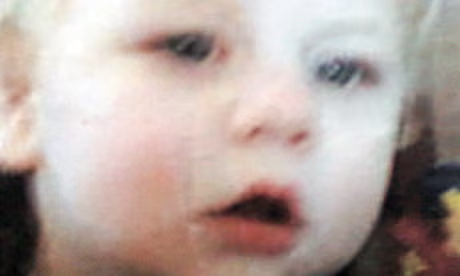
Peter was born on March 1, 2006, to 26-year-old Tracey Connelly. Not much is known about his father. Shortly after Peter was born, the father separated from Tracey and did not live with them.
Peter was assigned the pseudonym Baby P by the British press after his death. This was courtesy of a High Court anonymity order.
In the seventeen months of his existence, Peter knew little in the way of love and safety. The trauma he was subjected to was monstrous. Some of it was detailed in the post-mortem as he had more than fifty injuries to his head, torso, extremities, and limbs.
Maria Ward, the social worker assigned to the family, described Peter as a very active child. “You knew he was in the room”. She also claimed that Tracey seemed to care for him well.
Ward observed Tracey cuddling Peter, and vice versa. By her account, he had a good relationship with his mother at first.
Peter’s woes seemed to begin with the introduction of Steve Barker to his mother’s life.
Tracey, Steve Barker, and the Role of Social Services
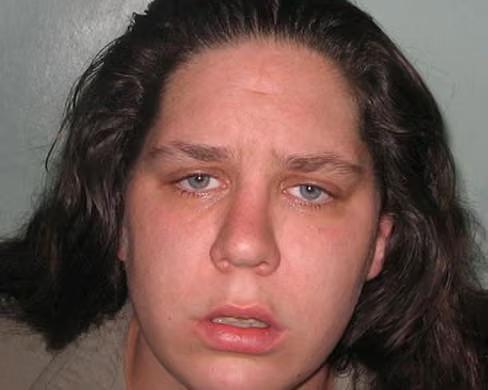
Tracey herself grew up with a household marked by her mother’s substance dependency. She herself had been removed from her own home at the age of 12 because of concerns about neglect. So she had been accustomed to social workers from a young age.
Tracey then met Peter’s father and lied about her age, and they married when she was 16. At the time, he was 33 years old.
Tracey lived in a church-owned semi-detached house in Tottenham, with Peter and his three siblings, along with several dogs. Despite her problematic upbringing, she was initially semi-competent as a parent.
Gillie Christou, a former team manager at Haringey Children’s Services, described Tracey as appearing caring and motherly. Tracey expressed a need for social services’ assistance in caring for her children.
Steve Barker’s entry into their lives marked a significant turning point for Tracey and Peter. Steve and Tracey met in a pub just after she split with Peter’s father.
He was roughly 33 years old at the time and had done maintenance work in a friend’s flat where Tracey was known. At the time they began their relationship, Peter was only about two months old.
Towards the end of 2006, in November, when Peter was eight months old, Steve moved into the home.
Tracey actively concealed his presence every time professionals visited, ensuring he was absent. She also cleaned the house beforehand and had no evidence of a male resident.
Steve Barker himself was described as the worst possible person to bring around a child. He stood 6 feet 4 inches tall and had an IQ of about 60. Earlier on in his childhood, Steve attended a special school to help with development.
He would later develop a fondness for Nazi memorabilia and Swastikas. Steve also loved everything to do with knives, martial arts weapons and even owned a crossbow. During his free time, he would walk around the house in combat gear.
Later, it was revealed that as a child, Steve liked torturing animals. His preferred victims were frogs, which he would skin and break their legs.
At the time he moved in with Tracey, he kept two snakes and fed them dead chicks and mice.
The abuse he inflicted on Peter Connelly took place over months. It was calculated and, at times, even seemed ritualised.
Timeline of Abuse and Hospital Visits
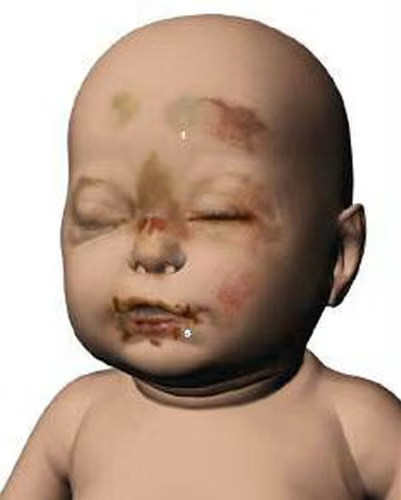
The abuse began almost immediately after Steve moved into the family home. In December 2006, during a hospital visit, a general practitioner noticed bruising on Peter’s face and chest. Tracey said she did not know how the swelling happened.
Tracey was subsequently arrested, and Peter was moved to a family friend before being admitted to North Middlesex Hospital with a head injury and more bruising. On December 22, 2006, he was placed on Haringey Council’s child protection register.
There was a formal acknowledgement that he was at risk, but it wasn’t followed through. Peter returned home in January 2007 after Tracey’s release.
The case was assigned to a single police officer for investigation. That officer was then transferred to another post, and the case was not handed over to anyone else. Hence, the investigation stalled.
In February 2007, when Maria Ward was assigned the case and made her first visit 20 days after, she found Tracey to be cooperative and engaged. Ward had no reason to suspect the level of danger that Peter was in at the time.
Tracey was very adept at managing the visits by cleaning the house beforehand and applying makeup to Peter’s injuries. She also ensured that Steve was absent when the social workers arrived on the scene.
However, a former Haringey social worker, Nevres Kemal, wrote directly to the Department of Health. She warned of systemic failures in the child protection activities within the boroughs. Her letter was largely ignored.
Throughout the spring and early summer of 2007, Peter was brought to the hospital repeatedly. He was then admitted to the North Middlesex Hospital again with bruising and scratches. Another social worker also noted marks on his face, prompting a medical assessment at the hospital.
The check-up confirmed these bruises were from child abuse, and Tracey was taken into custody again. Peter was again housed with a family friend in June, 2007.
On the 25th of July, the Haringey Council legal team convened to assess the case and found that the terms were insufficient for care proceedings. They returned Peter to his mother.
It was as if this prompted more abuse. When Jason Owen, Steve’s 35-year-old brother, began staying with them, the torture only got worse. Peter sustained injuries to his right hand because of being bitten consistently.
On August 1, 2007, Peter was taken to St Ann’s Hospital for a developmental assessment. It was done by Dr Sabah Al-Zayatt, a locum paediatrician, who noted that he seemed unwell. She said that he appeared miserable and cranky, but there was a partly healed scalp wound.
Sabah did not do a full physical examination but set a follow-up appointment. She also did not notice Peter had broken ribs or the other wounds on his fingers.
A day later, on the 2nd, the police contacted Tracey to let her know no further action was being taken against her concerning the investigation of child neglect. Again, it was as if this was a prompt for the abusers to increase their torment.
Peter was punched by someone so hard it dislodged a tooth. He swallowed it. On the 3rd of August, an ambulance was called to their home. Peter was unresponsive at the scene, so they rushed him to the hospital, and he was pronounced dead.
Inquiry and Murder Trial
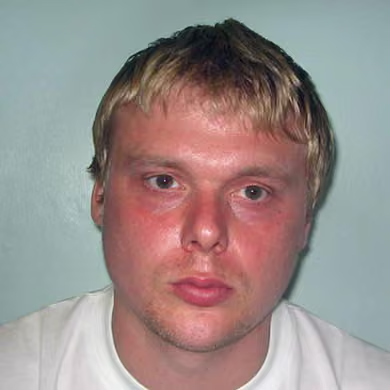
At the house, Tracey Connelly was immediately taken into custody. Steve Barker and Jason Owen, who were also at the home, were arrested afterwards. The other children were processed into foster care and other carers.
A search of the house confirmed they were living in squalor. Physical evidence showed that multiple individuals participated or willfully failed to prevent what was done to Peter.
Even so, the prosecution still did not have enough evidence to bring them up on murder charges. So they charged Tracey, Steve and Jason with causing the death of a child.
The pathologist found a broken spine, fractured ribs, a broken shinbone, a swallowed tooth, a torn frenulum inside the lip, blackened fingers, cigarette burns on the toes, missing fingernails, loss of soft tissue from the right middle finger, and a removal of the nail of the right big toe.
There were also untreated infections and evidence of sustained periods without being changed.
Pathologist Phillip Cox indicated that Peter’s broken spine was probably sustained within 24 hours of his death.
On November 11, 2008, Steve and Jason were found guilty of causing or allowing the death of a child. Tracey pleaded guilty to the same charges.
In April 2009, Tracey and Steve were almost immediately brought up on different charges, alluding to the rape of a two-year-old girl who was also on Haringey’s child protection register.
They were tried under aliases of Tracey Wilson and Steven Young. This was to prevent the jury from connecting the two from the previous Baby P case.
Steve was found guilty of rape, but Connelly was acquitted of child cruelty. Apparently, bloggers got wind of the assumed identities and published their identifying information online, almost causing prejudice from the jury.
The sentencing for both trials was done at the same time on May 22, 2009. Judge Stephen Kramer told Tracey, “I am satisfied that you acted selfishly because your priority was your relationship with Barker.”
Tracey was sentenced to an indefinite period for public protection, but with a minimum term of five years. Steve Barker was sentenced to life in prison with a minimum of ten years. He was also sentenced to 12 years for his role in the death of Peter Connelly. This would be served concurrently.
Jason Owen got an indeterminate sentence. Following an appeal, it was converted to six years in prison.
The sentences attracted public outrage, and the National Society for the Prevention of Cruelty to Children (NSPCC), which said the penalties were inadequate.
The Attorney General then reviewed the case to assess whether to refer the sentences to the Court of Appeal. He concluded that traction was insufficient to increase the sentences.
Fallout
Public indignation following the sentences prompted professional and political fallout for everyone involved. Case reviews done by Haringey’s local Safeguarding Children Board determined that Peter Connelly’s death was preventable.
It is also considered that attention was not given to the other children living in the house. They were medically and psychologically assessed, but not much was determined from these investigations. They have since also kept a low profile.
Several agencies, including the police, were involved in the case in the time leading up to Peter’s death. Despite noting failures in the child’s home life, they did not escalate the case.
The most public consequence of Peter’s death was the removal of the Director of Children’s Services at Haringey Council, Sharon Shoesmith. The Sun newspaper had also run a campaign demanding her removal, garnering 1.2 million signatures. They delivered these to Downing Street.
The Frontline social worker, Maria Ward, and her team manager, Gillie Christou, were also fired. Later on, Ward was forced to leave her home of nineteen years because the threats were too much. Though the General Social Care Council did not find any grounds to remove either Christou or Ward from their professional register.
Dr Sabah Al-Zayyat, who saw Peter days before he died, was suspended. Her contract with the Great Ormond Street Hospital was also terminated. Later, she tried to apply for a post at the Tallaght Hospital in Dublin without disclosing the restrictions placed on her career.
When the Irish Medical Council found out, she was charged with medical misconduct and fined 5000 euros. She later returned to Saudi Arabia.
Dr Jerome Ikwueke, the general practitioner who spotted Peter’s bruising the previous year and referred him to other specialists, was suspended by the GMC’s interim orders panel for 18 months.
Apparently, in the months after the convictions, the referral rates to children’s services in England skyrocketed. Researchers designated this as the Baby P Effect. The surge was so much that it paralysed the departments.
Social workers who had no connection to the cases also noted working under conditions of intense public fear. It was as though people wanted to refer any suspicious activities to avoid being the next person mentioned in an inquiry or in a newspaper.
The Perpetrators after Sentencing
Tracey Connely, who had a five-year minimum sentence, was released in 2013 on parole. However, she did not abide by the terms of her license by not disclosing an intimate relationship to her parole officer. So she went back to prison.
In 2022, Tracey applied and was given parole. She breached the terms again and was reincarcerated in 2024. In one of the parole hearings, one of the board members asked if she considered herself a risk to children.
Tracey answered: “Given how bad I was at it, I have to accept that’s always a risk if I’m left looking after children, which I can’t see ever being the case.”
Steven Barker is still in prison. A parole application was issued in 2017 but was denied. The parole board’s reason for continued refusal, even after a recent 2024 parole application, was that he refused to confront his crimes.
Jason Owen was released in August 2011 after serving six years. He was recalled to prison after a breach of parole terms in 2013. After completing the remainder of his allotted sentence, he was released in 2014. He is currently living under an assumed name.