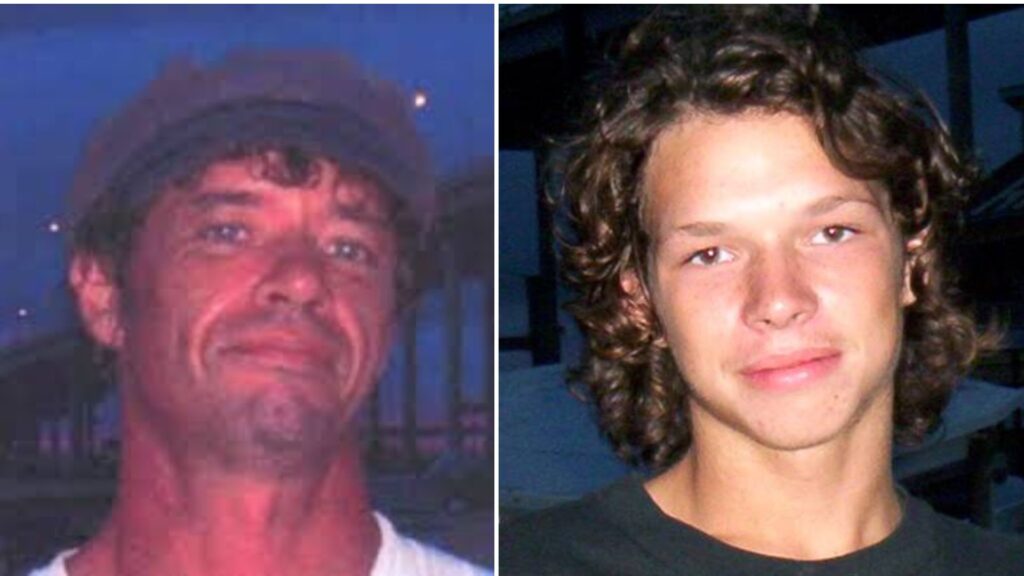
On Nov. 24, 2005, Christian Hall, 15, left Corpus Christi, Texas, aboard a 74-foot sailboat named the Gypsy II. He set out with the boat’s captain, David “Dusty” Andrews, headed for Florida.
Christian had been working as a deckhand on the Gypsy II to make extra money, according to later accounts shared by his family and advocates. When he asked to go on the trip, his family said he could not. He went anyway.
Andrews, 39 at the time, was Christian’s employer and the person responsible for the boat. Public case summaries describe Andrews by the nickname “Captain Dusty.” After the departure, Andrews also vanished, along with the vessel.
In a case that has remained largely quiet for years, Christian’s aunt, Carla Boehm, has become one of the most consistent voices pushing for attention. She has told the National Center for Missing & Exploited Children that she believes Christian could still be alive.
Boehm has also said Andrews told people in his own life that Christian was his son. Boehm has said that claim was false. Investigators and missing-persons organizations have repeated that point in public summaries.
NCMEC’s public poster lists Christian as missing from Corpus Christi, with a missing date of Nov. 24, 2005. It says he “was last seen at home” and “may be traveling in the company of an adult male.”
The Charley Project identifies him as Christian Glen Hall, born July 9, 1990, missing at age 15. The listing gives a height of 5 feet 7 inches and a weight of about 120 pounds, and notes a scar on his upper lip.
That same summary warns he “may use the last name Andrews,” a detail that has followed the case for years. The implication is straightforward: if he is alive, he may be living under a name tied to the man he left with.
The departure point was a local landmark. People reported the Gypsy II was docked on the John F. Kennedy Memorial Causeway, the stretch connecting Laguna Madre and North Padre Island in Corpus Christi, when Christian and Andrews sailed out.
The trip itself was long and exposed. Christian was traveling only with Andrews, according to NCMEC. There were no other crew members publicly identified, and no confirmed sightings have placed anyone else aboard when the boat left Texas.
At some point after leaving Corpus Christi, investigators say the Gypsy II was in the Gulf of Mexico off the coast of Louisiana. NCMEC describes a mayday signal that “reportedly” went out from the vessel, suggesting distress.
People and the Charley Project add a key detail: the boat was taking on water when the distress situation unfolded. Both accounts state that help was available, yet the people aboard declined assistance.
The Charley Project describes the assistance as coming from a civilian boater. It reports that the Gypsy II was taking in water, but Andrews and Christian declined help from that boater. After that, Christian, Andrews, and the boat were never seen again.
A local television report in Corpus Christi has described the mayday location more precisely, placing it about 65 miles south of the Louisiana coast. That detail has been repeated in later public retellings tied to the station’s reporting.
After the mayday and the refusal of help, the public record thins out fast. NCMEC says there have been no confirmed sightings of Christian, Andrews, or the Gypsy II since that day in late November 2005.
Christian’s family did not report him missing immediately. People reported that his relatives filed the missing-person report on Jan. 4, 2006. The Charley Project also notes the gap, describing it as about six weeks.
Authorities have publicly stated that Andrews did not have permission to take Christian on the boat trip. That detail, reported by People, is central to why the case is treated as more than a maritime accident in many missing-person databases.
In the Charley Project listing, the case classification is “Endangered Runaway,” and the summary says authorities believe Christian left “of his own accord” with Andrews. That phrasing speaks to the departure, not to what happened afterward at sea.
NCMEC’s blog post lays out the uncertainty in plain terms, asking what happened at sea and whether the pair got lost, the ship failed, or they reached another port and never returned. Those are presented as open questions, not conclusions.
The destination is described slightly differently across public summaries. People frames the trip as sailing from Corpus Christi to Florida, while the Charley Project says the boat was reportedly bound for the Florida Keys. Both agree the voyage never arrived.
The boat itself has become part of the mystery because it also vanished. In many sea disappearances, debris or a hull eventually surfaces. In this case, NCMEC says there have been no confirmed sightings of the Gypsy II.
Some public case overviews, including Uncovered’s summary of the file, say the situation was reported to the Coast Guard and that a search did not locate the vessel. Uncovered attributes its information to NamUs, though NamUs details are not fully visible in its public page view.
What remains consistently documented is the sequence of three moments: Christian leaves home with Andrews on Nov. 24, 2005; a distress signal is reported in the Gulf off Louisiana; and both people and the boat disappear from the record afterward.
Boehm has described a relationship she believes mattered. In NCMEC’s account, she said Christian grew attached to Andrews while working on the boat, seeing him as a father figure. She also said she believed the attachment went both ways.
Her memory of Christian also anchors the case in something smaller than coordinates and vessel names. She told NCMEC the last time she saw him in person, he was 11, visiting with his mother and older sister after years apart.
In that visit, Boehm recalled, the family exchanged friendship bracelets and the kids played pool. It is a mundane detail, the kind families remember when they are trying to hold a missing person in focus across years.
Public profiles of Andrews offer only limited biographical context. The Charley Project lists him as David Todd Andrews, born June 8, 1966, and describes him as 5 feet 11 inches and about 200 pounds, with brown hair and hazel eyes.
People’s later reporting notes that Andrews would be 59 now, based on his age at the time of the trip. In this case, the adult is missing too, so there has been no later interview, arrest, or confirmed sighting to settle the timeline.
The lack of later sightings has left Christian’s status unresolved in the most literal way. NCMEC’s poster lists him as missing, with ongoing contact numbers for the Corpus Christi Police Department and NCMEC’s tip line.
Those posters also include age-progressed imagery. The NCMEC blog explains that the organization released a new age-progressed image showing what Christian may look like at 35, created by a forensic artist, as the case approached 20 years.
The public version of the poster now shows him age progressed to 35. It also provides an NCIC number and lists the investigating agency as the Corpus Christi Police Department, with a direct phone number for tips.
The renewed attention in late 2025 and early 2026 came through a familiar path for long-term missing cases: a new image, a fresh headline, and a push to reach people who may have heard something years ago and never reported it.
Boehm has been frank about what she hopes that attention accomplishes. In NCMEC’s post, she worried that if Christian believes nobody cares, he might not try to come home. It is her explanation for staying public.
She has also said she hopes Christian sees the new image and understands that people are still looking for him. People’s reporting repeats that hope, describing the family’s message as direct and ongoing rather than symbolic.
The case’s hardest fact may be its most ordinary one: Christian was 15. He was young enough that adults controlled the boat, the route, and the decisions made after the mayday was raised and help was offered.
That decision point, the refusal of assistance, sits at the center of every public summary. The accounts agree on the basic shape of it. Distress was indicated, the boat was in trouble, and the people aboard turned help away.
From there, investigators have had to work with absence. NCMEC says there have been no confirmed sightings, meaning no verified port arrival, no verified radio contact after that point, and no verified recovery of the vessel.
The lack of permission for Christian to travel adds another layer that has never been fully explained in public. People reports authorities said Andrews did not have permission to take him, but the public record does not spell out the arrangement that allowed Christian to work on the boat.
The delayed missing-person report is another detail that shapes how the case reads in databases. The Charley Project notes the report came Jan. 4, 2006, weeks after he left. That delay can narrow what records are preserved and what early searches were triggered.
Despite those complications, the identifiers have stayed stable: a teenage boy from Corpus Christi, a white 74-foot sailboat called the Gypsy II, and an adult captain known as Dusty. Those names are the fixed points in every retelling.
There is also the possibility, noted in the Charley Project listing, that Christian could be using Andrews’s last name. That is why the case is still treated as a missing-person investigation rather than a closed maritime tragedy.
As of the most recent public updates, Christian Hall’s disappearance remains unsolved. NCMEC continues to list him as missing, and the public-facing summaries still describe the boat, Andrews, and Christian as unlocated since 2005.
Anyone with information is urged to contact the Corpus Christi Police Department or NCMEC’s 24-hour call center. Those tip lines remain active on NCMEC’s poster, alongside the case number NCMEC assigns to Christian Hall.