
At 4:03 p.m. on Feb. 17, 2008, Marilyn Bergeron made a small purchase at a Café Dépôt in Saint Romuald, on the south shore of the St. Lawrence. It is the last confirmed trace of her.
A witness told investigators she was alone at that moment. Minutes later she was simply gone from the record, with no more verified sightings and no more verified card activity attached to her name.
Cases like this usually come with one clear hinge, one moment where everything turns. Here, the hinge is a five hour gap between two ordinary stops, and the uneasy fact that both stops were captured by systems built to remember.
Police in Quebec City have kept the file open for years, and the family has kept the story alive with marches, press conferences, and repeated requests for fresh eyes. The disappearance sits in public view, while the answer stays out of reach.
The details matter because there are so few of them that are solid. When you lay the confirmed pieces in order, you can feel exactly where the trail ends, and exactly where the unanswered questions begin.
A young woman with a working life in motion
Marilyn Bergeron was 24 when she vanished, and official listings describe her as about 1.70 metres tall and about 52 kilograms, with brown hair and blue green eyes. She left home in winter clothing suited for Quebec in February.
Her parents, Michel Bergeron and Andrée Béchard, have been the steady public voices of the case. They appear again and again in coverage, describing the same shock: their daughter said she was going for a walk, then never came back.
By 2017, reporting described Marilyn as someone trying to build an adult life across two cities. She had been living in Montreal for about three years before returning to the Quebec City area shortly before she vanished.
That same 2017 coverage said she had studied in Joliette and was working as a freelance camera operator at the time. To make ends meet, she also worked retail shifts at a music store on rue Saint Antoine.
Her mother also said the family had noticed she had not been herself for months, which is the kind of phrase families often use when they are trying to describe something real but hard to pin down. It became part of the timeline.
There is another reason her work and routines matter. A disappearance can look random until you remember how many people have access to a person who is commuting, working, and moving through public spaces on fixed schedules.
Nothing in the public record shows that she had packed to leave forever that Sunday. Police descriptions emphasize that she left for a walk, and later documentation repeats that her family feared for her safety soon after.
One official listing also notes a tattoo on her left breast and states that dental X rays are available, which is a practical detail that becomes important years later. Identifiers like those can resolve cases long after the last sighting.
Even her tattoos have become part of the confusion. Some reporting describes a horse tattoo on the right side of her chest, while an official listing describes a different tattoo location and subject, which shows how easily public descriptors drift.
That drift is not just a trivia problem. In a world of tips and sightings, small mismatches can make a true lead look false, or make a false lead feel convincing, especially when years have passed.
The fear she would not explain
The week before the disappearance is where most retellings start to tighten. Multiple outlets report that Marilyn left her Montreal apartment abruptly on Feb. 10, 2008, telling people close to her that she was afraid to stay there.
She returned to the Quebec City area, and accounts from her mother describe a painful conversation that stopped just short of a clear explanation. When asked about seeing someone else, drugs, or debts, her mother said Marilyn answered no.
The question that changed the tone was simpler. Her mother asked if she had been assaulted, and described her daughter as going quiet, looking down, and crying, which is one of the few concrete descriptions of that private fear.
In 2023, a published chronology again describes Marilyn telling her mother she was afraid to remain in her apartment, and says she cried in her mother’s arms when pressed about whether she had been harmed. That consistency is striking.
Those moments are not proof of a crime, and they do not name a person or an event. What they do is establish a mood shift, and a reason to treat the disappearance as connected to something that happened before Sunday.
Families often replay the same narrow window of days because it is the only part that feels editable. If a phone call had been made, if a report had been filed, if a different ride had been taken, maybe the story changes.
In 2017, her mother said she suggested a psychologist. That detail reads like an ordinary parental response, but it also hints at how little the family felt they had to work with, even while sensing danger.
The family also pushed for a different police force to take over, arguing that the case was complex and tied to Marilyn’s life in Montreal. They wanted an investigation with a wider reach than the local police.
Officials responded publicly as well. A spokesperson for Quebec’s public security minister said the file had been handled with care, and said any new information would be considered, while noting that provincial police had offered support when needed.
That back and forth matters because it shaped how the case moved through the years. It also set up one of the ongoing tensions: police leaning toward one interpretation, and the family living with another, day after day.
Feb. 17, 2008, the walk that became a disappearance
On the morning of Feb. 17, the Quebec City police say Marilyn left the family residence on foot around 11 a.m. Her parents reported her missing the next day, when she did not return.
The description of what she wore is unusually specific for a case with so few fixed points. Police described a long black coat with a fur hood, black suede boots with fur trim, and velvet pants.
The first confirmed stop is tied to a time and a place, down to the minute. Police say she went to an ATM at 11:09 a.m. at the Caisse Desjardins in Loretteville, using her credit card.
On the public missing person page, Quebec City police also state the address for that ATM location as 9850 boulevard de l’Ormière. It is one of the rare pieces of this story that has a street number attached.
Video exists from that location, and police have urged the public to view it for her physical appearance that day. The missing person page notes she was last seen around 11:15 in connection with that footage.
A 2016 police update adds another concrete detail from that same stop. It states she attempted to withdraw money at the Loretteville ATM, and then left the business alone, walking south on boulevard de l’Ormière.
French language coverage later adds that the transaction involved a 60 dollar attempt, which investigators discovered through the record. Even small sums matter in a case like this, because they can hint at intent and planning.
Then the timeline opens into a blank space that is too large to ignore. Police describe the next confirmed action as happening about five hours later, in a different city on the other side of the river.
At 4:03 p.m., police say she made a credit card transaction at the Café Dépôt in Saint Romuald. The missing person page lists that café address as 655 de la Concorde, and notes a witness said she was alone.
That is the spine of the official timeline: a departure from home, a stop at an ATM in Loretteville, and a purchase at a café in Saint Romuald. Everything else in the case is either inference, memory, or an unconfirmed report.
If you are trying to picture the day, geography becomes the quiet pressure point. Saint Romuald is not a casual stroll from Loretteville, and the river crossing raises the simplest question that still has no simple answer.
Did she meet someone, accept a ride, use public transport, or plan the movement herself. Each option implies a different type of choice, and a different type of risk, especially for someone who had just said she felt unsafe.
The police statements are careful about what they claim. They say she would have gone to the ATM, and she would have made the café transaction, language that reflects what records show, without pretending they can narrate her motives.
A 2018 account adds one more human detail from the café, relayed through a cashier. The cashier said she remembered Marilyn looking depressed and eager to leave, which is the kind of observation people cling to in the absence of facts.
Even that detail should be handled carefully. A cashier can recall a mood, but a mood cannot prove what happened next, and it cannot tell you whether she was afraid, determined, distracted, or simply cold in a crowded place.
The last official public line in the Quebec City police listing is blunt. Her family fears for her safety, and police ask anyone with relevant information to contact them, because the file remains open and unsolved.
What police confirmed early and what they asked the public for
In 2016, Quebec City police published a public update marking eight years since she vanished. They emphasized that the investigation was still ongoing, and they amplified a video appeal featuring her mother asking for help.
That same update included the first widely publicized reward figure, stating that Sun Youth was offering up to 10,000 dollars for information that could help locate her. The reward was tied to public attention, and to leads.
The police update also repeated the basic chain of events and included an important phrase. Someone, somewhere, might have one small detail that feels unimportant to them, but becomes vital when added to the timeline.
Police also provided practical reporting routes, including a confidential tip line and a case reference number, 2008 18087. In missing person files, administrative numbers are not trivia, they are the handle that keeps information connected.
The public missing person page later reflected a higher reward amount, stating a reward up to 30,000 dollars. It also repeated the two key addresses, the ATM on boulevard de l’Ormière and the café on de la Concorde.
That kind of official repetition is deliberate. Investigators want the public to lock onto two locations and two times, because any credible witness statement usually has to intersect with something verifiable, and those are the only two fixed pins.
Behind the scenes, police also obtained video and records quickly. A 2018 chronology notes that by Feb. 19, 2008, police had obtained the ATM video, and the account described Marilyn with a black backpack, seeming afraid.
It is important to separate what is proven from what is interpreted. The existence of the video is confirmed by police, while judgments about how she looked are filtered through viewers and reporters, and can harden into lore.
By 2009, the file had grown large enough that a phone line for information was established, according to the 2018 timeline. That is a sign of volume, the steady drip of tips that can overwhelm a small investigative team.
Tips are both hope and noise. The same system that catches one true sighting can also absorb dozens of honest mistakes, and years later, all of it can look the same from the outside, a pile of maybes.
The first big split: suicide theory versus foul play
By 2018, reporting said Quebec City police had quickly settled on a working hypothesis of a voluntary departure followed by suicide. That is a heavy conclusion for a family to hear when the body is missing and the trail is thin.
The family has consistently resisted that frame in public. In the same 2018 reporting, her mother described feeling abandoned and said the family experienced it like a homicide, even without the closure that a confirmed crime would bring.
This is where a case can get trapped. Police may see patterns that fit self harm, while families see the same pattern as the work of another person, especially when there is talk of fear in the days before.
Neither view, on its own, answers the hardest question in the file. If the departure was voluntary, why leave a trail that crosses the river and ends at a café transaction. If it was forced, how did it happen in broad daylight.
The family’s push for a wider investigation sits inside that tension. They argued that Marilyn’s life in Montreal and the complexity of the file justified involvement from a provincial force, rather than leaving the case with local police alone.
A 2017 article describes the lawyer Marc Bellemare as recently hired by the family, and it notes he had tried in 2015 to persuade the public security ministry to shift the investigation. He framed it as a matter of scope.
The same piece also explains why a lawyer became part of the tip pipeline. Bellemare said some people hesitate to speak to police because they may have something to hide, and he offered confidentiality to encourage information.
That approach can be controversial, but it is also understandable. In long unsolved cases, families often build parallel systems, lawyers, private searches, media events, because they believe the official system is moving too slowly.
When officials responded, they did so with careful see through language. They expressed sympathy for the parents, defended the handling of the file, and stressed that provincial police had offered support when asked, without announcing a takeover.
In the background, the reward increased. By 2017, multiple outlets report that the reward was raised to 30,000 dollars, a move designed to shake loose a tip with real weight, not another vague sighting.
A family that searched, traveled, and spent years in the field
Public reporting in 2018 gives the clearest picture of what the family did when the official trail ended. In 2010, her father led searches in wooded areas near the Café Dépôt, without police collaboration, according to that account.
The same reporting says he found a coffee cup and a backpack he believed belonged to Marilyn. Those objects are haunting because they sit right at the edge of certainty, plausible but not definitive, easy to misread without forensic proof.
That article also says the parents spent more than 100,000 dollars and made more than 60 trips chasing different leads. When families do that, the case becomes a second life, built around airports, roads, and unreturned phone calls.
Marilyn’s sister, Nathalie Bergeron, also appears in that 2018 account. It says she walked the streets of Toronto in 2013, following a lead, and that effort became part of a documentary, which carried the story beyond Quebec.
The family’s public appeals did not stop at searches. They kept returning to the idea that someone knows something and is staying silent, and you can hear that frustration in the way her mother speaks in quotes included in the coverage.
With time, their work expanded into advocacy. A 2023 article says the parents contributed to a green paper on police practices that began in 2019, and it links that work to later recommendations about missing person investigations in Quebec.
That same 2023 piece says a specialized missing persons unit was announced the previous May, presented as part of the recommendations that emerged from that policy work. For the parents, progress for others became a form of meaning.
At the same time, the personal theory inside the family evolved. In 2023, her mother is quoted as still believing in a human trafficking explanation, which shows how the absence of proof can push people toward the explanations that fit the fear.
There is a difference between a belief and a fact, and responsible retellings have to keep that line bright. The family’s theory tells you what they fear most, while the official file still rests on those two transactions.
Even so, the family’s persistence changed the case’s public footprint. Rewards, marches, and repeated media moments kept Marilyn’s name circulating, which is often the only way an old tip gets reexamined with fresh attention.
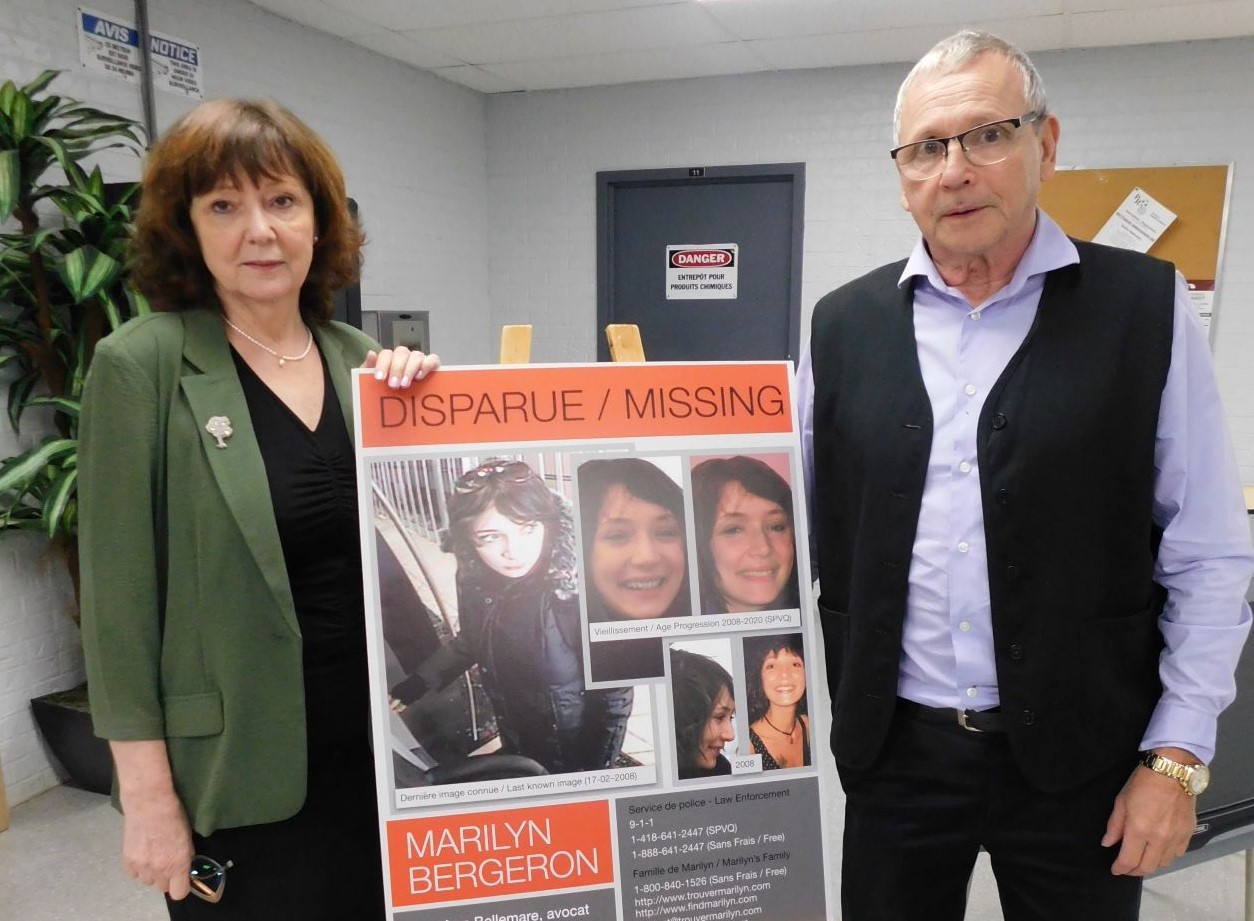
Age progression and the long middle years
In February 2018, two different age progression portraits were released publicly, according to reporting at the time. The idea was simple: if she was alive, the public needed a face that matched the years that had passed.
That same coverage said more than 80 new pieces of information had been verified in the previous year, a number that captures both effort and frustration. Verification is slow, and most tips dissolve when you test them against records.
The family also used anniversaries as pressure points. A 2016 update marked eight years since she vanished, and a 2018 timeline includes a march for the tenth anniversary, tracing a route connected to the last known area.
Anniversary events serve two purposes at once. They keep the case in the news, and they send a message to anyone holding back information that the silence has not aged out, even if the story feels old to them.
In 2017, the family’s lawyer also emphasized anonymity, suggesting that people could speak to him if they did not want to approach police directly. That detail matters because it hints at what the family believed about the nature of the missing knowledge.
The more time passes, the more the case becomes a contest between memory and documentation. Records stay fixed at 11:09 and 16:03, while human recollections drift, and every drift forces investigators to choose what to prioritize.
At some point, almost every retelling circles back to the same question. If she was leaving to start over, why leave a trail that ends with a traceable card purchase, rather than cash and distance, especially after saying she felt threatened.
Police have never publicly provided a full narrative, only these anchored points and requests for information. That restraint is common in open files, but it also leaves room for theories to grow louder than the official facts.
The Ontario lead that changed the public conversation
In late 2022, the family held a press event built around a single witness story in Hawkesbury, Ontario, a town near the Quebec border. They said they believed Marilyn might have been alive and living in Ontario.
Global News reported that a Hawkesbury resident, Guy Salico, said he believed Marilyn rang his doorbell in December 2009 at about 2 or 3 a.m., asking for directions to Chamberland Street. He said he reported it later.
In his account, she was cold, wet from rain, and looked frail. He said he and his partner offered to drive her, but she refused, and after about fifteen minutes she left on foot into the night.
He also described what she wore, a light jacket, jeans, a white V neck shirt, and high heeled shoes. He said she was blonde, polite, and spoke fluent English, and did not appear impaired in the moment.
Those descriptors are part of what made the story catch. The idea of a missing person showing up at a stranger’s door is vivid, and it feels like a near miss, the kind that makes people ache because it suggests the case could have ended differently.
According to Global News, Salico said he only realized the possible connection after he later saw circulating photos of the missing woman. He then reported the incident to police, and said officers met him at his residence to discuss it.
French language reporting in 2023 presents the same core story and places it in a chronology. It says Salicco hosted her for about fifteen minutes, describes her as a blonde young woman in distress who was crying and cold, seeking someone on Chamberlain.
That same 2023 chronology says he contacted Quebec City police in March 2010 after connecting the woman he had helped with Marilyn’s photos online. The timing matters because it suggests the tip was not born years later from a fuzzy memory.
Global News adds another important layer. Bellemare said Salico’s tip became part of more than twenty credible tips in Eastern Ontario during 2009 and 2010, people reporting possible sightings, which pushed the family toward an Ontario focus.
Bellemare also said he believed there was enough evidence to indicate Marilyn was alive in Ontario in the years after 2008. That is a strong statement, but it is still presented as his assessment, not an announced police conclusion.
Police did not appear at the press conference, and Global News reported that police refused to comment on the case that day. That absence created its own silence, a familiar dynamic in long unsolved files where public messaging becomes cautious.
In the same report, Marilyn’s mother told reporters she still had hope. She also spoke of years of suffering and the family’s need for answers, which is the emotional truth of the case, even when the factual truth remains unproven.
What the Ontario story does and does not prove
Even if you accept the Hawkesbury account at face value, it does not solve the disappearance. It simply suggests Marilyn may have been alive nearly two years later, which would rewrite every earlier assumption about the day she vanished.
A reported sighting also creates new questions. If she was alive in Ontario, how did she get there, who was she trying to reach on Chamberland or Chamberlain, and why was she outside in bad weather dressed for a different kind of night.
The detail about speaking fluent English adds texture, but it can also mislead. Marilyn lived and worked in Montreal and moved between regions, so bilingual ability would not be unusual, yet it can make a witness feel more certain.
The blonde hair detail also sits in that uncertain zone. Hair can be dyed easily, and the difference could mean disguise, personal preference, or a mistaken identification, which is why sightings are hard to treat as anything more than leads.
There is also the problem of the passage of time. A person can be confident about a visitor at the door, but the brain fills gaps over the years, especially after seeing the same missing poster image repeated in media.
That is why investigators tend to privilege records. In this case, the only publicly confirmed records remain the two key transactions on Feb. 17, 2008, and the reality that those are the last verified actions tied to her identity.
The Ontario lead, however, does something else. It shows how the family thinks about possibility, and it shows why they continue to resist a closed narrative, because the case has generated too many plausible threads that never snapped cleanly.
Despite years of searching, Marilyn Bergeron’s case remains unresolved. Her family and supporters still believe she could be alive, but investigators have never been able to confirm a single trace after that Sunday afternoon.
Bergeron was 24 when she disappeared on Feb. 17, 2008, after leaving the family home near Quebec City on foot, saying she was going for a walk. Those closest to her have not seen her since.
Records show she visited an ATM at 11:09 on boulevard de l’Ormière, then at 16:03 used her credit card at the Café Dépôt on de la Concorde in Saint Romuald. A witness said she was alone.
She is described as 1.70 metres tall and about 52 kilograms, with brown hair and blue green eyes. Police say she wore a long black coat with a fur hood, black suede boots with fur trim, and velvet pants.
Bergeron is still listed as missing, with a reward offered up to $30,000. If you have information, contact the Service de police de la Ville de Québec at 418 641 AGIR (1 888 641 2447) and cite file 2008 18087.