On a cold December night in 1968, a mother and daughter checked into a cheap roadside motel outside Atlanta. They were not hiding from anyone. They were just trying to get home for Christmas.
Twenty year old Barbara Jane Mackle lay in one of the twin beds, weak from the Hong Kong flu that had swept through Emory University. Her mother, Jane, had driven up from Florida to collect her and bring her back to Coral Gables.
Barbara was not a celebrity in the usual sense. She was an honors student at Emory, the daughter of Florida real estate developer Robert F. Mackle, whose company built entire suburbs out of scrubland.
Friends described her as bright, direct, and affectionate. She had a steady boyfriend, fellow student Stewart Woodward, and a comfortable, if sheltered, life as the only daughter in a wealthy family.
That night at the Rodeway Inn in Decatur, Jane and Barbara took a simple, cautious precaution. They registered under a slightly altered spelling of their surname, hoping to avoid unwanted attention to the Mackle name.
They ate a small dinner, checked on Barbara’s fever, and talked about getting an early start the next morning. Stewart visited briefly, then left for the night. Nothing about the scene looked like the start of a national crime story.
Outside the room, however, somebody already knew exactly who they were. Someone also knew how much Barbara’s father could pay to get his daughter back.
The Knock At Four In The Morning
Around four a.m., the heavy knock on the door jolted both women awake. Jane heard a man’s voice announcing himself as a police officer. There had been an accident, he said. Stewart had been hurt.
Half asleep and terrified for her daughter’s boyfriend, Jane opened the door a few inches. Two figures pushed hard against it. A man forced his way inside with a shotgun. A woman stood behind him, face covered.
They were not police. They were twenty three year old fugitive Gary Steven Krist and twenty six year old graduate student Ruth Eisemann Schier. Both wore ski masks. Both had rehearsed this entry in detail.
The man struck Jane and forced her back onto the bed. The woman held a chloroform soaked cloth over Jane’s face while Krist tied her wrists and ankles. Within minutes, Barbara watched her mother lose consciousness.
Krist turned the gun on Barbara and told her plainly that she was being kidnapped. There were no threats about hurting her if she screamed. He did not need them. The shotgun and the unconscious body in the next bed said enough.
He marched Barbara out of the room into the cold parking lot, hands bound, still in her nightgown and winter coat. Eisemann Schier followed with a small bag of supplies. They pushed Barbara into the back of a waiting car.
The door slammed. The car pulled away from the motel and merged into the dark highway. In the rear seat, Barbara had no idea where they were going, only that her mother was left tied in the room behind her.
A Box In The Woods
Krist drove north out of Atlanta toward Gwinnett County, then turned off onto quieter roads lined with pine trees. He was not improvising. Weeks earlier, he had picked a spot and prepared something in the ground.
Deep in a wooded area near Berkeley Lake Road, he stopped the car. Under trees and leaf litter, he had already dug a trench and placed a long fiberglass box inside. It looked like a coffin crossed with a storage tank.
Barbara saw the shape only briefly in the beam of a flashlight. Krist and Eisemann Schier ordered her to climb down into it. She obeyed, shivering, still half dizzy from the flu and from shock.
Inside, the box felt narrow and smooth. Krist had tried to make it livable. Along one side sat jugs of water, food, and some sedative laced drinks. There was a battery powered light, a fan, and a crude air pump.
Two plastic pipes rose from the lid to the surface to bring fresh air down. At one end, he had installed a bucket and roll of toilet paper. Blankets were stacked near her feet. It was a prison designed to keep its occupant alive.
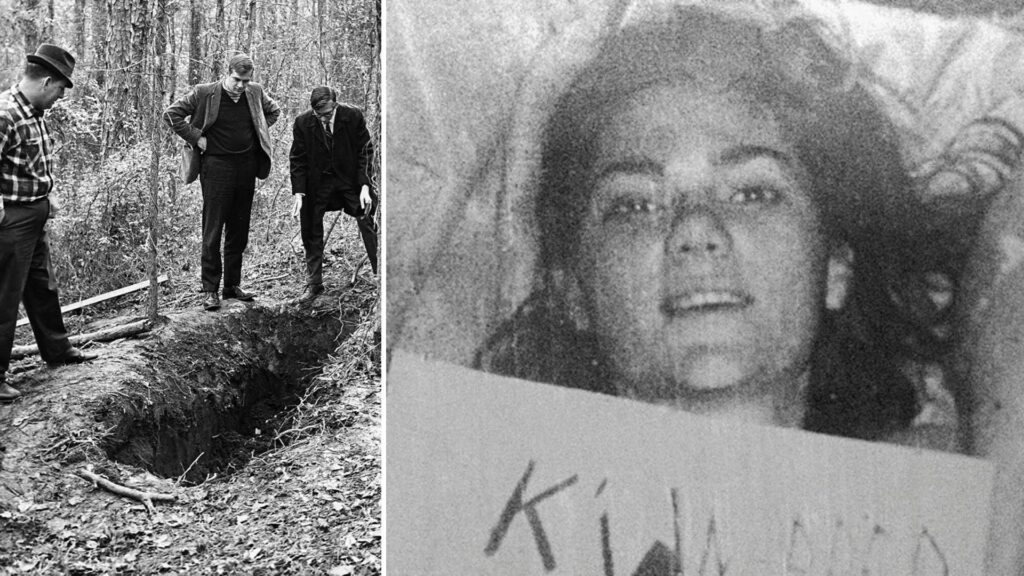
Before sealing the lid, Krist handed Barbara a hand lettered cardboard sign that read “Kidnapped.” He propped a Polaroid camera on the edge, snapped a picture of her curled in the box, and tucked the photograph away.
Then he closed the lid. Barbara heard bolts turning and felt cold dirt hitting the top of the fiberglass. She screamed and pounded on the ceiling while the sound of shovels grew fainter. Soon there was only silence and her own breathing.
Panic Underground
Inside the buried box, the light cast a weak glow. The fan hummed softly, moving stale air around her face. Barbara forced herself to breathe slowly, to count, to do anything but think about the weight of the earth above.
At first she screamed continuously, calling out for her mother, for anyone. When no answer came from outside, she rationed her voice. She remembered her father’s face and their decorated house in Coral Gables, and told herself she would see it again.
She tried to read the kidnapper’s intentions from the design of the box. The presence of water, food, and air tubes felt like proof that they wanted her alive long enough to trade her for money.
That logic comforted and frightened her at the same time. If something went wrong outside, the box could turn from lifeboat into tomb. Batteries could die. The air pump could fail. The kidnappers might panic and run without calling anyone.
At some point, the small light flickered and went out, plunging her into complete darkness. In the black, sounds felt larger. The tiny thump of her heartbeat seemed to echo against the walls.
To stay sane, Barbara started to imagine carefully choreographed scenes. Christmas morning with her parents and brother. Sunny afternoons in Miami. Arguments with friends over nothing at all. She treated each one as a promise rather than a memory.
A Mother Wakes Up
Back in the motel, daylight crept through the curtains while Jane lay on the bed with rope marks on her wrists. The chloroform finally wore off. She woke disoriented, then remembered the gun, the masks, the empty bed.
Her daughter was gone. The room looked ransacked. The car outside sat exactly where she had parked it. Panic crashed over her in waves, but she managed to free herself from the bindings and reach the phone.
Local police arrived first, then state officers, then the FBI. Within hours, the small motel room was crowded with law enforcement. Agents took Jane’s statement in pieces, pausing as she cried and tried to recall small details.
She remembered the shotgun, the cloth over her face, the man’s false reassurance about being a detective, and the mention of a car accident involving Stewart. She had not seen the car’s license plate or the direction they left.
Agents photographed the room and dusted surfaces for fingerprints. They also began to anticipate a ransom demand. A wealthy developer’s daughter rarely vanished without some demand for money.
The Ransom Letter
The kidnappers had planned that part carefully. A three page typewritten ransom letter, sealed in a plastic jar, soon reached the Mackle family. It addressed Robert Mackle directly and laid out terms with unusual precision.
The letter stated that Barbara had been buried in a box equipped with air and provisions, and that her survival depended on strict obedience to instructions. It demanded five hundred thousand dollars in used notes.
The writer promised that if Robert followed every step, his daughter would be released alive. Any deviation, including obvious police surveillance, would mean they would leave her underground until her air or water ran out.
It described a series of phone calls and a future drop site. It also tried to calm the father by stressing that the kidnappers were not sadists. They claimed this was a business transaction and that harming Barbara would serve no purpose.
The language was chilling in its clinical tone. Robert did not debate. He began assembling the money immediately, working with the FBI, who marked and photographed the bills but agreed to keep a low profile to avoid spooking the kidnappers.
For the family, every hour felt like a reduction in the air inside that box. For the FBI, the letter provided their first clear picture of what they were dealing with and a narrow window for error.
The First Drop That Went Wrong
Following the instructions, Robert packed the cash into suitcases and drove with agents to the designated area outside Atlanta. He wore a wire, but the Bureau positioned its people far enough back to avoid obvious detection.
They waited in the darkness near the rural road, as directed. At the appointed time, a signal was supposed to tell Robert where to leave the money. What happened instead looked trivial to anyone who did not know Barbara was underground.
A police car unrelated to the kidnapping rolled slowly past the site, its driver unaware of the operation. To Krist and Eisemann Schier, watching nervously from nearby, the passing cruiser looked like proof that law enforcement had flooded the area.
Panicking, they abandoned the plan, fled the scene on foot, and left their car nearby. The first ransom drop had failed. The money remained in Robert’s hands, and Barbara remained underground, counting hours she could not see.
For the FBI, however, the failure turned into a stroke of luck. Agents soon located the abandoned car and secured it. Inside that vehicle lay the clues that would crack open the kidnappers’ identities.
The Abandoned Car And A Name
In the trunk and glove compartment, agents found the ransom letter jar, some personal items, and the Polaroid photograph of Barbara curled in the box holding the “Kidnapped” sign. That picture confirmed she was alive when buried.
They also found documents and registration papers bearing the name George D. Deacon. The car was registered under that identity. The name meant nothing to the Mackle family, but it meant a great deal to investigators once they ran it.
Agents sent fingerprints from the car to the FBI lab and began calling institutions where someone named George Deacon might have worked or studied. A match turned up in south Florida, hundreds of miles from the Georgia woods.
From Miami Labs To Georgia Pines
Records at the University of Miami showed that a man named George Deacon had recently worked at the Institute of Marine Science. Professors remembered him, in part, because he built sealed, ventilated boxes for research projects.
To agents reading the ransom letter’s description of a buried container with air tubes, that detail lit every warning light. They flew to Miami, interviewed colleagues, and checked personnel files.
The director explained that Deacon had quit abruptly shortly before the kidnapping. Staff also mentioned that he spent much of his time with a young Honduran researcher named Ruth Eisemann Schier, who had also disappeared from campus around the same period.
Separately, a man in Georgia came forward who had purchased an old trailer from a stranger matching Deacon’s build. In the trailer, he found letters addressed to both George Deacon and Gary Steven Krist.
Once the FBI ran the name Gary Krist through its systems, they discovered he was an escaped prisoner from California who had slipped away from custody in 1966. The fingerprints from the Georgia car matched those in his file.
Within a few days, the FBI knew that “George Deacon” was an alias for Gary Steven Krist, a twenty three year old convict with a history of theft and escape. They also knew his likely accomplice.
The Clock Starts To Run
By now, Barbara had been underground for more than two days. Agents believed the kidnappers’ description of the box, but they could not know whether the air pump still worked or whether the pipes had been damaged.
The Bureau pushed both tracks of the investigation at once. One team built a full picture of Krist and Eisemann Schier, tracing their movements, friends, and possible hideouts. Another began planning for a second ransom exchange.
Krist, realizing his car and papers were gone, knew the FBI was closing in. He still had his prize, though, and he still believed the authorities would trade everything for Barbara’s safe return if he could control the timetable.
Through a new message, he revived the ransom plan and issued fresh instructions for another payoff. Robert agreed again. The FBI tried to make sure no stray patrol cars would appear this time.
Everyone involved understood that the second attempt might be the last chance to get Barbara out alive. On the day chosen for the drop, agents took up their positions and waited for the next move.
That next move would decide whether the story of the heiress in the box ended with a recovery or a burial.
Click here for part 2.