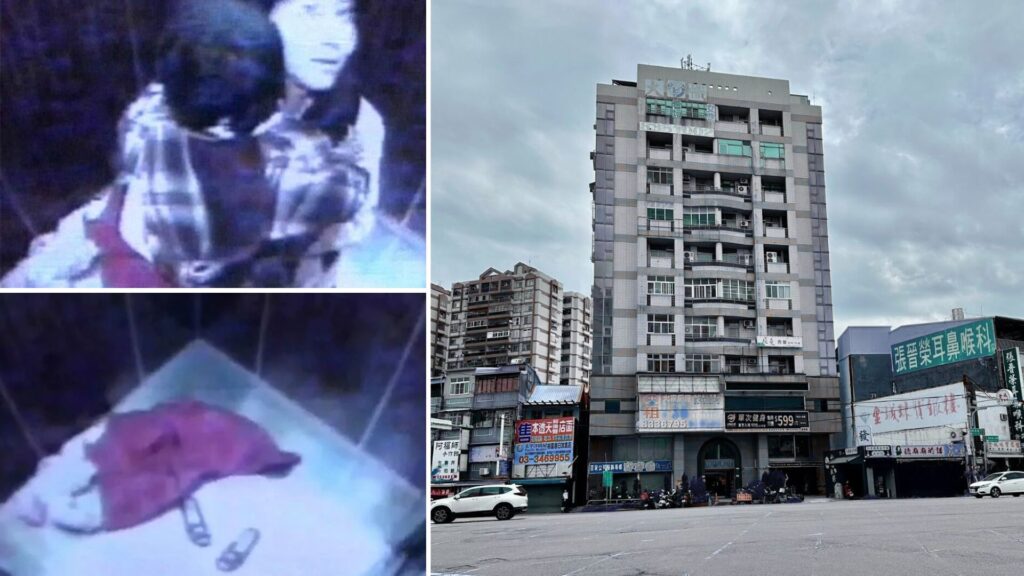
The next morning, the building manager began with something that should have stayed small: coats and sandals abandoned in an elevator overnight. He pulled up the security feed to find the owner and instead watched a mother and little girl ride up, undress, step out, and disappear.
People in Taiwan still refer to it as the Changhua mother and daughter elevator disappearance, a cold case that gets compared to the Elisa Lam mystery. Years later, the story still has the same blank center: a few minutes of video, then nothing.
The building stands in Yuanlin, Changhua County, a mixed-use block locals describe as the Yuanlin Finance Building, part offices, part residences. It sits on Yu Ying Road, in a stretch of town busy enough that strangers can pass without drawing much attention.
Late on Jan. 20, 2008, a woman in her late 30s arrived on a Yamaha scooter with a 4-year-old girl. An account in United Daily News placed the scooter at the entrance around 8:40 p.m., key left inside, and the elevator camera catching them at 8:47:30.
Inside the elevator, she pressed for the 11th floor, described as the highest level. Then came the detail that keeps replaying in people’s minds: she removed her own coat, then her daughter’s, leaving them on the floor, and slipped off footwear as well before exiting.
Another camera angle picked them up again, moving down the hallway toward the safety stairs, the route that led to the roof. After that, the building’s system never caught them returning to the elevator, crossing the lobby, or passing through an exit.
The scooter became the stubborn physical trace that refused to vanish. Police later located it outside the same building, and Central News Agency reported that her husband had already filed a missing-person report before officers tied the scooter back to her.
It is easy to picture the sequence and hard to square it with what followed. A mother rides roughly eight kilometers from Shetou to a building she does not appear to own, rent, or work in, parks, walks in, rides to the top, drops winter clothes, and vanishes.
That contradiction became the case itself: a disappearance compressed into an elevator ride and a hallway sprint, inside a place that, on paper, should have recorded any ordinary way out.
Officers moved quickly because the behavior looked like panic or despair. The manager feared she meant to harm herself, and her family pleaded publicly for her to come forward safely, hoping the footage would shake loose a name, an address, anything.
Accounts described the search in the way these searches usually unfold. Police checked rooftop corners and access points, looked through mechanical areas and stairwells, scanned the exterior and nearby alleys, and still found no trace that matched the urgency of the video.
The building itself added pressure to every assumption. The manager insisted that the management desk sat at the only entrance, with a camera trained to capture anyone passing through, which left him convinced that the pair never walked back out the front.
A later reconstruction by TVBS leaned into the same puzzle, describing multiple cameras on the first floor and emphasizing that investigators could not find footage of the pair leaving by any normal route the building offered.
Most Taiwanese coverage identified the mother as Liu Huijun, sometimes leaving her first name in Chinese only, and it treated the child largely as “her 4-year-old daughter,” a small privacy choice that also kept the public guessing about who the girl might have become.
What surrounded the disappearance, at least publicly, looked like a family in conflict. Accounts described a dispute with her husband and framed the departure in the shadow of domestic violence, then repeated allegations of heavy drinking, abuse, and a previous split followed by reconciliation.
Set beside the elevator footage, that background sits like a second story running underneath the first. A volatile home can produce a flight that looks impulsive, and it can also produce a disappearance that looks planned, especially when someone believes the same life will swallow her again.
The simplest version of the mystery still holds two impressions at once. The building’s layout suggests confinement, while the real-world limits of older surveillance suggest escape, and the case has lived for years in the space between those two ideas.
One impression comes from the building’s promise of control. Cameras, a visible lobby, a manager watching the entrance, and police combing the obvious hiding places all point toward a conclusion that feels blunt: if they left, the system should have shown it.
The other impression comes from how such systems actually fail. Blind corners exist, stairwells swallow movement, doors get propped, and cameras miss faces or angles, which leaves space for a person to move in ways that do not match the neat logic of coverage.
That gap, between what the building should have captured and what it did capture, is where the case’s competing explanations took root.
One explanation stays grounded in routine failure. It assumes the mother reached a spot outside the cameras’ clean view, chose stairs over the elevator, and exited through a basement or side route that did not register clearly in 2008.
A later report from CTS described a version of this idea that circulated locally, involving a basement connection into an adjacent billiards hall where camera coverage was thin enough to let someone slip out without ever crossing the main lobby again.
TVBS cited a senior officer who argued for another practical route, a departure by vehicle through a back area, with tinted glass or angles that made identification difficult even if a camera caught motion.
If she did manage to leave, the elevator scene reads differently. Clothing left behind becomes a planted clue, one that pushes attention upward to the roof and holds investigators inside the building while the outside world keeps moving.
The trouble is what comes after an escape. Starting over with a 4-year-old takes planning, money, and help, and later rechecks returned to the same absence: investigators could not find convincing activity in the banking, medical, or school trails they examined.
Another explanation stayed inside the building and turned darker. It persisted because the video looked like distress and because the pair headed toward the roof route, which made early observers fear suicide even before anyone had a name to attach to the faces.
Search results complicated that fear. Officers searched exterior areas and rooftop spaces where a fall would likely be discovered, and follow-up checks of tanks and mechanical areas still did not yield remains or a trace that closed the loop.
Some versions of the theory shifted into the building’s hidden anatomy, void spaces, overlooked shafts, sealed rooms. The idea leans on the possibility of concealment and preservation, though the repeated searches and years of ordinary building life offered no public sign to support it.
A third explanation turned toward human violence. It imagines a meeting behind a door, either with someone she knew well enough to trust or with someone who crossed her path in a blind spot and kept her from leaving.
Investigators and later coverage kept circling back to the same obstacle: they could not establish a clear link between Liu and anyone in the building. TVBS described officers having family compare resident lists, and still no one emerged as the obvious connection she came to see.
A crime inside a private unit also requires time and silence. Early on, without a warrant or a specific crime scene, police could not simply enter every apartment, and the public record of the case never filled with forensic details beyond the clothing left in the elevator.
A fourth possibility sat between flight and confinement. It imagines the building as a staging point, not an end point, with the mother leaving the property and meeting her end elsewhere, which would explain an empty rooftop and an empty lobby at the same time.
That line of thinking matches how investigators kept working the case during reopenings. Instead of only returning to stairwells and rooftops, they looked for administrative traces, medical visits, withdrawals, insurance use, school enrollment, the small paper footprints life usually leaves.
The disappearance never fully left Taiwanese public memory, but it resurfaced in bursts, often when another high-profile case made people revisit old mysteries and look back at footage that still felt fresh.
When the Elisa Lam case captured global attention, Taiwanese audiences drew parallels to Liu’s elevator footage. Police returned to the building and revisited investigative steps, including the creation and comparison of DNA profiles tied to unidentified remains.
Later, another Changhua case involving a child missing for years ended with a discovery, and Central News Agency described local police using that moment to review older missing-person files, returning again to the lack of financial or medical activity connected to Liu and her daughter.
A reopening described by CTS widened the search further. Investigators pulled records from insurance and medical history, tried to spot school enrollment, and even checked consumer membership programs at pharmacies and department stores, chasing the faintest hint of continued life.
One small cultural mismatch has shaped how people outside Taiwan talk about the case. International audiences sometimes reach for “dumpster” theories because they fit familiar cityscapes, but Taiwan’s daily waste routine, in many places, runs on timed collection and designated bags.
That system does not erase every commercial container or private collection arrangement, but it does shift the logic. A disposal theory needs a specific container, a specific schedule, and a specific chain of handling, not a generic image imported from elsewhere.
Surveillance video feels like certainty because it offers a picture. In this case, the most consequential moments live outside the frame, in the seconds after the stairwell turn, when the building stopped supplying answers and started supplying only silence.
The cameras never captured whether the mother paused at the stairwell door, met someone in the corridor, climbed toward the roof, or headed down instead. They never showed her returning to the elevator, stepping into a blind corner, or moving through a vehicle lane where faces blurred.
Some investigators quoted in later pieces pushed back against the case’s haunted reputation. The missing footage does not demand a supernatural explanation, and it reads more like an investigative failure that hardens over time as tenants change and memories thin.
In 2023, Liu’s husband died in an accident while repairing or cleaning a rooftop water tank at home, removing one of the few people who might have clarified details about the argument, the departure, and what he believed she intended when she left.
By 2024, after more than a decade without a confirmed trace, her family petitioned the court to declare Liu and her daughter dead under Taiwan’s framework for long-term missing persons, and the court approved the request.
That ruling helped survivors handle paperwork and inheritance and the unending administrative grind of “missing.” It did not answer where the pair went. It simply treated the years of silence as its own kind of evidence.
Most missing-person cases stretch across geography. Investigators track routes, phones, bank machines, transit lines, witnesses, the places a person might reasonably pass through. Here, the map collapses into one building, one elevator ride, one top floor, one stairwell turn.
That tight frame is what keeps the case lodged in public memory. If Liu Huijun and her daughter left the building, they did it through a gap that has never been documented clearly enough to settle the story, and if they did not, the building kept a secret that years of searching never exposed.