On the surface, mid September in Balby looked exactly as it should. School runs, packed lunches, buses at the same times. In a brick house near Westfield Park, a fourteen year old boy moved quietly through that pattern.
A boy who liked being indoors
Andrew Gosden had been born in July 1993 and grew up in a family that knew his habits well. He loved video games, maths, metal bands and preferred staying home to going out. Teachers described him as bright, reliable and academically gifted.
He was not the kind of teenager who disappeared for hours without telling anyone. He did not drink or party and he rarely visited friends. Home felt like his centre of gravity and he came back to it at the end of each school day.
The last ordinary evening
On Thursday 13 September 2007, the Gosdens ate dinner together as usual at their home in Balby. Afterwards, Andrew and his father worked on a computer puzzle game, and later Andrew watched television with his mother before heading up to bed.
Nothing about the evening stood out as tense or unusual. His parents later said his mood seemed normal, the sort of quiet night families expect before an ordinary school day. The house settled, lights went off and everyone went to sleep.
The morning that changed direction
The next day Andrew did not wake smoothly. His mother later said he was unusually hard to rouse and more irritable than usual when he finally got up. He skipped breakfast, got dressed in his school uniform and left the house just after eight.
A family friend saw him walking across Westfield Park toward the bus stop used by pupils from his school. At that point, nothing looked out of place. A uniformed boy with a school bag, on the route everyone expected him to take.
Somewhere after that crossing, Andrew altered the script. Instead of catching the bus, he walked on toward a nearby cash machine. From his account balance of a little over two hundred pounds, he withdrew exactly two hundred in notes and put them away.
Back home, out of uniform
CCTV from a neighbour’s house later showed him returning home soon after the cash withdrawal. Inside the house, he took off his uniform, put it into the washing machine and hung his blazer neatly over the back of his chair.
He changed into black jeans and a black Slipknot T shirt, packed a black canvas bag covered in rock and metal band patches, and picked up his PSP, wallet and house keys. His school blazer stayed behind in the bedroom where he left it.
He did not take his passport. He did not take a change of clothes. He left the charger for his PSP in his room. Small decisions like that would later feed every theory, because nobody could say how long he imagined being away.
Walking toward the station
At around half past eight, Andrew left the house for the second time. This time he did not pass the bus stop. He walked in the opposite direction, following the streets that led toward Doncaster station, about a twenty minute walk from his home.
He arrived at the ticket office and asked for a ticket to London. The clerk who served him later remembered the conversation in unusual detail. She offered a return ticket because it cost only slightly more, and he refused and asked for a single.
The choice sounded deliberate rather than impulsive. A single ticket to London at fourteen, bought in cash from money withdrawn only minutes earlier, suggested a plan that existed before he left the house. If that plan had an end point, it never surfaced.
On the 9.35 to King’s Cross
Andrew boarded the 9.35 GNER service from Doncaster to London King’s Cross. Other passengers later recalled a quiet boy travelling alone, sitting near them, keeping his bag close. The journey would have taken around two hours through fields and suburbs.
He had no mobile phone with him. He had left it at home charging on his bedroom desk, even though he usually took it when he went out. Because of that choice, investigators later had no cell tower pings or itemised calls from London to work with.
From the outside, the train ride looked unremarkable. Nobody reported a disturbance, argument or conversation that stood out. He bought nothing from the buffet car. He did not speak to staff. Cameras recorded him at Doncaster and again as he arrived in London.
King’s Cross at lunchtime
At around 11.20 in the morning, Andrew stepped onto the platform at King’s Cross. Later checks of rail records would confirm his journey, but at that moment he was simply one more teenager in a station full of commuters, tourists and suitcases.
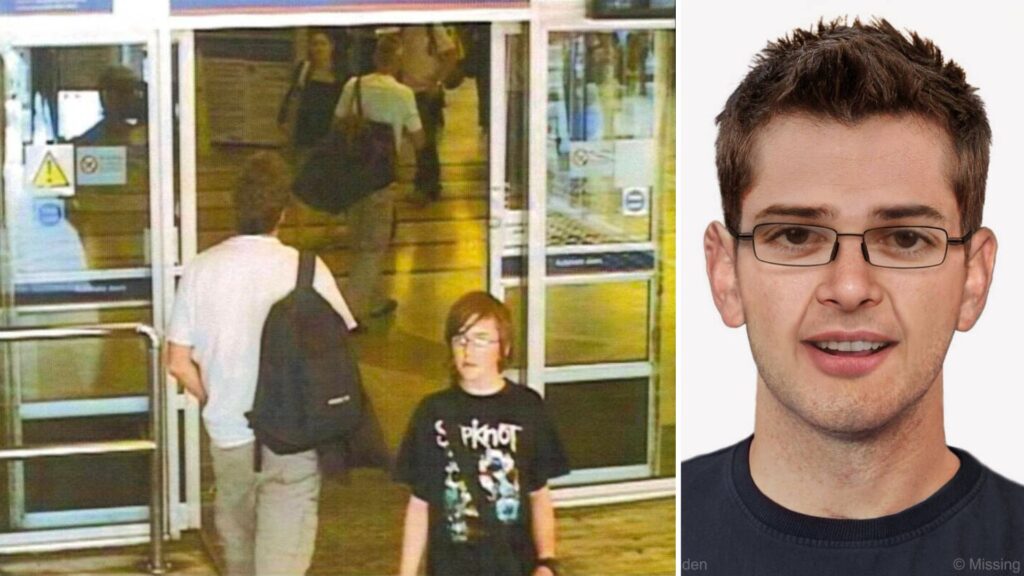
CCTV later caught him emerging from the main concourse. In the image that would circulate for years, he walks steadily past a line of ticket barriers with his rucksack over one shoulder, hair neat, hands relaxed, eyes lowered toward the floor.
Investigators highlighted the shape of his right ear, which had a distinctive double ridge, hoping someone would recognise it. That ear, and the dark clothing, and the plain rucksack became anchors in a case that otherwise lacked any confirmed visual trail.
After that short walk out of frame, nothing certain follows. There are theories about which exit he used and which streets he might have taken, but investigators never found verified footage of him on pavements, buses, shop cameras or at nearby attractions.
The day that still looked normal at home
Back in Balby, Friday went on as a work and school day. Andrew’s father Kevin was at work. His mother, Glenys, went through her usual routine. His older sister Charlotte was at school. They assumed Andrew was where he always was, at lessons.
That evening the family sat down to eat with a family friend who had seen Andrew crossing Westfield Park that morning. They believed he was either downstairs in the converted cellar playing games or upstairs doing homework. Nobody imagined he was in London.
When dinner ended and Andrew still had not appeared, they went to check his room and the cellar. The uniform in the washer and blazer on the chair were there to be found. Andrew was not. At first they thought he might be with friends or neighbours.
The phone calls that broke the illusion
They began calling his friends to ask if he was staying late. The answers came back quickly. He had not been seen at school that day. Teachers confirmed he had never arrived for morning registration. The picture changed from mild worry to sharp fear.
Around seven in the evening, his parents rang the police to report him missing. Officers took details about his hearing loss, his glasses, his height and his clothing, then began checking likely routes between home and school for any sign of an incident.
Charlotte and Kevin walked the streets themselves, tracing the path he usually took toward the bus stop, scanning hedges, side roads and alleys for anything that might have happened on his way to school. They saw nothing that explained where he had gone.
Searching the route that suddenly felt longer
Within a few hours of realising he truly was missing, the family produced and copied a simple leaflet with his photograph and description. Friends helped distribute it around local shops, bus routes and parks. The search stayed close to Balby because everyone thought locally.
That weekend police searched bushes and open ground near the family home, checked sheds and garages and looked at waterways and culverts along his normal commute. They treated the route between home and school as the most likely place for something to have gone wrong.
Officers also began looking at CCTV in the area, though some footage had already been overwritten by standard recording cycles. At this stage they still believed they were tracing a missing schoolboy somewhere near his house, not following a trail to another city.
Realising he had gone to London
Three days after Andrew left home, police spoke to the ticket clerk at Doncaster station and checked rail records. They confirmed he had bought a child ticket to London King’s Cross and boarded the morning service. For the first time, the search shifted to the capital.
South Yorkshire Police asked British Transport Police to review CCTV from King’s Cross to find him. Early viewing did not pick him out of the crowds. It took another review, around three weeks after he vanished, for officers to identify Andrew walking from the concourse.
The still image of that walk became the reference point for every future appeal. It confirmed that he arrived safely in London and left the station on his own. It did not answer the essential questions of where he went next or why he had come.
Taking the search to the capital
Soon after they learned he had travelled to London, Andrew’s family did what they could with that information. They travelled to the city, stood outside King’s Cross with leaflets and posters, and began visiting places they thought might appeal to him.
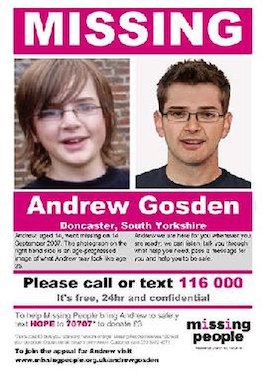
They targeted museums, science exhibitions and spots connected to music and alternative culture. Staff were asked to look twice at teenagers passing through, to notice anyone quiet with dark hair and a distinctive folded ear. Nobody could say for certain they had seen him.
By the time the image from King’s Cross appeared in newspapers and on television, the moment it showed was already weeks old. The boy in black had long since stepped out of frame. The family, and the search, were still trying to catch up to that single stride.
Once investigators confirmed he made it to London, the focus shifted to what he might have done next and why none of it left a trace. Click here for part 2.