Tarrare was born around 1772 near Lyon, although even the name is uncertain in the sources, which sometimes treat it like a nickname. What is consistent is that his appetite was described as extreme from childhood, then impossible in adolescence.
By seventeen, accounts claim he could eat in one day what would normally be a large share of an animal, and still feel driven to find more. His family, unable to supply that volume of food, forced him out of the home.
He lived in a France where poverty was common and the gap between a fed household and a hungry one could be thin. For someone like Tarrare, that gap became a cliff, because ordinary scraps could not keep him steady for long.
The early accounts say he drifted, begging and stealing to survive, and travelled with a roaming band of thieves and prostitutes. It is hard to separate the moral tone of the era from the facts, but the pattern points to instability.
Somewhere along those roads, hunger became performance. In Paris and other cities, crowds paid attention to people who did things that tested the limits of the body, and Tarrare found a place in that world because he could always eat more.
One account places him on the boulevards among familiar street characters, saying he challenged spectators to satisfy him. They brought apples, then stones and corks, and he swallowed what was offered, turning his need into a spectacle.
By 1788, reporting in later summaries says he moved to Paris to work as a street performer. He could attract a crowd, but the act carried risk. One time, the sources say, he developed a severe intestinal blockage and needed hospital care.
He was taken to the Hôtel Dieu and treated with strong laxatives, according to the later compilation. He recovered, then offered another demonstration that suggests how loosely fear and logic held him: he offered to eat his surgeon’s watch and chain.
The surgeon refused, and warned him that if he did it anyway, he would cut him open to retrieve the objects.
A body that did not match its appetite
The physical descriptions that survive are as strange as the eating. Tarrare was described as having soft, fair hair and an unusually wide mouth. When he had not eaten, his skin was said to hang loosely, and after meals his belly could swell.
One phrase from the record is repeated often because it is so visual: his abdomen could swell “like a huge balloon.”
The same sources describe heat, sweat, and smell as part of his daily presence. One line says he stank “to such a degree that he could not be endured within the distance of 20 paces.”
A later account in an English medical journal, quoted in a modern summary, adds another detail: “a vapor arose, sensible to the sight.”
The medical record also notes chronic diarrhea and describes it with a blunt phrase, “fetid beyond all conception.”
There are also behavioral descriptions that keep appearing. Aside from food, he was often described as apathetic, without strong ideas or force, which makes the hunger stand out even more. Almost everything else about him was written as flat, ordinary.
The army finds him useful, then hard to contain
When war expanded in the early 1790s, Tarrare joined the French Revolutionary Army. Official summaries place his service years between 1792 and 1794. The reason for joining is not recorded as a choice or belief, just as a step in his path.
Military rations were fixed by policy and supply, and in his case they failed immediately. Accounts say he did chores for other soldiers in exchange for their leftovers, and scavenged from waste when that still was not enough.
Eventually he collapsed into exhaustion and was admitted to the military hospital at Soultz sous Forêts. He was given quadruple rations, and when that did not calm the hunger, he moved to what was available: scraps, refuse, and anything within reach.
The story includes a detail that makes the setting clear. He slipped into the apothecary room and ate poultices, which were meant for wounds, not for mouths. That is the kind of act that turns a patient into a problem, and then into a subject.
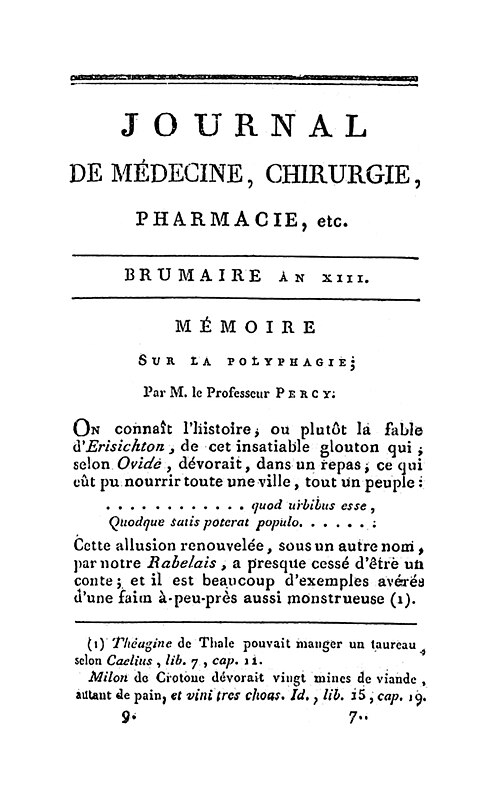
Two names appear repeatedly in the hospital chapter. One was Dr. Courville, a military surgeon. The other was Pierre François Percy, a prominent army surgeon who later wrote a memoir on extreme eating and placed Tarrare at its center.
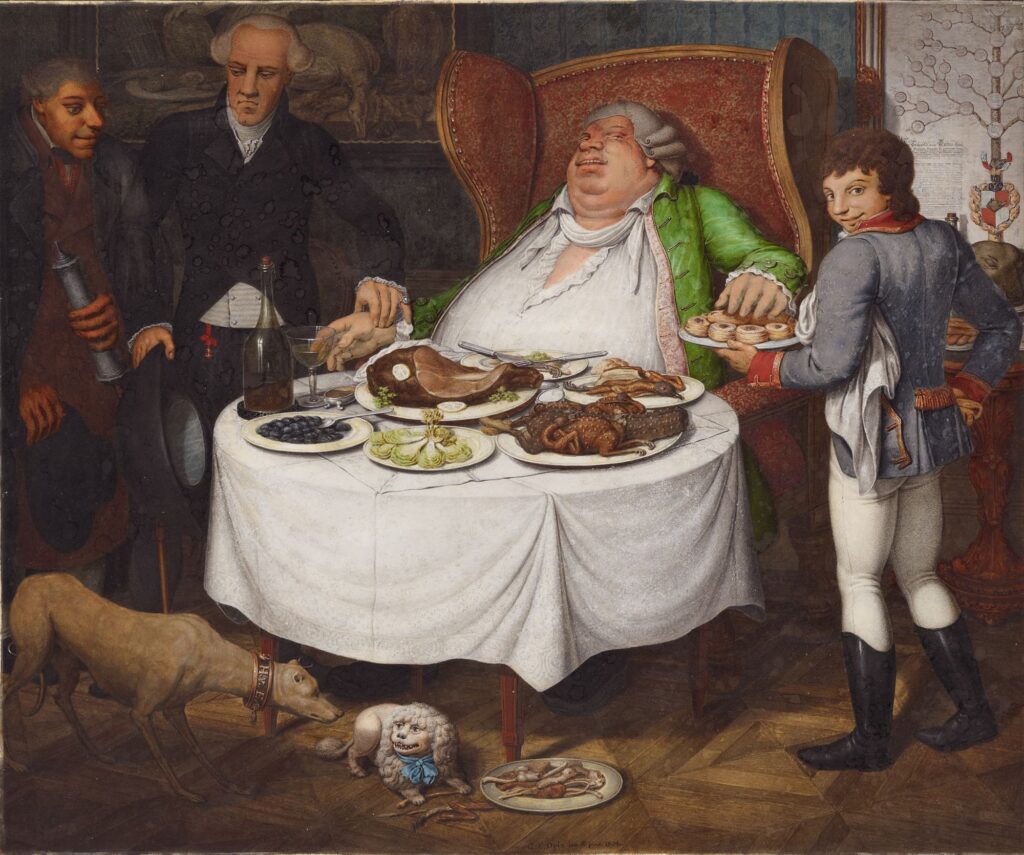
Accounts describe a choice made by the doctors that now looks like a controlled test. A large meal prepared for fifteen laborers was set near the gates, and Courville let Tarrare reach the table. He ate it all, then lay down and slept.
After that meal, the doctors wrote that his belly ballooned outward, then eventually slackened again. They emphasized that he did not show obvious distress afterward, and that the meal did not stop the hunger for long, which was the point they kept returning to.
The experiments, as described, were simple and brutal in their logic. If he can eat what should be impossible, what else can he swallow. If he can swallow it, can he carry it across a border. The army did not need a theory to ask those questions.
One line attributed to Percy tries to translate the scale of his hunger into something a reader could picture. He wrote that you should imagine “all that domestic and wild animals, the most filthy and ravenous, are capable of devouring.” That was his closest comparison.
The moment the record turns gruesome
Modern retellings often focus on the most shocking episodes, but the older accounts include them for a different reason. They were trying to show that the appetite did not stop at cooked meals, or even at food that most humans would recognize as food.
In the presence of senior medical staff, Tarrare was reportedly presented with a live cat. The accounts say he killed it with his teeth, drank its blood, and ate it, leaving only bones, then later vomited up hair.
He was also described as eating snakes and other animals offered to him, and swallowing a large eel without chewing, though observers thought he crushed its head.
At the same time, the record insists on his thinness. He did not become heavy, and he did not seem to gain strength from what he consumed. That mismatch between intake and physical state is part of why the doctors treated the case as an anomaly worth documenting.
The hospital staff also described his constant searching. He ate the scraps left by other patients. He went looking near kitchens. He returned to places where medical waste was stored, because that was material he could consume even when nothing else was offered.
This is where the story begins to tighten around a specific idea: concealment. A soldier who can swallow objects and pass them intact might become useful, not because of courage or language skill, but because his body could hide what hands could not.
The wooden box test
The accounts describe a test meant to check whether Tarrare could swallow a small container and pass it without destroying its contents. He was given a wooden case with a sheet of paper inside, and the next day he produced it, paper intact.
After that, the military interest became more direct. The general Alexandre de Beauharnais is named in later summaries as the officer who decided to use Tarrare as a courier. The plan was to have him swallow a message, cross enemy lines, then recover it.
Accounts say the general first watched him swallow another wooden case after eating an enormous amount of raw organ meat, then gave him a message meant for a French officer held by the enemy. The method was crude, but the logic was clear enough.
Tarrare set out for enemy territory disguised as a peasant, according to later summaries. The plan depended on him blending in long enough to reach a prisoner. It failed quickly, and the reason given is simple: he did not speak German.
He was captured by Prussian forces and beaten, and the accounts describe a mock execution. The box stayed inside him for a long time, then came out. One retelling says he had the presence of mind to swallow it again to hide its contents.
The mission also failed because the message itself was considered useless or insignificant once it was recovered, at least in the way later summaries tell the story. Whatever the plan was meant to achieve, Tarrare returned to the French side without proving his value as a spy.
After this, the record shifts back to the hospital, and to the idea of a cure. The sources say Tarrare agreed to submit to treatments if it meant avoiding more military service, and Percy and others tried what they had.
Attempts to stop the hunger
The treatments described are typical of the era’s toolkit. The accounts mention acids, preparations of opium, tobacco pills, and other measures used to quiet the body or blunt appetite. The record is consistent on the outcome: nothing reduced the drive to eat.
A later summary also mentions laudanum, wine vinegar, and attempts to keep him on a controlled diet, with the same result. Control lasted only as long as the staff could watch him, and his hunger pushed him to search beyond the ward.
He slipped out and fought for offal near butchers and slaughterhouses, according to the sources. He searched in gutters and rubbish heaps. In the language of the time, he competed with dogs and wolves for what was available in the dirtiest places.
Inside the hospital, accounts say servants caught him drinking blood from patients who had undergone bloodletting. They also described him in the dead room consuming bodies, a claim repeated in more than one retelling and presented as a reason staff wanted him gone.
This section of the record contains the most serious allegation in the case, and it is handled in the sources as suspicion rather than proof. A child of about fourteen months disappeared from the hospital, and the staff immediately suspected Tarrare.
The account does not present evidence that he harmed the child, only that fear gathered around him because of his documented behavior and because the child was missing. The result was decisive: he was driven out of the hospital and vanished from view.
Four years missing, then Versailles
After his expulsion, Percy wrote that he lost sight of Tarrare for four years. That gap matters, because almost everything we know about the man comes from institutional settings, and those years suggest a life lived outside records, outside wards, and outside observers.
When he reappeared, it was at the civil hospital at Versailles. The sources describe him as dying, and say the hunger that had defined him was fading, replaced by a wasting illness. The writers use the language of “consumption,” later summarized as tuberculosis.
One later summary adds a detail that reads like a desperate attempt to explain his decline. Tarrare told Percy he had swallowed a golden fork years earlier and believed it was lodged inside him. He hoped removal would save him.
Percy, according to that same summary, recognized advanced tuberculosis rather than a trapped utensil. Within weeks, Tarrare developed relentless diarrhea and died. The sources emphasize how quickly the body decomposed, even by the standards of hospital death.
Surgeons initially refused to dissect him. One physician, Tessier, pushed forward anyway, partly out of curiosity about what made Tarrare different. In the autopsy description that survives, the anatomy is described in blunt, physical terms.
A short line from that account captures the shock: “surgeons could see down a broad canal into the stomach.” Other descriptions speak of an enormous stomach filling much of the abdomen, ulcers, and organs in advanced decay, with such a stench the examination ended early.
The autopsy did not deliver a neat explanation. It offered only confirmation that his digestive tract looked abnormal, and that his final illness was severe. The fork he believed in was not found, according to the modern summary that includes the story.
What remains after the spectacle
Tarrare’s life survives as a chain of observations written by others, most of them men in uniform, writing in the language of medicine and military utility. They described him as showman, patient, and failed courier, and then as a body on a table.
Even the most vivid scenes, the laborers’ meal, the wooden case, the border crossing, are preserved because they served a purpose for the writers. They wanted to record a case that exceeded familiar examples, and to fix it in print before it could dissolve into rumor.
Modern writers sometimes attach a label to what he had, using a clinical term for uncontrollable hunger, then listing possible causes. The older sources do not diagnose so much as describe. They show a body that could take in vast amounts and still appear depleted.
The record also shows how quickly an unusual body could be pulled into public entertainment, then into military experimentation, without a clear line of consent as we understand it now. Tarrare moved through systems that used him because they could not otherwise explain him.
By the time Percy’s accounts and later retellings circulated, Tarrare was already dead, and the medical world had only a small set of notes, a few witnesses, and an autopsy that stopped early. That is why the case still reads like a puzzle rather than a solved story. Man with the world’s worst hunger ate for 15, swallowed live animals, and was forced to poop out secret spy messages during war missions