John Schneeberger arrived in Canada in 1987 with his family and set up life in Kipling, Saskatchewan, a farming town of roughly 1,000 people. Patients learned his face, his hours, his calm voice, and the routine of being examined by the same doctor.
People in Kipling treated him as a fixture, and he practiced as the town’s physician while building a private home life that included a marriage and children. He had been born in Lusaka and trained in southern Africa before he crossed the border north.
On Oct. 31, 1992, a 23-year-old patient walked into the rural hospital in Kipling and ended up on an exam bed, unable to move. She later told police the doctor anesthetised her, undressed her, raped her, and dressed her again.
Investigators treated the first hours as procedure, not theory. Nurses and officers collected what they could from her body and clothing, and a lab later identified semen on her underwear. A toxicology test pointed to midazolam, a sedative with amnestic effects.
The woman’s complaint put the doctor in a different posture inside the same small-town rooms. He still wore a white coat, but he now faced questions about what he injected and why she could not speak or resist. He had an answer ready for the drug.
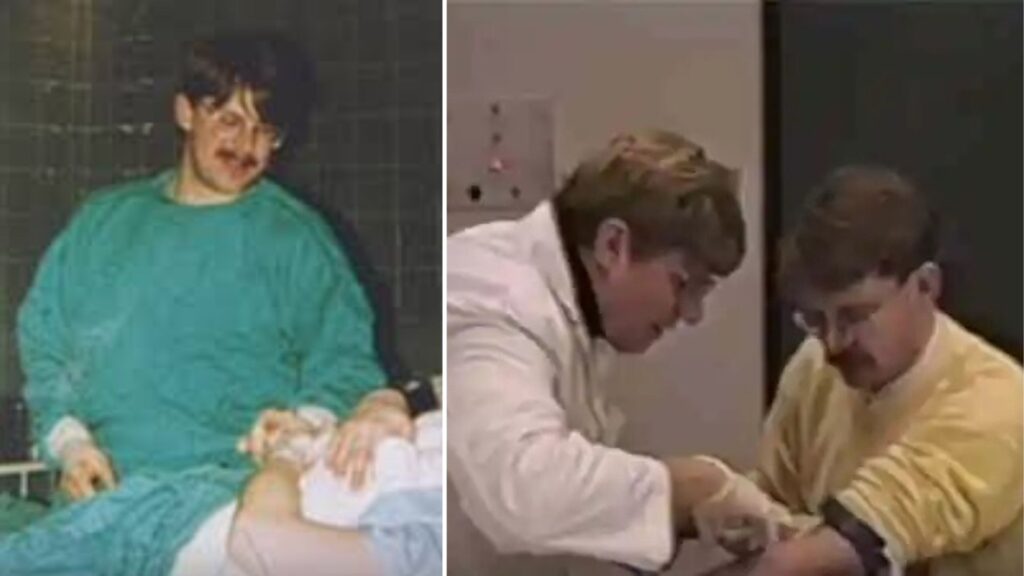
Police moved to the step that can end a case quickly. They asked the doctor for a DNA sample so the lab could compare his profile to the semen recovered from the woman’s clothing. A technician drew blood from his arm and sealed the vial.
The lab compared the semen profile to the blood sample and got a mismatch. Police had a patient naming a doctor and a test pointing away from him. In a town where reputations travel faster than patrol cars, the mismatch changed the tone.
In court, Schneeberger later described how he steered that blood draw. He said he made “an incision on the inside of his left arm” and inserted a plastic tube filled with a male patient’s blood, then pushed the technician toward the “vein.”
The mismatch did not end the woman’s insistence that she had been assaulted. She pushed for another test. Police repeated the process in 1993, and the lab again compared semen to blood taken from his arm and again reported a mismatch.
A police decision followed the second mismatch. Investigators closed the case in 1994. The complainant stayed in the same town and carried the consequences of accusing a popular physician without a lab match to back her up.
While the first complaint sat closed, other allegations surfaced. Prosecutors later laid out a second patient’s complaint in court, saying Schneeberger sexually assaulted her twice, once in 1994 and again in 1995, inside the clinical spaces he controlled.
Those dates mattered because they expanded the pattern and forced investigators to decide what to do with earlier doubts. Police had already seen one case stall on blood evidence. They now faced a second alleged victim describing unwanted sexual contact.
By 1996, investigators took another run at the first allegation and returned to the same kind of sample. A technician drew blood again and forwarded it for comparison. The lab again could not match that blood to the semen recovered in 1992.
The repeated draws came from the same place Schneeberger had prepared. Mail & Guardian later described the practical point the lab work could not see: “a tiny drop from a finger would have sufficed,” but he kept insisting on a venous draw from the spot he controlled.
Investigators eventually changed what they collected. Instead of accepting another vial from his arm, they obtained a hair sample and sent it for testing. The lab matched the hair to the semen, and that match did what three blood draws could not do.
The shift from blood to hair forced the next institutional move. Police charged the doctor. Prosecutors built a case that linked the semen from the 1992 complaint to the man practicing medicine in Kipling and added the later allegations as separate counts.
When the case reached court, the courtroom became the place where procedure caught up with improvisation. Schneeberger sat as a defendant while lawyers walked witnesses through injections, immobility, and the difference between what semen matched and what blood pretended.
Schneeberger did not simply face allegations of sexual assault. Prosecutors also pursued an obstruction charge tied to how he handled the DNA testing. The same action that protected him in the first years became a separate crime once the hair match surfaced.
A judge convicted him in 1999 and imposed a six-year prison sentence. The convictions covered sexual assaults and obstruction of justice, with the court hearing how he had inserted a blood-filled tube into his arm to mislead investigators during testing.
After sentencing, Saskatchewan’s medical regulator moved from suspension to removal. The College of Physicians and Surgeons of Saskatchewan described how it had suspended him while criminal charges progressed, then revoked his licence after the convictions.
On Dec. 8, 2000, the College’s council met with the case still echoing beyond the trial. Minutes from that meeting recorded that the Saskatchewan Court of Appeal had upheld his convictions and the council debated penalty without him present.
A representative told the council that he “can still appeal his conviction to the Supreme Court of Canada but has elected not to do so.” Council members then passed a motion revoking his licence to practice medicine in Saskatchewan.
The end of his licence did not end the case’s spillover into other systems. Family court proceedings and corrections decisions pulled his ex-wife and children into public conflict, with courts weighing visitation while he served time for sexual assaults.
Immigration authorities then treated his status as another question that required its own hearing rooms and lawyers. Officials argued that he had secured Canadian citizenship through misrepresentation by denying a criminal investigation when a citizenship judge asked him directly.
The citizenship fight moved through Federal Court in 2003. A judge granted summary judgment in August 2003, and the Federal Court of Appeal quashed his appeal in November 2003, leaving the government’s position intact as he pushed further.
Schneeberger sought leave to appeal to the Supreme Court of Canada. The docket shows the Court dismissed the application on May 13, 2004, “with costs,” and closed the file later that summer after the paperwork cycle finished.
By June 2004, his immigration status became an in-person decision again. An Immigration Board convened in Regina and moved fast. Mail & Guardian reported the hearing lasted less than 10 minutes before officials labeled him “an undesirable alien” and ordered deportation.
The speed of that hearing reflected how much had already been decided elsewhere. Criminal court had taken his liberty, the medical regulator had taken his licence, and Federal Court had taken his citizenship. The immigration board’s job became removal logistics, not reinvestigation.
Even at that late stage, the mechanics of his deception stayed central because they explained why the system had stalled for years. He had used his medical knowledge to shape the testing environment, down to where a needle entered skin.
He did not need to hack a computer or bribe a technician. He cut his own arm, slid in a blood-filled tube, and relied on normal clinical obedience to carry the fake sample into an evidence bag. The first lab comparisons treated that vial as truth.
The early investigators also faced a choice they could not see clearly at the time. They could accept a venous blood draw from a cooperative suspect, or they could insist on additional sample types. When police later switched to hair, the case reopened.
That sequence left visible gaps. Public reporting does not name the technician who drew blood three times from the same prepared location, and it does not describe whether anyone noticed scarring, swelling, or an unusual firmness under the skin before inserting the needle.
The case also leaves unclear how widely the initial mismatch traveled inside policing circles and whether investigators documented alternate sampling options in the early years. The later match shows the lab could identify him once police collected material he could not counterfeit.
His professional collapse followed him beyond Saskatchewan. Wikipedia and later coverage described him returning to South Africa after removal and trying to re-enter medical practice by approaching the country’s health regulator soon after arrival, then withdrawing the application.
Mail & Guardian’s story framed the end of the Canadian chapter as a simple sentence: he lost the fight against expulsion and the state put him on a path out. By July 2004, he had moved on physically, with the convictions fixed in place.
For a separate investigation, read The Unsolved Killing of Brian Egg. Egg vanished in San Francisco in August 2018. Weeks later, police searched his home, uncovered a concealed room, and found his body in a fish tank, decapitated and missing both hands, a discovery that reshaped the case.
Sources
Mail & Guardian, Supreme Court of Canada, Federal Court Reports, College of Physicians and Surgeons of Saskatchewan, College of Physicians and Surgeons of Saskatchewan, Wikipedia