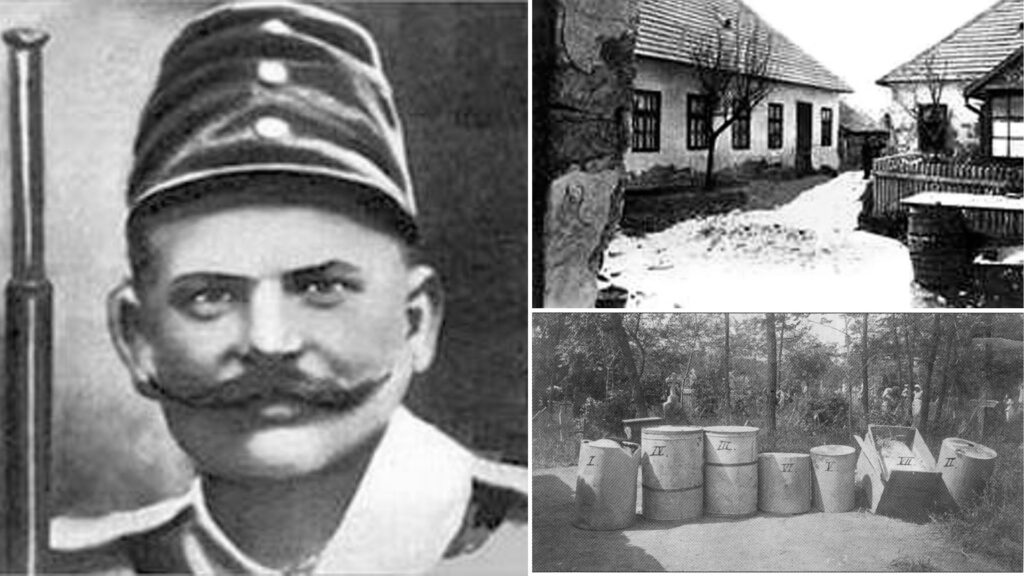
In spring 1916, a rented house on Kossuth Lajos Street in Cinkota stopped being just another workshop. Men pried open a sealed metal drum, and the first thing that hit them was the smell.
The property owner, Márton Kresinszky, had come to renovate and expected stored supplies, not secrets. He and a pharmacist neighbor, Takács, found lead sealed drums stacked near the workshop and hacked a lid open.
Inside was a woman’s body sewn into a sack, preserved but unmistakably dead. When a second drum gave off the same odor and a lock of blond hair fell out, the men alerted local authorities.
A notary and police arrived and ordered every drum punctured and opened. Reports describe seven corpses in those first containers, with more drums nearby, and dark liquid seeping out as the seals broke.
To understand how this happened, start with the place. Cinkota was a small commuter settlement outside Budapest, with wartime manpower shortages and limited policing, even as residents moved daily between village life and the city.
Béla Kiss worked there as a tinsmith, a skilled trade that fit the neighborhood’s practical rhythm. Sources place him in the area from around 1900, later linked to a property at 40 Kossuth Lajos Street.
He also had the reputation every fraudster wants. A 1907 profile in Magyar Nemzet described him as reliable, not in debt, and safe to extend credit, the kind of description that lowers suspicion for years.
His personal life adds another layer. Records say Kiss married twice and had two daughters, Aranka and Ilonka. Hungarian accounts identify Júlia Peschadik as a long term partner and the children’s mother.
In 1912, after a wife reportedly left him, he hired a housekeeper, Mrs. Jakubec. She later told investigators she saw constant letters and occasional female visitors, but she claimed she never learned their names.
Kiss cultivated harmless eccentricity. Neighbors remembered him as polite and well read, with an interest in astrology and occult ideas, traits that can register as quirky rather than dangerous in a quiet suburb.
The drums were visible enough that townsfolk asked questions. Kiss told local police they were filled with gasoline, stockpiled for rationing if war came, an explanation that sounded practical when Europe was bracing for conflict.
What pulled women to Cinkota was paper and ink. Investigators found letters dating back to 1903 and evidence that Kiss placed ads in newspapers as a marriage broker, sometimes also offering fortune telling.
Later summaries describe him using the name Hoffman, presenting himself as a lonely widower or bachelor with stable work. The women who responded were often described as middle aged, financially comfortable, and socially isolated.
Police believed he selected victims with few local ties. Letters suggest he probed for relatives and family distance, then focused on women whose disappearance would not quickly trigger pressure on Budapest police.
Money shows up repeatedly in the correspondence and in later reporting. Some women sent large sums as proof of commitment, and at least one case involved a woman selling her business before traveling to meet him.
The investigation also surfaced formal complaints. Sources say two women took Kiss to court for taking their money under marriage promises, then vanished, causing the cases to collapse when the plaintiffs failed to appear in court.
How did the scheme turn lethal? Accounts describe women arriving in Cinkota with luggage and cash, then disappearing within days. Investigators reconstructed who traveled by matching letters with missing person files.
Neighbors later recalled a pattern. A visitor arrived, shutters went down, and the night passed behind closed blinds. People remembered Kiss escorting women from the station to his house, then not seeing them again.
Across sources, the stated cause of death is strangulation. Some accounts say a rope was used, and pathologists recorded neck marks on the seven recovered bodies. Several reports say cords remained tied.
Preservation made the discovery stranger. Bodies were described as naked or partly clothed, packed into sacks, and submerged in liquid described as alcohol or methanol, also called wood alcohol, which slows decay.
Why keep bodies on site? Airtight drums reduce smell, and preservative liquid buys time. Storage through seasons suited someone commuting to Budapest, running a shop, and arranging visits without a sudden crisis.
His trade helped him hide. As a tinsmith, he shaped metal, soldered seams, and sealed joints, the skills needed to make drums watertight. Reports describe lead sealed lids, and those details match a craftsman’s work.
Hungarian reports identify Varga Katalin, a cook who disappeared and was recognized after the drums were opened. A witness described her habit of carrying saved cash, a detail that strengthened the robbery theory.
Another drum held Júlia Peschadik, described as Kiss’s partner and mother of his two daughters. Accounts say the girls were placed with the White Cross charity. Her letters later described fear and pressure at home, then stopped.
Tóth Margit appears in Hungarian summaries as a 37-year-old woman who gave Kiss money and left for Cinkota expecting marriage. Her earlier fraud complaint was reportedly shelved when she disappeared, a sign that paperwork failures protected him.
Kukán Katalin was among the victims from whom money was taken. Hungarian accounts say Kiss told searchers she had gone away pregnant. A 16-year-old cook, Händler Mária, was also found among the seven bodies.
Once officials grasped the scale, Budapest detectives took over. Sources describe detective chief Charles Nagy arriving, ordering drums opened, and recording what was inside. Local officials handled crowds of relatives who came to identify bodies.
Victim totals still shift by source. Seven drums were opened first, and investigators later reported more containers around the property. Many summaries cite 24 bodies, while some reports raise the total closer to 30.
Hungarian accounts say investigators weighed empty and full drums to see whether one person could move them. The exercise mattered because the barrels were heavy, and it raised an unresolved question about whether Kiss had help.
Inside the house, evidence shifted to paperwork. A locked room, which Mrs. Jakubec said she was forbidden to enter, held books on poisons and strangulation and a desk arranged like a filing cabinet.
Sources describe the desk containing correspondence packets for 74 women, plus photographs. The oldest letters dated to 1903, setting a timeline. Detectives used those names to cross-check missing person files and identify victims.
The letters show his reach. Some sources say he received about 174 proposals and promised marriage to more than 70 women. That network let victims vanish without neighbors linking names to faces.
Mrs. Jakubec’s role stayed unclear. Police suspected her because she lived on the property and was named in Kiss’s will. She denied involvement and guided investigators to the locked room, saying she had never entered it.
Hungarian reporting records small confrontations. A witness said she noticed missing women’s scarves in Kiss’s cupboard and asked about them. Kiss told her not to pry, and the items vanished the next day.
World War I gave Kiss a clean exit. He was conscripted in 1914 and left the house in Jakubec’s care, pushing any search into military channels. Wartime shortages and chaos drained attention from missing women reports.
Detective chief Nagy pushed the hunt into official channels. He notified the military to arrest Kiss if found and asked postal services to intercept letters that could warn him. Police forces across Hungary were alerted.
The case then tangled with contradictory paperwork. Hungarian sources discuss an official report that a soldier named Kiss Béla died of typhus in Serbia in February 1915, while other documents and later reporting suggested he survived longer.
On October 4, 1916, Nagy received word that Kiss was recuperating in a Serbian hospital. When he arrived, the man in the bed was dead, and the patient was gone, implying a substitution that bought Kiss time.
Later reporting gave the case a vampire nickname. Police noted puncture marks on some necks and claimed bodies were drained of blood. Other accounts describe dark fluid seeping when barrels were punctured, but preservation and decay complicate interpretation.
After the hospital escape, sightings replaced evidence. Kiss was seen in Budapest in 1919. In 1920, a Foreign Legion member flagged a legionnaire named Hoffman who fit his description, then vanished before questioning.
Rumors placed him in Romania, Turkey, and the United States, without proof. In 1932, detective Henry Oswald said he saw Kiss at Times Square. Police chased a janitor tip, but it went nowhere.