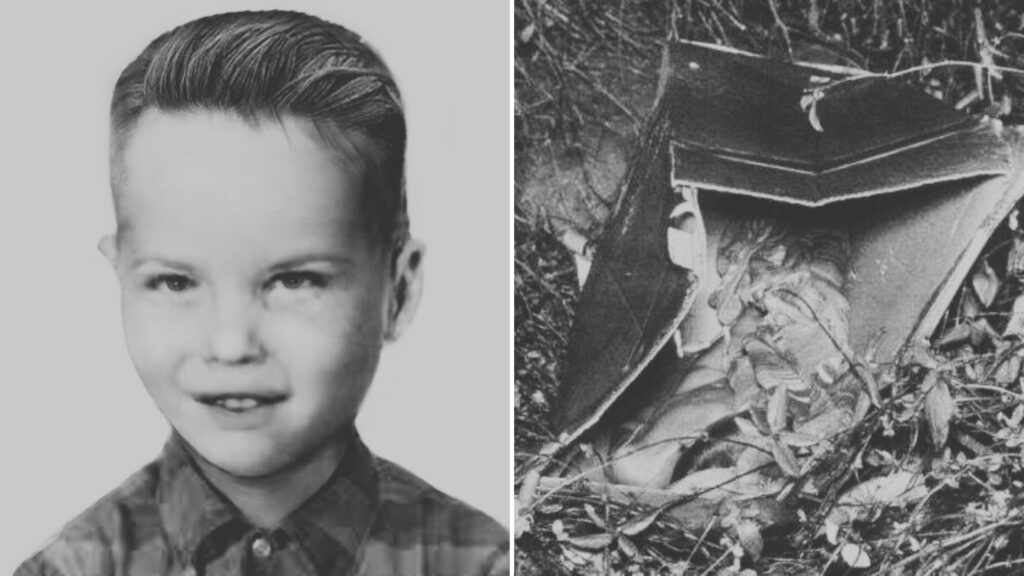
It took around 66 years to give a name to “Boy in the Box”, a homicide victim who was discovered in gruesome circumstances. Joseph Augustus Zarelli was just 4 when his body was found nude and malnourished, stuffed inside a cardboard box.
The case is said to be “the longest continuously investigated homicide in the history of the Philadelphia Police Department.” In the course of those dreadful years, during which Joseph’s case remained open for investigation, authorities chased a thousand leads that led nowhere.
Boy in the Box: A Chilling Find in Philadelphia
On February 25, 1957, a young man discovered a body in the woods off Susquehanna Road in the Fox Chase neighbourhood of Philadelphia. Although the body was initially found on February 25, it was not reported on the same day.
The young man who is said to have discovered the body was near the area to check his rabbit traps, and because he feared his traps being confiscated by the police, he did not call the authorities after the horrific sighting.
It was only a few days later, when a college student spotted a rabbit running into the underbrush near the area, that the body was actually discovered and reported.
The said body was stuffed inside a large rectangular cardboard box. The box was placed on its side in a tangle of underbrush, with one end open. From where the box was opened, a small head and shoulder stuck out.
The cardboard box had once contained a bassinet of the kind sold by J. C. Penney.
The victim was around 40 inches tall and weighed 30 pounds. He had a full set of baby teeth, which helped identify his age. He was said to be between 4 and 6 years old. He was deeply malnourished. His body was nude and badly bruised.
The body was wrapped in an Indian-patterned blanket of rust and green colour. His hair was blond and cut short. Since the hair clippings were found on the body, it was concluded that the hair was cut after his death, possibly to conceal the boy’s identity.
Apart from the hair, his nails were also trimmed.
The body was bruised all over, but mainly the injuries were inflicted on the head and face. There were also seven scars on the body, three of which could have resulted from surgical procedures. Two of the scars were on the chest and groin. Although they appeared to have healed.
Another scar was found on his left ankle. It looked like a “cut-down” incision. It resembled an incision usually made to expose a vein so that a needle may be inserted for an infusion or transfusion.
The scar on the left side of the chest was 1 and ½ inches long. On the left elbow, there was a round, irregular scar. An L-shaped scar was found on the chin, which was an inch long in each direction. No vaccination scars were found on the body.
His right hand’s palm and soles of both his small have become rough-skinned and wrinkled. It led to the discovery that just before or after death, one hand and both feet had been submerged in water for an extended period of time.
Posters, Fingerprints, and Clues That Led Nowhere
The authorities opened an investigation on February 26, 1957. Fingerprints and footprints were obtained and compared against hospital birth records and other medical files. The exhausting search for identity lasted for a long time.
The case soon became a nationwide sensation, and alerts were broadcast to all 48 states. Reporters started calling him “The Boy in the Box.”
During autopsy, blood and other body fluids, hair, gastric contents, and tissue samples from vital organs, including the heart, liver, and lungs, were extracted for toxicologic analysis and microscopic examination.
The Philadelphia Inquirer printed 400,000 flyers to help identify the victim and give them a name. The public could find these flyers at every street corner, hung in shop windows, and enclosed with every gas bill.
The authorities checked neighbourhoods, orphanages, foster homes, and hospitals, desperate to find a lead, but no one came forward. Around 270 police academy recruits went through the crime scene again and again.
The recruits found a man’s white handkerchief with the initial G in one corner, a tan, child-size scarf, a boy’s yellow flannel shirt, size four, a pair of black children’s shoes, size 1, a torn, stained piece of blanket, and a dead cat wrapped in a man’s grey sweater.
The clothes are said to have belonged to the victim. The authorities also distributed a photo of the victim postmortem wearing the found clothes.
Leads That Haunted “Boy in the Box” but Failed to Hold Up
While the case initially attracted many leads, two stood out from the rest.
In 1960, an independent investigator started investigating a particular foster home. With the help of an elderly psychic from New Jersey, the investigator, Remington Bristow, tracked down the foster home. Although the family that ran the foster care business moved away in 1961.
The said foster home was opened by Arthur Nicoletti and his wife, Catherine Nicoletti. It ran from 1956 to 1959. Although the house was unlicensed, it accommodated around 25 children at a time.
Catherine also had an adult daughter from a previous marriage, called Anna Marie Nagle, with intellectual disabilities. She was also a part of the foster home and had four children, out of which three were stillborn.
The foster home was later closed up and put for sale. During a preview of an auction of its furnishings, Bristow spotted a bassinet similar to the one sold by J.C. Penney. It was old and dusty, sitting in the basement.
The investigator also found plaid blankets hanging on a clothesline that had been cut in half. Another clue that put the foster home on the radar was a duck pond on the property. However, even with repeated attempts, the Philadelphia police refused to reinvestigate the family.
Then, finally, in 1984, two homicide detectives reluctantly agreed to interview Arthur Nicoletti at his home in Dublin, Bucks County, PA. When the interview led nowhere, Bristow urged Nicoletti to take a lie detector test.
The request was denied by Nicoletti. But because Bristow was convinced that the family had something to do with the victim, he came up with a theory. He concluded that the victim may have actually been an illegitimate son of Anna Marie Nagle.
The suspicions were strong because after the death of his wife, Arthur Nicoletti married his stepdaughter. In 1988, Bristow also tried to connect with the doctor who had treated the children at the foster home.
He was successful in locating the doctor’s wife, but to his dismay, the records were destroyed after the death of the doctor. Although Bristow tried his hardest to come up with some solid evidence, he failed miserably every time.
The foster home angle was explored many times, even after Bristow passed away, but no direct link was found.
The second-largest lead came from a businesswoman in Cincinnati, Ohio. In February 2002, “M” contacted investigators through her psychiatrist. The woman claimed that her mother purchased an unknown boy from his parents in 1954.
She said that her mother subjected the boy to extreme physical and sexual abuse for two and a half years. The boy was then killed in a fit of rage. The woman said that the victim was slammed to the floor, after which he vomited in the bathtub.
“M” had previously told all of this to her psychiatrist in 1989, but refused to disclose it to the authorities. In May 2002, “M” was interviewed by Philadelphia detective Tom Augustine, accompanied by Vidocq Society investigators Joseph McGillen and William Kelly. The interview lasted 3 hours.
According to “M”, the name of the boy was Jonathan. She described the boy as mentally handicapped, very frail, and mute. She stated that her mother would regularly sexually abuse her and the boy. Neither was the boy allowed to go out, nor did he have any visitors.
She narrated the entire incident, and her statements closely match the confidential testimony of an anonymous male witness who originally reported it in 1957. Not only were the investigators impressed by the testimony, but the entire witness record sounded believable; there was just one issue: a lack of evidence.
“M”, as described by her psychiatrist and neighbours, had a history of mental problems and was capable of fabricating the entire story. The Philadelphia police department also launched an intensive follow-up investigation to verify the account of the statements.
Even with 6 months of extensive investigation and thorough searches, no corroborating evidence was found.
Approximately 150 tips were called in response to the special Boy in the Box segment shown on the America’s Most Wanted program. Another 8 tips were received by the Philadelphia Homicide Department.
Even with regular leads, nothing seemed to work.
The Day America’s Unknown Child Finally Got A Name
Decades after the boy was discovered, the Philadelphia police obtained a court order to exhume his remains. This was the second exhumation in the case’s history. The exhumation helped obtain higher-quality DNA samples, which were better suited to modern forensic techniques.
62 years after the burial, the remains of the victim were examined by the forensic anthropologist Dr Arthur Washburn. The samples were extracted from the bones and teeth to create a comprehensive genetic profile. These were then processed by the Philadelphia Police Department’s Office of Forensic Science.
The updated DNA profile was uploaded to the Combined DNA Index System (CODIS), the FBI’s national database. Unfortunately, there were no immediate matches. The profile was also uploaded to public genetic databases.
Around 2020, investigators voluntarily matched the DNA to the DNA that had been voluntarily submitted. Some initial matches were found with third- or fourth-degree cousins, which provided the investigators with a bunch of potential relatives.
Finally, after 66 years, investigators found light at the end of the tunnel in 2022 when the DNA of the victim matched that of an individual. This proved to be a closer genetic match, accelerating the identification of the victim.
With the help of a comprehensive family tree, it was easier to identify the victim’s parents: Augustus John Zarelli and Mary Elizabeth Abel. To verify the victim’s identity, the Philadelphia Police Department consulted the birth records.
They finally found Joseph Augustus Zarelli there. He was born on January 13, 1953. He was just around 4 years and one month old at the time of his death in February 1957.
Joseph was born in Philadelphia, Pennsylvania, and registered under his father’s surname, Zarelli. No immediate adoption records were found in the statistics. Joseph was said to have born out of wedlock.
The victim has no full siblings but multiple half-siblings on both the maternal and paternal sides. The police department did not disclose information about the siblings.
Unanswered Questions, Lingering Theories, and a Search for Justice That Continues
After the “Boy in the Box” got a name in 2022, the theories that were previously discussed were ruled out. After Joseph was identified, the authorities concluded that the Nicoletti family had no connection with him. Even the lead from “M” was ruled out after the victim was identified.
Joseph was buried before his identification, around 5 months later, when he was found, that is, on July 24, 1957. The burial took place in Philadelphia’s Potter’s Field, on the former grounds of Byberry State Hospital. He rests in Grave 191 at a public burial site reserved for unclaimed deceased individuals.
Before the identification, he had a simple headstone which read, “Heavenly Father, Bless This Unknown Boy, February 25, 1957.” Over the decades, the boy had several visitors who left flowers, toys, and notes.
After the identification, a new headstone was placed at Ivy Hill Cemetery in Philadelphia, where Joseph Augustus Zarelli was reburied in 1998 following exhumation for forensic testing. The replacement of the headstone was a breath of relief for the investigators and the general public.
In December 2022, the Philadelphia Police Department continued investigating the case and contacted the half-siblings on both the maternal and paternal sides. Interviews were conducted, and the family tree was examined to obtain potential insights into the victim’s early life.
The DNA obtained from the family confirmed the biological evidence for identification; however, no information was found specifically about Joseph. Some family members also confirmed that Joseph may have been given up for adoption; however, no formal records were found supporting the claim.
The victim’s identification was made public on December 8, 2022. During the press conference, the police commissioner urged the public to submit tips on the victim’s whereabouts. A $20,000 reward was also offered if the information was actionable.
The helpline attracted a bunch of calls, but nothing made it to a full-fledged investigation.
The investigation is currently in progress. The latest update in November 2025 stated that no arrests had been made and that no suspects had been publicly named by the police department.
Although the investigators identified the “America’s Unknown Boy”, justice is still far away. Joseph remains a 4-year-old whose killers are yet to be found.