This article contains detailed descriptions of sexual violence, rape, harassment, extreme physical violence, mutilation, murder, self-harm, and a graphic vigilante killing. Some passages include threats of assault and disturbing testimony from survivors and witnesses
“Mahishasura had a boon. No man could kill him. He was immortal… or so he thought.”
13th August 2004. Two days before Independence Day, the residents of the Kasturba Nagar slum had a festival of their own. There was dance and music on the streets, mutton cooking in the kitchens, and joy in the air. The reason? Bharat Kalicharan Yadav… a.k.a Akku Yadav.
How Akku Yadav built his early reign of fear in Kasturba Nagar
Akku Yadav was the son of a milkman. He was from an upper-caste, well-to-do family… at least compared to the rest of the lower-caste residents. In Kasturba Nagar, well-to-do meant he got two square meals a day. He didn’t have to struggle to survive. But the neighbourhood was infested with gangs and criminals. So a young Yadav still gravitated to a life of crime. He started with low-hanging fruit. Extortion.
“He would threaten us all. If we did not pay, he would threaten to come armed.” A woman said in a CHRI (Commonwealth Human Rights Initiative) report.
Pratibha Urkude was one of Yadav’s first victims. She ran a grocery shop with her husband, Dattu. He would take things from the shop and refuse to pay, or pay very little. Sometimes he even demanded money. Inability to pay was met with violence.
Leela Kumbhalkar, a shop owner in the slum, recounted the day he robbed her of everything.
“I’d kept my stock at the back of the shop. One afternoon, he loaded all my stock in an auto and a truck and sold it off. That man took away my entire life’s earnings, made me completely poor and helpless. I sat under a tree for three to four hours. I was completely numb”
Meena Gajbhiye, a local resident, had once accused him of stealing a watch from her home. Insulted by the accusation, he thrashed her husband. In his fury, he grabbed a glass jar and slammed it. One of the shards cut his own hand, and it started bleeding profusely. The walls of Meena’s home were stained at the spots where he wiped his blood.
This was just the beginning of his oppression. One dreadful day, he got a taste for something much worse.
In 1991, he and his gang were wasting time away at a construction site. They found a couple there. The initial plan was to extort and steal whatever the guy had. Then Akku Yadav noticed the girl. Ideas began to form in his twisted mind. Lust dripping from his eyes, he cornered the girl with heinous intentions. Soon, the whole gang joined. They violated her together.
Vilas Bhande (co-accused in the gangrape) said in a documentary,“In that tussle, the complainant (the boy) escaped and ran to Koradi Police Station. A criminal case was filed under Section 354 for molestation.”
It was Akku Yadav’s first recorded crime. The first time he saw the inside of a jail cell. But it wasn’t the end. The predator had tasted blood, and he would soon get out of jail.
As per IPC Section 354 (BNS Section 74), convicts are supposed to serve at least one year in prison. But Akku Yadav got out in only a few months, reportedly on the basis of ‘good behaviour.’ The peace in Kasturba Nagar was short-lived.
After his release, Akku Yadav built a rap sheet of several cases. Despite his criminal record, he continued to torment the locals. It seemed he had a boon. The authorities couldn’t touch him.
Actually, he’d bribe the authorities with money, alcohol, power and other incentives. As per a court judgement, the Jaripatka Police were ‘hand in glove’ with Akku Yadav. They protected his illegal activities. Most of the residents were lower caste, so the police turned a blind eye to their complaints. Spurred on by the authorities’ inaction, Yadav became a nightmare for the locals.
Why the police allegedly failed to stop Akku Yadav in Kasturba Nagar
Akku Yadav’s return laid the foundations for two of his most heartless murders.
One of them was Asha Bhagat, a local with an alcohol business, catering to slum residents and criminals. Bhagat was a strong, opinionated woman. She was the only one in the slum with the guts to stand up to Yadav. A thorn in his side.
Once, with a few other goons from the slum, she planned to finish him off. The goons met him under the guise of a drinking session. Once Yadav was drunk and starting to get incoherent, they took their chance and started hitting him and stabbing him. Somehow, despite being under the influence, Yadav escaped… with serious head injuries and bleeding.
Avinash Tiwari, a local, good-natured man, had donated blood to Bhagat during his recovery. Naturally, they formed a close friendship. According to his aides’ testimony, he felt quite possessive of his saviour and friend. Tiwari used to mix with the locals and keep good relations with them. Yadav didn’t approve. Naturally, when his friend started frequenting Bhagat’s house, he confronted him and asked him to stop interacting with the lady.
When Tiwari refused, Yadav returned with a knife. It was a folding knife, so he held it in his mouth and pried it open with his teeth. With one strike, he stabbed Tiwari. Yadav ended his life – right there on the street, in clear view of onlookers and bystanders. Like he wasn’t afraid of the consequences. The corpse of his saviour/friend lay there in a pool of blood.
Resha Raut, the sister of Asha Bhagat, witnessed the cold-blooded murder. “I stood there stunned. I had never seen a murder before, and it took me a while to register that he had just killed him,” she said in an article. This wasn’t the last murder Raut would witness.
In 10 months, Yadav was released from jail. It would be an understatement to say he came back with a vengeance.
On the night of June 8th 1999, Megha (Bhagat’s 14-year-old daughter) was applying Mehndi on her mother’s hands. Doors and windows were closed after sunset, as was usual practice in the slum.
So when Bhagat suddenly heard a knock on their door, she went to check. Little did she know, the demon of Kasturba Nagar stood in wait. The moment she opened the door, Yadav grabbed her by the hair. He then slit her throat, cut off her ears and breasts right in front of her daughter.
That morning, the rising sun brought unsettling light. A deathly silence hung over the whole of Kasturba Nagar. None of the residents had ever seen such a ghastly murder. In the years to come, the grotesqueness continued to haunt them.
“Akku Yadav forced a man to dance naked in front of his teenage daughter.”
“He chopped one woman into pieces in front of her daughter.”
“Another woman burned herself to death after he and his men gang-raped her.”
These are just a few incidents the residents of Kasturba Nagar have divulged in a book. Akku Yadav went on to build a rap sheet of 26 such recorded offences.
Because of his criminal activities, Yadav was persistently paranoid. He wouldn’t let groups of people gather or talk in the street, and he wouldn’t let boys play together. He’d warn the locals not to inform the police about him and remind them of the consequences. He was even suspicious about outsiders asking questions, ‘cause he always felt they were about him.
People were afraid to speak to the authorities for fear of his wrath. This was the terror Akku Yadav had instilled in them. As if even the breeze in Kasturba Nagar was afraid to rustle any leaves. This reign of terror would have continued had it not been for one of Akku Yadav’s methods of silencing people. Rape.
It was Yadav’s primary way of keeping people silent. Threats proved ineffective after a point, and murders were too alarming for the authorities to ignore. But a raped woman and her family would never go to the police because of social stigma. On record, Akku Yadav raped 24 women, but the allegations take the count to over 40.
In one account, Akku Yadav knocked at a married couple’s door at 4-5 am in the morning, announcing himself as a police official. When the woman opened the door, he barged in. He stabbed the husband in the thigh and locked him in the bathroom. Now unobstructed, he grabbed the woman by her hair and dragged her to an unknown place, raping her for 3-4 hours.
The monster didn’t have any fetters. Old woman, young woman, or even a child – Yadav wanted them all. It’s evident in what happened to Kalma.
Kalma was a newly married woman in Kasturba Nagar. She’d just given birth to her first child. She was very vulnerable. And yet 10 days later, Yadav barged into her home with his aides. All of them gang-raped her brutally. The incident broke her completely. So much so that she poured kerosene onto herself and burned herself alive.
Resha Raut, the sister of Asha Bhagat (whom Akku Yadav killed and mutilated), expressed the air of fear in a report. “Like many women, I, too, stopped going out of the house altogether. No marriage proposals for women from Kasturba Nagar ever got accepted. There were no relatives coming from or going to anyone’s house or any celebrations taking place.”
Fear in Kasturba Nagar had reached a flashpoint. All it needed was a spark. And that spark came in the form of Usha Narayane.
How Usha Narayane challenged Akku Yadav in Kasturba Nagar and triggered his downfall
Usha Narayane was one of the few educated women in Kasturba Nagar. She was studying hotel management. Coming back from the institute, she’d get harassed by Yadav. He would often catch her alone on the street and make comments about her uniform (a skirt and blazer). Her education and headstrong nature already stuck out to him like a sore thumb. But then a singular incident triggered him to do something about Narayane. That was the beginning of Akku Yadav’s downfall.
One night, Narayane woke up hearing some commotion. She shifted a brick from one of her walls to peek. Nothing inside the house was visible. All she could see was Akku Yadav and his men standing outside her neighbour’s door. One by one, the men went in and came out. It didn’t take a genius to understand. She was being raped.
“The lady came to me, asking, ‘What should I do?’ I told her to lodge a complaint. When she didn’t follow my advice, I took her to the police station myself. And when we reached, no one even took our complaint.” Narayane said in a public talk.
The officers were likely on Yadav’s payroll. Akku got wind of this and descended on Usha’s home with 10-12 goons armed with Bagh Nakhs (tiger-claw weapons) and swords.
At 6 pm, it was normal for doors and windows to be shut. Since Akku had no way to get in, he started his assault with a barrage of curses. “We’ll grab you, tear your clothes, gangrape you, throw acid on your face and cut you up into pieces… so everyone can see what we can do.”
At that time, Narayane was living with her younger brother, her parents, her older brother and his wife and kids. Afraid for her family’s safety, she tried to sneak them out the back door. But Yadav’s men were already waiting there. Having no other choice, she locked them in a room on the back side of the house.
Backed into a corner, she remembered her production manager’s advice, “Make the best use of what you have at home.” That advice was about food, but it applied to her situation. One look at her gas cylinder and she knew what to do.
Moments later, Akku Yadav heard a threat which appealed to his survival instincts. “Akku, come in now. The moment you break the door, this house will be blown up, and with it, you will die too.” That was the first time Akku backed off. And onlookers saw that too. They sensed his fear.
On 6th August 2004, residents of the Kasturba Nagar slum spurred action. They registered a mass complaint at the police station, signed by several members of the slum. Then the mob headed straight to Akku Yadav’s house looking for him. Unable to find him, the mob thrashed his belongings and destroyed his house. For the first time, the demon was truly afraid. The next day, he surrendered to the police. For his own protection.
How Akku Yadav was killed in court on 13 August 2004 in Nagpur
Since being detained, Akku Yadav has appeared in court three times. Usha Narayne, along with her brother-in-law, Vilas Bhande, went around the slum campaigning to wake people up. “If you don’t step out now, you will never be able to step out.”
The residents knew – once the heat cooled, Yadav would be out on bail. The demon hadn’t given up. He was only hibernating.
On 8th August, before one of his hearings, Yadav had his aide deliver him a hidden knife. But the slum residents gathered there sensed the ploy. They beat up the aide and turned him over to the police. All of Kasturba Nagar was on high alert. They couldn’t be careless this time.
It was announced that on 13th August 2004, Akku Yadav would be produced in court for a bail hearing. The people couldn’t afford a judgment in his favour. And they didn’t trust the system to do the right thing. So a plan started cooking. Weapons were gathered. Activities were coordinated. All residents had a single motto: Kill or be killed.
Around 200 angry people from the slum showed up at the court. Yadav was being brought to Court No. 7 when around 12 women and 30 men blocked the gate. They started abusing Akku Yadav. When he spotted one of his former rape victims, he called her a prostitute and threatened to rape her again. Alas, his last words were as obscene as his life.
The police soon took him inside the courtroom and closed the doors. But the angry mob managed to break down the northern door. They overpowered the police protecting Yadav, and started assaulting him with knives, spearblades, Guptis (concealed swords), stones and glass.
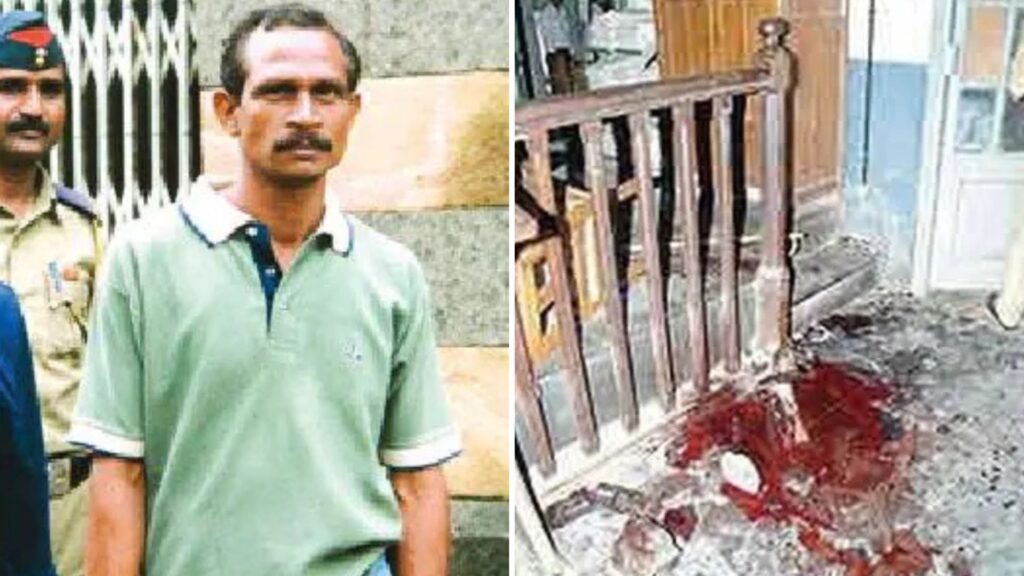
According to the court judgement that details this, Akku Yadav fell onto the dias, slain, lying in a pool of blood. The wall, benches and the almirah of the courtroom no. 7 were stained with the blood of the Demon of Kasturba Nagar.
This whole incident is a parable. A reminder of feminine strength, and a war-cry against those who dare look at women the wrong way. It is a testament: no matter how great an evil, it can be thwarted. All it needs is a spark of courage!