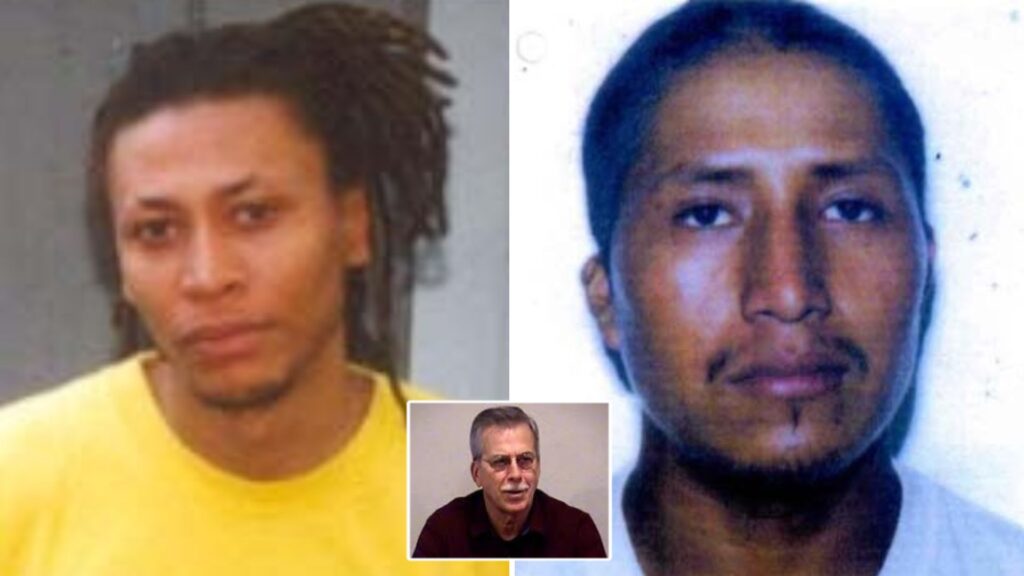
Two men entered the patrol car, and the two differed in terms of their backgrounds. Home never saw either of the men again. The last people to see them were Deputy Steven Calkins.
What happened when Felipe Santos got into Deputy Steven Calkins’ patrol car in 2003
Felipe Santos was the first one to vanish on October 14, 2003. He was twenty-three years old and was employed in construction. He was a Mexican immigrant in Immokalee. He supported his family with all his paychecks.
There was a minor road accident at 6.30 am. Felipe took his brothers to a working location that morning. They crashed into another vehicle close to the Greentree Shopping Centre. This minor incident led to irreversible losses.
Deputy Calkins reported to the fender-bender. He found out that Felipe did not have a legitimate driver’s license or insurance. Calkins put Felipe in handcuffs and restrained him in the backseat. He informed the brothers that he was going to jail.
“I am going to put him in the county jail”, Calkins told the party. The cruiser was heading south, being observed by the brothers. The initial stage was to collect bail money and take it to the facility. Hours were spent at the booking desk.
Felipe Santos was not registered with the jail staff. There was no paperwork on that day regarding the arrest. Calkins did not do an official report of the accident. Felipe disappeared without a footprint in law enforcement.
Later, Calkins said he had reversed his statement about the arrest. He told investigators he left Felipe at a Circle K store. He claimed that Felipe was correct and obedient when he was riding around. This was the sole defence he could make in respect to the disappearances.
What witnesses saw when Terrance Williams was taken from the smoking Cadillac in 2004
Three months went by, and no trace of Felipe Santos appeared. Most North Naples residents went on with their lives. On January 12, 2004, Terrance Williams met the same deputy, however. Terrance was twenty-seven and was employed at a Pizza Hut.
Terrance was a driver of a white 1983 Cadillac with mechanical problems. His automobile started smouldering next to the Naples Memorial Gardens cemetery. He pulled aside and stopped. The cemetery was filled with witnesses who were observing the action.
Behind the halted Cadillac, workers observed a patrol car. This officer was named Steven Calkins. Calkins asked the car drivers to let him leave the car. He then took Terrance to the back of his truck.
Calkins drove away with Terrance in the backseat. He went back to the same cemetery forty-five minutes later. He went away with the Cadillac in another location. He never took Terrance to any police station or hospital.
The same evening, Marcia Williams discovered that her son was missing. Terrance was a good father to four kids. He talked to his mother daily. Marcia was awakened in terror by his silence.
The Cadillac was located at a local tow yard by Marcia. The tow report listed Deputy Calkins as the authorised officer. She dialled the Sheriff’s Office, attempting to locate her son. They informed her that Terrance had never been arrested or booked.
Marcia inquired of the department on numerous occasions. She started to make her own inquiry on the Naples streets. She spoke with the cemetery personnel who witnessed the event. Their narratives confirmed the fact that Calkins was the last contact.
Why the Circle K drop off story and dispatch tapes made Deputy Calkins a focus
Calkins had denied him a previous knowledge of Terrance Williams. This was later changed when he faced the two records. He alleged that he drove Terrance to a Circle K gas station. The same he had told about Felipe.
Internal affairs detectives began recording Calkins’s statements. Their perceptions of his speeches and texts they found were full of contradictions. Calkins discussed the homie-cadillac in tape-recorded communications. He adopted a sarcastic and violent tone.
Calkins told him against it on the tape, saying he was going to “take him to jail or whatever”. He was laughing and told dispatchers about the encounter. He was sounding impatient with the young man. “Maybe he’ll come back to the cemetery. He’ll come back, and his car will be gone.” This comment turned out to be the most haunting piece of evidence in the investigation.
Additional questions were provided by the patrol car’s GPS vehicle records. During the period when the two men disappeared, Calkins was non-descript. He alleged he had been at certain places that were not determined in his notebooks. The physical evidence contradicted his personal testimony.
The Sheriff’s Office conducted an intensive search of the cemetery. They sniffed cadaver dogs on the soil and the woods. They sought out the canals and swamps around the area without any traces. All searches yielded no physical evidence.
Calkins underwent three polygraphs as part of the internal investigation. The findings indicated tendencies toward deception in the three attempts. He gave wrong answers to questions about where the men were. He could not answer questions concerning the truthfulness of the stops.
In 2004, the department terminated Steven Calkins for his lack of candour. They referred to him for not adhering to procedure and for his contradictory narration. He went on to quit the force and thereafter transferred to Iowa. He was not charged with any criminal violation.
Williams was also declared legally dead in 2009.
How Tyler Perry Ben Crump and social media kept the Felipe Santos and Terrance Williams case alive
Anderson Cooper did an episode on it, and CNN posted an article on it.
Between 2001 and 2004, Calkins did not arrest a single individual until he was fired. It happened one day in 2001, 14 years into his career, he simply stopped.
He authored nearly 400 incident reports, and it is obvious by the fact that he was arresting people in the sense that he got them into his patrol car, but not a single one of them ever made it to jail. There has been no known person besides Terrance Williams and Felipe Santos who entered his patrol car during that 3-year period, but neither was latched into the local jail facility.
He also wrote about one traffic ticket every month, which is quite peculiar for a road patrol officer. Even with all this, his superiors did not actually appear to notice or care. In June 2003, it was documented in an article that earlier the same year, one of the supervisors wrote that “Calkins met the standard in numerous categories, including apprehending and booking suspects.
Marcia Williams represented both families. She organised marches and contacted national media outlets. She did not want to accept the silence of the Collier County authorities. This tenacity made her a national scandal in a local case.
It was decades of unproductive investigation that she kept the case alive. That is why she reached out to the Santos family so that they would remember their son. They shared a bond of grief.
In 2012, Tyler Perry took part in the cause of justice. He heard about the story on a news piece, and he was motivated to do something. He offered a $100,000 reward for information on the men. He subsequently increased it to $200,000.
Perry took advantage of his huge following to call for a new inquiry. He was featured on the national television shows with Marcia Williams. He named the disappearances a gross miscarriage of justice. He accompanied the families to every social gathering. He put Naples in the national media spotlight.
Perry was on “Good Morning America” with Marcia Williams. He demanded a fresh examination of this case against Calkins. He was represented, together with civil rights lawyer Ben Crump, alongside the families. Their participation drew the world’s attention.
This, said Perry, if it were a coincidence, would make him the most unfortunate man in the world. He marked on the statistical impossibility of losing two men together with one deputy. He wondered why Calkins was not taken as a major suspect.
The entertainment tycoon created a documentary series titled ‘Never Seen Again’. Williams and Santos featured in this series. It enabled the mothers to give their experiences to the world. The families’ support was a wave on social media.
In 2018, the case was picked up by civil rights attorney Ben Crump. He sued Steven Calkins for wrongful death. This legal action was supposed to lead Calkins to a deposition. Crump sought the truth regarding the penalty for perjury.
Crump said, “We always stand up and say Black Lives Matter when individuals are murdered. We also need to do the same when they are black and missing.”
In 2020, Calkins was deposed through a video conference. He was on the defensive and belligerent throughout the process. To several precise questions with reference to the dates, he responded “I do not remember”. He refuted any implication of being a murderer of the men.
When questioned concerning the homie-cadillac dispatch record, he became furious. He said it was just a joke among colleagues. He was not ready to accept the fact that he had done something wrong. No new evidence in the case was given by the deposition.
The court later threw out the lawsuit for wrongful death. He decided that the evidence was circumstantial. The legislation required additional physical evidence to proceed to a civil trial. This verdict was a blow to the head of Marcia Williams. And to add to it, she was also ordered to pay over $5,000 for Calkin’s legal costs.
The users of social media are still investigating the case on their own. Thousands of comments analysing the dispatch tapes are present in Reddit threads. Users plot the locations of traffic stops and gas stations. They are seekers of contradictions.
The creators of TikTok share the story to attract a younger audience. They tweet under the hashtag #JusticeForTerranceAndFelipe. The viral videos emphasise the strangeness of two men disappearing with one policeman. Digital activism ensures the case remains in the memory. Podcasts like “The Last Ride” have reached millions of listeners.
Other online theorists speak of the “Starlight Tour” phenomenon. This includes dropping individuals in isolated or hazardous locations by the police. According to these theories, the men were abandoned in the Everglades. The wilderness was so immense that it could easily cover an individual permanently.
A popular documentary show, Disappeared on Investigation Discovery, also aired an episode covering the disappearance of both men, titled ‘Crime and Punishment’ in season 5 episode 3.
The Collier County Sheriff has an open file. In some cases, the media provide tips on the case. They also pursue leads on where they may find a burial site. None of these suggestions has resulted in a recovery.
Marcia Williams accomplishes this by keeping a room in her home and housing Terrance there. She has his clothes, his jewellery, even the way he left them. She feels that he will eventually come back to her. Hope is her constant tortured companion.
The Mexican Consulate used to support Santos’ family. They agitated for transparency into the investigation of the case of Felipe. They brought out the weakness of undocumented workers in the United States.
The case files were examined by the Florida Department of Law Enforcement. They found no evidence of a broader conspiracy within the department. They put all their attention on the behaviour of the individual deputy. Their results confirmed the move to terminate him.
North Naples in the community has been split on the case. Some people perceive Calkins as a victim of circumstance. There are those who consider him a man who has eluded the law of murder. The silence of the pine trees can give no answer.
Marcia Williams still conducts a yearly vigil for her son. She calls upon people to light candles and give his name. She wants the world to be aware that Terrance was a human being. He was a father and a son.
The incentive to report is still in effect and is still offered. Money has yet to inspire the truth to be brought forward. The veil of secrecy that shrouds the events of 2003 remains in place. The families are still waiting for a crack.