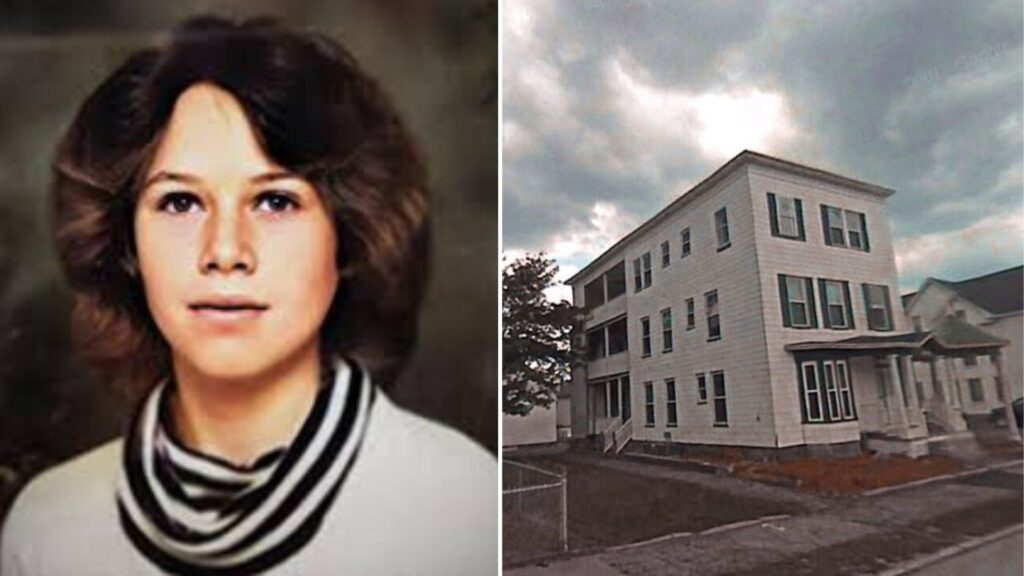
Judith Rahn climbed the stairs to the third floor on Merrimack Street a little after 1 a.m. and found the building altered in a way that made no noise at all. The hallway lights were out on every level. Someone had left the place dark.
At her apartment door, Judith found another small change. The lock had not been turned. Inside, the rooms looked normal at first glance, the kind of normal that invites a parent to talk herself down. Then her boyfriend spotted the back door hanging open.
Judith walked to Laureen’s bedroom and saw a girl asleep in the bed. For a moment she assumed it was her daughter. When she leaned closer she saw it was Laureen’s friend, the sleepover guest, still out cold. Laureen, 14, was nowhere.
In the hours that followed, Judith called relatives, searched the neighborhood with her boyfriend, and finally flagged down a police cruiser around 3:45 a.m. Police now list Laureen Rahn as missing with foul play suspected. She has never been found.
The case started as a familiar story for its era, a teenager on spring break, alcohol, a late night, a parent out of town, and a missing child treated as a runaway until the facts refused to cooperate. Then the search widened across state lines when Judith’s phone bill carried California charges.
Over time, detectives pursued sightings, chased anonymous calls, ran comparisons against unidentified remains, and kept a file open that never produced the one thing families and police both need, a verified answer. The absence sat in Manchester while the leads traveled.
Spring break night
Laureen Ann Rahn was born on April 3, 1966. She grew up mostly with her mother after her parents divorced when she was still a baby. Judith kept the Rahn surname, and so did Laureen, even though Laureen rarely saw her father.
Judith worked in nightlife and restaurants and raised Laureen in a family network that could feel both large and close. Laureen had relatives in the Manchester area and farther away, including family ties that stretched back to Florida from years the pair spent in Miami.
By 1980, the two lived in a third floor apartment on Merrimack Street. Manchester was big enough for anonymity and small enough for rumor, a city where teenagers orbited corner stores, stoops, and friends’ apartments, and where adults noticed patterns only after something broke.
People who knew Laureen described a bright kid, a strong student who liked to sing and dance and talked about acting. She also carried a reputation for roaming, spending time outside, drifting through a rougher neighborhood, and taking up habits that alarmed adults.
Her missing-person description stayed consistent across decades. Laureen stood about 5 foot 4 and weighed about 90 pounds. Police and child-advocacy bulletins listed blue eyes, brown hair, and the outfit she wore that night, down to a heart-shaped ring and a silver-and-blue necklace.
On Saturday, April 26, spring break had started. Judith planned to drive out of town to watch her boyfriend, a tennis player, compete in a match hours away. Laureen asked to stay home. Judith agreed and left her daughter with a day of freedom.
Relatives stopped by the apartment during the day. Laureen moved through the neighborhood and spent time near the corner store that shows up repeatedly in later accounts of that day, a place where local kids congregated and where alcohol was easier to obtain than it should have been.
That evening, Laureen brought friends back to the apartment. The version that entered public summaries most cleanly involved one male and one female friend and a small supply of beer and wine. Laureen’s mother left town for tennis and returned to a different household.
Close to midnight, Laureen’s female friend went to bed. Laureen and the male friend stayed awake in the living room. The boy later said they heard voices in the hallway outside the apartment. He assumed Judith was coming home and panicked about being seen.
He left through the back door. He said Laureen locked the door behind him. A neighbor later told Judith he heard voices and someone leaving, then heard voices near the Rahn apartment, then silence. Judith did not arrive until around 1:15 a.m.
Judith’s return gave the case its fixed images. The hallway lights had been unscrewed, she later learned. The front door was unlocked. The back door was open. The girl in Laureen’s bed was the sleepover friend. The couch held no sleeping child.
The friend, woken by a frantic adult voice, said Laureen had moved to the couch with her pillow and blanket. She later said intoxication blotted out much of the night. Police searching the apartment found no obvious signs of a struggle or forced entry.
Judith called family members, searched streets, and then pulled over a police cruiser to report Laureen missing. In the city’s own missing-person listing, the report date is April 27, 1980, and the remarks are brief: last seen inside her apartment, foul play suspected.
The first theory
In the first stage of the investigation, police treated Laureen as a possible runaway. The conclusion fit the era’s default assumptions and fit some parts of Laureen’s life, a teenager who drank, who spent time with older kids, who had talked about leaving.
Judith resisted that framing. She acknowledged a disagreement that morning, but she described it as small. She pointed to the simplest counterargument a parent can offer, that Laureen left behind the very things a runaway typically takes, especially a purse and clothing.
Police chased a lead that pushed the runaway idea further. A bus station employee said he sold a ticket to a girl who resembled Laureen. A bus driver identified Laureen from an older photo as a girl he dropped off in Boston’s Park Square. Later, shown a newer photo, he wavered.
Investigators adjusted without finding Laureen. They moved from “runaway” to a narrower version of voluntary departure, a teenager stepping out for a short time, expecting to come back, and meeting something she could not control. That framing has persisted through the case’s public life.
Detectives who worked the case described it as unlike the runaways they were used to. One officer in the juvenile division invested personal time searching, the kind of devotion that can form in a case where a child vanishes inside a tight window and leaves no proof of direction.
Judith reached beyond Manchester. When she contacted federal authorities, an agent told her they needed evidence of a kidnapping before stepping in. He also floated threats that were circulating in the public imagination at the time, trafficking fears and cult fears that fed desperation.
Judith hired private investigators who had law enforcement backgrounds. They worked for months and produced no break that brought Laureen home. The investigation continued with leads and interviews, but the center of gravity stayed in that apartment and the quiet hallway outside it.
In the months that followed, rumors filled the gaps, a predator in the building, a store employee, strangers in the neighborhood. Police investigated what they could verify. Judith tried anything that sounded like it might move the needle, including psychics.
One psychic pointed Judith toward Goffstown. Another described a room at a fuel depot near the Merrimack River with enough specificity that police dug at a site, finding nothing. Officers who later spoke publicly described skepticism mixed with willingness, because the case offered so little else.
Investigators also tried to recover the missing night inside the apartment. They hypnotized Laureen’s friend in an attempt to surface memory. The effort failed. The friend’s fog remained part of the case, leaving police without a clear last-seen moment they could trust.
The other disappearances nearby
In the weeks surrounding Laureen’s disappearance, other missing-person cases in New Hampshire and Manchester provided a grim backdrop. Each case had its own circumstances, but the clustering of dates and the shared geography fueled comparisons among families, police, and later researchers.
A month before Laureen disappeared, 15-year-old Rachael Elizabeth Garden vanished in Newton after stopping at Rowe’s Corner Market around 9 p.m. She paid five dollars for cigarettes, left the store heading north, and never arrived at the destination she had told people about.
Garden’s family reported her missing the next morning. Police initially treated her as a runaway and then confronted facts that did not fit cleanly, including possessions left behind and the absence of a plan. Years later witnesses described seeing her speaking to men in a dark car near the market area.
Newton in 1980 was small enough to magnify every rumor. The town had limited resources, and investigators chased tips across decades, including searches, dogs, excavations, and psychic claims. Modern reporting has described authorities suspecting foul play while acknowledging they never recovered her body.
Six weeks after Laureen vanished, a Manchester woman named Denise Ann Daneault disappeared after a night out. She was 25, a divorced mother of two, last seen socializing, and her case became another long absence that stayed active in the city’s memory.
Years later, investigators returned to Daneault’s case with heavy equipment and search teams in a wooded area behind public housing on Kimball Street. The FBI joined Manchester police in the effort, working a lead that officials described as accumulated information rather than a single new tip.
That renewed search drew attention to another name tied to New Hampshire’s cold-case landscape, Terry Rasmussen, a serial offender known for aliases and for leaving families with missing partners. Officials in the Daneault investigation said they had no evidence connecting her disappearance to his crimes.
Laureen’s case sat adjacent to those stories without merging into them. Police never established a public link. The comparisons persisted because the same region kept producing women who vanished without verified exits, leaving families balancing hope against the practical need for proof.
California on the phone bill
In November 1980, Judith opened her phone bill and saw three charges that did not belong to her routines. The bill listed calls placed on October 1 from Santa Monica, California, billed to her number. Judith had no ties to California that matched the pattern.
Judith decided Laureen made the calls. With help from Santa Monica police, she traced two calls from a motel pay phone to another motel in Santa Ana. The third call reached a hotline for teenagers with questions about sex. The details dragged the case into an adult world.
When investigators contacted the doctor linked to the hotline, he denied knowledge at first. Later, he offered a different story. He described runaway girls visiting his wife at their home and suggested one visitor might have come from New Hampshire. He pointed investigators toward a New York name.
The name he gave was Annie Sprinkle. Police learned she was connected to pornography. Investigators reviewed some of her films looking for Laureen and found nothing that proved a link. Sprinkle has never been implicated in Laureen’s disappearance.
Judith contemplated going to California. She held off, expecting that a holiday might draw a call from her daughter if Laureen was alive and somewhere reachable. Judith also carried a private logic that made California plausible, warm weather, a teenager who wanted movies, and a mother who knew her child’s fantasies.
The California charges did not solve the case, but they changed its boundaries. A disappearance that started in a Manchester hallway now included motel names, a hotline number, and a doctor with shifting answers. Investigators had to decide how much weight to put on a bill and a belief.
In 1985, an organization that assisted missing children also contacted the hotline and reached a man identifying himself as a plastic surgeon. He repeated the runaway-girls claim and added that a girl from New Hampshire might have visited in the company of an older woman and then moved on to New York.
A case manager working missing-children cases mailed Sprinkle and included Laureen’s photograph, asking for help. He received no response. Sprinkle soon relocated to Europe, leaving investigators with another closed door and no proof that the hotline story belonged to Laureen’s life at all.
In 1986, a person working on Judith’s behalf traveled to California and located the motels connected to the October calls. Authorities said one of the establishments might have been used by a child pornographer known as “Dr. Z.” Investigators could not connect that figure to the hotline.
The case’s public summaries held onto “Dr. Z” because it offered a framework that explained the distance and the silence. Police never confirmed Laureen stayed at those motels. The only fixed point was Judith’s bill and the work police did to trace the call path.
Voices after midnight
As Christmas approached in the first year after Laureen vanished, Judith began receiving late-night calls that carried no words. They tended to arrive at roughly 3:45 a.m. When someone answered, the caller stayed silent and hung up quickly, leaving the family listening to dead air.
Those calls returned across several holiday seasons. Judith changed her phone number years later, and the calls stopped. A public cold-case detective in Manchester has said this detail did not appear in the official police file, leaving uncertainty about how much investigators pursued it at the time.
Other family members described similar experiences, calls that asked for a relative by a nickname that sounded like Laureen’s voice in their memory, then turned silent when the person came to the phone. In the absence of confirmation, the calls lived as family lore and potential evidence.
A possible sighting surfaced in Boston in 1981. Someone close to the family reported seeing a girl matching Laureen’s description at a bus terminal. Police never confirmed the sighting. It joined a long list of moments that moved people to action without producing proof.
The list grew later in the decade. In 1986, Roger Maurais, a childhood friend of Laureen’s who had dated her briefly when they were young, received a call. His mother answered and spoke to a young woman who said she was “Laurie” or “Laureen” and called herself an old girlfriend.
Maurais believed the caller was Laureen. Police never identified the woman on the line. In 1988, a witness in Anchorage, Alaska reported seeing a sex worker who resembled Laureen. Investigators discounted the sighting’s strength because the witness used Laureen’s 1980 photo as his reference.
A separate event hit Judith hard in the mid-1980s. The boy who had been with Laureen on the night she disappeared died by suicide in 1985. Police said they never treated him as a suspect. Judith, like many parents in this position, carried the question of what he knew and what he never said.
The case aged into the phase where law enforcement keeps working and families keep living. Detectives assigned to Laureen’s disappearance changed over time. Some retired with the case still open. One detective described believing someone interviewed early on knew more than they admitted.
Judith remarried and moved to Florida. She continued seeking Laureen while managing a life shaped around the missing child’s absence. Her public statements held to a core idea, Laureen was alive, Laureen had made the California calls, Laureen would eventually reach back if she could.
The online claim that complicates the night
Decades after the disappearance, the internet introduced a new kind of witness statement, a family claim made in a comment thread rather than in a police interview. A commenter wrote that their mother was the friend who slept in Laureen’s bed that night and urged readers not to treat every published detail as fact.
The commenter disputed parts of the standard narrative and added specific names and ages for two men the girls met that night. The commenter described one as 18 and one as 21 and said the younger one worked at a store and obtained the beer.
The commenter also described their mother hearing Laureen say she was going to sleep on the couch. The commenter then floated a scenario their family discussed, Laureen might have left with one of the men, expecting to return, and then never made it back.
The commenter wrote that the memory in their household included Laureen leaving with one of the guys. The claim carried no verification attached to it in public, only an email address offered for questions and a tone of frustration with the way the story had traveled online.
This kind of material can be useful to investigators when it points to a tangible lead, a name, a job, a location, a person who can be interviewed. It can also mislead when memory and retelling harden into “facts” that no one can corroborate.
What it does in Laureen’s case is re-center the crucial issue that has hovered since 1980, who exactly was present that night, and what did each person say in the first hours and days after Judith reported her daughter missing.
Public summaries disagree on the male friend’s age, sometimes placing him close to Laureen’s age, sometimes describing him as older. The commenter’s version offers an explanation for how multiple young men might have existed in the story while later retellings collapsed them into a single figure.
Even if the commenter’s account is imperfect, it maps onto the basic structure police already held, Laureen left the apartment alive, intending to return. In that model, the important evidence sits outside the apartment door, in the hallway voices, and in the person Laureen chose to respond to.
The cases that touched Laureen’s name
By the time Judith had lived with the disappearance for decades, investigators in other states began contacting her when they encountered unidentified victims who resembled Laureen. One comparison emerged in Nevada, a young woman found dead in October 1980 near Henderson, first known publicly as Arroyo Grande Jane Doe.
A coroner’s investigator in Las Vegas contacted Judith in 2005 and asked her to consider whether the victim could be Laureen. Judith rejected the match, pointing to differences in facial features, height, hair color, eye color, and the absence of Laureen’s distinctive leg scar.
A small tattoo on the victim’s arm also struck Judith as wrong for her daughter. She described Laureen as fearful of needles and insisted her daughter would not have chosen a tattoo. Investigators used DNA comparisons to rule Laureen out as the victim.
In December 2021, Henderson police identified that victim as 17-year-old Tammy Terrell, ending the Jane Doe status and closing that particular branch of comparison for Judith. The identification did not bring Laureen back, but it removed one persistent “maybe.”
Over the years, investigators compared Laureen to other unidentified remains as well. In this kind of case, the work is procedural and relentless, dental charts, DNA when available, photographs sent between jurisdictions, calls between detectives who have never met in person.
Laureen’s case continued to sit in the systems built for missing children. The National Center for Missing and Exploited Children lists her as missing from Manchester since April 27, 1980 and repeats the same clothing and jewelry details that have traveled with her name for decades.
Names that entered the investigation
A Manchester detective’s core job in a case like Laureen’s is to hold two facts at the same time. Police found no public evidence of forced entry or a struggle. Police also cannot accept that a fourteen-year-old simply evaporated from a third-floor apartment without help.
Over the years, investigators considered men who fit a local pattern, adults who supplied alcohol to teen girls, men known for sexual interest in minors, men living close enough to be present in the building without attracting attention. Public summaries describe one unnamed man as a strong early suspect.
That man, public accounts say, invited teenage girls into his apartment and gave them beer and possessed child sexual abuse material. Police searched and monitored him but never developed evidence strong enough to support an arrest in Laureen’s disappearance.
Another name surfaced in the background of New England cases in the 1990s, Lewis Lent, a convicted child kidnapper and murderer. After his arrest and confessions in other crimes, investigators looked across missing-girl cases for possible connections, including New Hampshire disappearances that fit a nonfamily abduction profile.
The Lent angle never became a central public theory in Laureen’s file, but it shows how detectives work in the absence of direct evidence, lining up offender travel, opportunity, and known behaviors and seeing whether any piece touches the facts of a particular night on Merrimack Street.
In later decades, the rise of genetic genealogy and cold-case work around serial offenders introduced Terry Rasmussen into the mental landscape of New Hampshire disappearances. Rasmussen used multiple aliases and left missing women and children behind him across states.
Authorities tied Rasmussen to the Bear Brook murders after barrels found in a state park contained four victims. Investigators identified three of those victims in 2019 and, in September 2025, confirmed the identity of the last unidentified child victim as Rea Rasmussen, his daughter.
Rasmussen lived in Manchester during the broad period when Laureen vanished, a fact that has drawn scrutiny simply because geography invites it. His known patterns, drawn from confirmed cases, centered on adult partners and their children. Laureen does not fit that profile cleanly.
Still, the Rasmussen story has shaped how New Hampshire investigators and the public understand the landscape. It demonstrated that a man could live under false names, move between states, and leave bodies in barrels, while families nearby experienced their own missing-person cases as separate catastrophes.
In Daneault’s case, officials said renewed interest came from the attention to Rasmussen, even while stressing they had no evidence tying him to her disappearance. That public caution reflects the limits police face when a suspect’s shadow grows larger than the facts of a specific case.
The mother who kept answering the phone
Judith’s life after Laureen’s disappearance became a long exercise in maintaining contact with someone who never called in a way she could verify. She pursued leads. She spoke to investigators across jurisdictions. She picked up silent calls in the middle of the night.
Her statements over the years stayed consistent in one respect. She focused on Laureen as a living person with a personality she knew intimately, a girl who left notes, who called if she was late, who kept her mother informed even when she was pushing for freedom.
In that framing, the absence of contact does not equal a choice. It signals interference. Judith spoke publicly about scenarios that could erase memory or block communication, and she returned repeatedly to the only request she could still deliver into the world, a plea for Laureen to call.
Police never publicly offered a narrative that fully closes the loop. Investigators stated foul play was suspected, and their public postings keep her clothing and jewelry in the description, as if someone might still recognize a ring or a necklace and connect it to an old face.
The city’s missing-person page carries a spare line that compresses forty-five years of waiting. It lists Laureen Rahn’s height and weight, the white V-neck sweater, the blue plaid blouse, the jeans, and the brown shoes. It lists the ring and necklace. It ends with the same remark: foul play suspected.
In a different corner of the world, another disappearance case turned into a crime scene that nobody recognized in real time: the Snowtown murders in South Australia, where police opened an abandoned bank vault in May 1999 and found victims hidden in barrels after years of quiet killings and manipulation.
Sources
- The Charley Project, Laureen Ann Rahn case page
- National Center for Missing and Exploited Children, Laureen Ann Rahn poster
- Manchester Police Department, Missing Persons page (Laureen Rahn listing)
- The Doe Network, Laureen Ann Rahn case page
- The Doe Network, Denise Ann Daneault case page
- The Doe Network, Rachael Elizabeth Garden case page
- WMUR, “NH unsolved case file: Disappearance of Rachael Garden”
- New Hampshire Public Radio, FBI and Manchester PD search related to Denise Daneault
- CBS Boston, search resumes in Denise Daneault cold case
- City of Henderson Police Department, identification of Arroyo Grande Jane Doe as Tammy Terrell