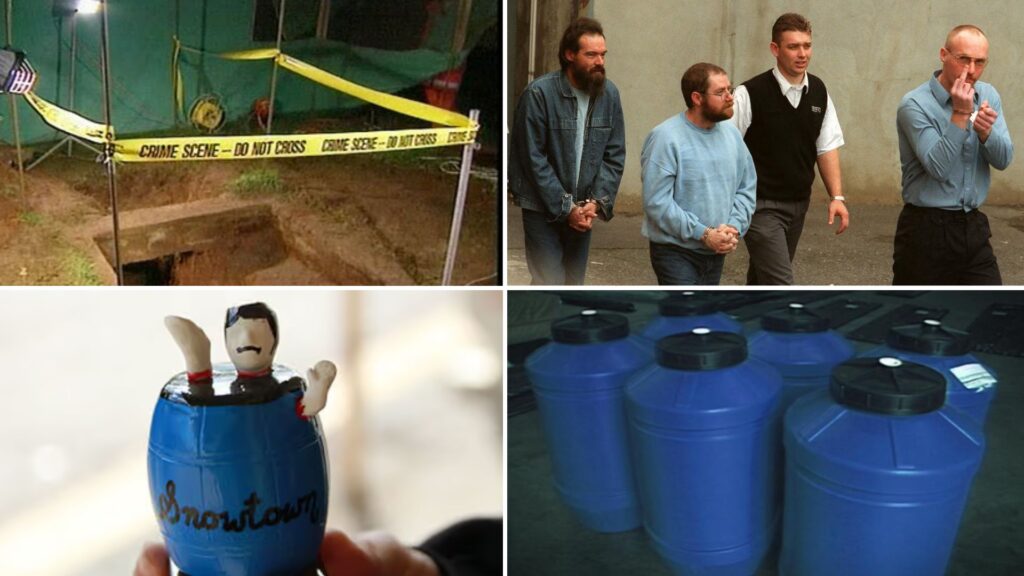
On a Friday in late May 1999, a crime reporter in Adelaide took what sounded like a prank call from her newsroom and treated it like a lead anyway. Anna Cock had been preparing to wrap up her stint at The Advertiser when her chief of staff pushed her toward a tip from a photographer: bodies, cut up, sitting in acid, inside a bank vault in a town called Snowtown.
She and a photographer drove north-west out of Adelaide, past the flat paddocks and the long, exposed stretches of road that make South Australia feel enormous. Snowtown had a main street that looked like it had been waiting for nothing in particular. Then she saw Denis Edmonds, a police officer she recognized from organized crime work, and she understood that someone had already decided this wasn’t a joke.
The bank itself looked like what it was: a disused building, the sort of place a small town stops noticing. Behind its walls, Major Crime detectives and a handful of forensic officers opened the vault and met the practical problems that arrive before meaning does. Superintendent Paul Schramm later told reporters the smell hit first. The officers could manage only a quick inspection, he said, because decomposition was so advanced.
In the hours that followed, television satellite dishes and news vans turned a quiet street into a set. Police carried evidence bags out through the doorway. A bank building that had once held cash now held something harder to count, and police still didn’t know, at that stage, how many people they were dealing with.
By the end of the investigation and the trials that followed, the public learned the outline that still clings to the town’s name: a group of men, led by John Justin Bunting, killed people across Adelaide’s northern suburbs and around Murray Bridge between 1992 and 1999, stored bodies in barrels, and tried to keep living off their victims’ money and identities. One murder happened in Snowtown itself. The rest simply ended up there.
The case mattered for the plainest reason, then the slow ones. Eleven people were murdered, and a twelfth death became part of the story that police and courts wrestled into categories. The men who carried out the killings spoke about “cleaning up” predators and “filth,” then used the same victims’ voices and bank details to buy time, cash, and control. The state built a prosecution inside tight suppression orders and a marathon trial, and decades later it still runs parole processes that keep reopening wounds.
The Wall
In the early 1990s, John Bunting lived in Adelaide’s outer north, in the zone of public housing and small brick homes where neighbors see each other’s lives through fences and open doors. People who met him described a man who talked big, liked to instruct, and carried himself as if rules were a personal invention.
He found Robert Wagner nearby, a younger man with a young family and a reputation, in at least one corner of the neighborhood, as steady and helpful. Wagner could play the part of a community adult. He could show up. He could speak politely. He could sit on the committee of a kindergarten. Years later, people who knew him there would describe that version of him with the particular shock that comes when someone’s private life detonates publicly.
Bunting also drew in Mark Haydon, an older associate he had met years earlier through work and training. Haydon’s later sentencing hearings described a difficult childhood and a personality that retreated rather than confronted. Justice John Sulan, who sentenced him, told him he had been too frightened even to ask questions in school. That passivity would become a legal category in the Snowtown case. It would also become a moral wound for the families of the dead.
Bunting built a private language around public fears. He talked obsessively about pedophiles, about “rock spiders,” about the idea that authorities did nothing. He kept lists of names. He tied suspicion to sexuality and rumor and personal dislike until they became interchangeable. In one account from the period, he turned a spare room into a kind of map of enemies: Post-it notes and strands of wool, a web of people he believed deserved punishment.
He didn’t only speak in abstractions. He called people, threatened them, and used fear as a way to make himself central. He learned quickly that a neighborhood can hold the same small set of stories for years, and that if you repeat them with certainty you can recruit accomplices who want to feel righteous.
In August 1992, Bunting killed Clinton Trezise at his home in Salisbury. The killing became the first in the sequence that prosecutors later pinned to him. Two years later, searchers found Trezise in a shallow grave at Lower Light, and police still did not tie the death to the man who would become central to the story.
The gap between the killing and the connection mattered. It gave Bunting a lesson in patience. It also gave him time to refine the method he would use repeatedly: pull someone close through familiarity, isolate them inside a home or a shed, take what you can from them, and then erase the person from the neighborhood’s daily view.
In December 1995, Ray Davies died. Davies had lived in a caravan on the property of Suzanne Allen, Bunting’s former girlfriend. Davies, like several others who would become targets, lived with an intellectual disability. When police later dug at Bunting’s former Salisbury North address in May 1999, they found Davies there.
The public eventually learned another pattern layered over the violence: money. The group didn’t only kill. They also tried to keep living as if the victims had simply moved away, leaving behind access to welfare payments, bank cards, and the small assets that keep poor households running.
In the version of the story prosecutors built in court, Bunting taught his group to harvest details as if they were tools. He demanded PIN numbers, passwords, and welfare information. He pushed victims to cooperate, then used what they gave him to delay discovery.
That strategy required a more specific kind of manipulation than brute force. It required the victims’ voices.
Proof of Life
In September 1997, Nicole Zuritta returned to her home in Adelaide’s northern suburbs from a holiday and walked into a staged disorder. Drawers sat open. Clothes lay across the floor. Her television was gone, along with VHS tapes and computer games. A robbery scene has its own logic: someone came in, took objects, left the house broken open.
Then she realized her boarder, a 19-year-old named Michael Gardiner, was missing too.
Gardiner sometimes preferred to be called Michelle, and Zuritta described him as a close friend. He didn’t drive, she told reporters later. He didn’t own a car. Zuritta looked at the empty space in her house and saw a problem the burglary didn’t solve: how does someone like that move a television and boxes of tapes without help?
She cleaned up, then found Gardiner’s wallet under a bed. Inside, she found a note thanking her for letting him be himself without judgment, promising friendship, and mentioning a plan to move to Goolwa. Zuritta took that note as a kind of proof. A person who writes gratitude and future plans, she reasoned, doesn’t smash up a friend’s home and disappear.
She went to police anyway. She reported the break-in. She told them she had a boarder who was gone. She told them she didn’t think he was the thief.
After that, the case began to behave in ways that made ordinary sense impossible. Zuritta said she received calls demanding the wallet. She said acquaintances came to her door asking for it. She refused to hand it over to intermediaries. If Michael wanted his wallet, she insisted, he could collect it himself.
Then people she knew through her local web offered “information.” Bunting and Wagner came to her house with supposed sightings and directions. Zuritta spent months putting up missing-person flyers in places they pointed out, moving through her suburbs with the faith that someone was helping her. Later she would describe that period as a game played at her expense.
Police and prosecutors eventually alleged a simpler explanation: Bunting and Wagner killed Gardiner, then staged the burglary to make Zuritta think her friend had robbed her and fled. They didn’t only remove a person. They tried to turn the victim into the villain in the mind of the person most likely to insist he mattered.
The case wasn’t only about murder. It was also about the social ease of making certain lives disappear.
Around that time, the circle around Bunting tightened. People drifted in and out: acquaintances, partners, family members, people with fragile housing or addiction problems, people with limited money and limited protection. Bunting’s confidence and Wagner’s ability to look normal did the work that a mask does.
In October 1997, Barry Lane died. Lane also used the name Vanessa. He had been part of Wagner’s life before Bunting. Later, prosecutors and journalists described him as someone Bunting turned on. His remains ended up in the set of barrels police later recovered from Snowtown.
That same year, the death of an 18-year-old named Thomas Trevilyan initially passed through the system as suicide. Trevilyan had been Lane’s partner and had mental health issues. His body was found hanging in the Adelaide Hills. Later, police folded his death into the Snowtown investigation, and the case expanded again, reaching backward to collect earlier disappearances and unexplained ends.
In November 1997, Suzanne Allen disappeared. Police later found her remains buried at Bunting’s former Salisbury North home. At trial, jurors could not reach a verdict on whether Bunting and Wagner murdered her, and prosecutors did not pursue another trial. Still, the story of Allen’s death lived inside the broader case as a demonstration of the group’s confidence: they buried her in a backyard and continued to touch her money.
By then, Bunting’s household had changed. He lived with Elizabeth Harvey and her children, including James Vlassakis, who would become the youngest of the main offenders and the most complicated figure in the legal aftermath. People who later spoke about the family described Vlassakis as vulnerable, and they described Bunting as the adult who stepped into the center of the home and stayed there.
Vlassakis entered the killing group as a teenager and kept moving deeper. The prosecution later framed him as both participant and product: a young man who helped torture and kill, and a young man shaped by a dominating older figure who treated violence as discipline and loyalty as a test.
In April 1998, Gavin Porter died. Porter was a friend of Vlassakis and lived with mental illness. The killing, as later described publicly, contained details that showed how unstable and improvisational the violence could be. Porter fought back at one point, injuring Bunting. The men still killed him, and they stored his remains.
In August 1998, Troy Youde died. Youde was Vlassakis’s half-brother. Vlassakis had made an allegation that Youde sexually abused him when he was younger, and Bunting used that claim as a recruiting pitch: vengeance, protection, justice that authorities supposedly refused to deliver.
Justice Sulan later told Haydon that he joined the attack on the sleeping 21-year-old, then ran to another room as the violence escalated. Sulan told him he would have heard Youde’s cries in the small Murray Bridge house. Sulan told him he did nothing. Afterwards, Haydon helped clean up and move the body.
A month later, Frederick “Fred” Brooks disappeared. Brooks was the teenage son of Jodie Elliott, a woman in a relationship with Bunting and the sister of Elizabeth Haydon. Brooks was last seen leaving Haydon’s home in Smithfield Plains, and he was killed in Murray Bridge.
The torture inflicted on Brooks became part of the case’s unbearable detail, and it also became central to sentencing and parole debates decades later. Prosecutors described how the killers used pain to force compliance and extract financial information. They didn’t only kill him. They tried to squeeze usefulness out of him on the way.
In October 1998, Gary O’Dwyer died. O’Dwyer lived with physical and intellectual disabilities. Justice Sulan later said Haydon did not know O’Dwyer and was not present at the killing. Still, Haydon helped move the barrel containing O’Dwyer’s body.
In the same month, police began to circle the group more tightly. The reasons were practical. Too many connected people had stopped appearing in their usual places. Too many small facts sat wrong: bank withdrawals, missing welfare recipients, inconsistent stories.
In November 1998, Bunting and Wagner murdered Elizabeth Haydon, Mark Haydon’s wife. They arranged for Haydon to take a long drive to Reynella, a trip that kept him away while they went to his home. Elizabeth Haydon’s disappearance was reported. Her brother filed the missing-person report that would eventually push detectives toward Snowtown.
After Elizabeth Haydon died, Haydon’s role shifted from associate to compromised accomplice. He didn’t only store bodies. He also sat inside the consequences. His wife was among the dead. His sister-in-law was Bunting’s partner. The group’s private world became a trap that closed from multiple sides.
The storage strategy changed around then too. Haydon kept barrels at his Smithfield Plains home, and he kept at least one body in a service pit in his shed. Over time, the killers needed a place that felt less like a home and more like a container.
They found it in Snowtown.
Haydon co-signed the lease for the disused bank building. Police later treated that act as one of the clearest markers of knowing assistance. A person doesn’t help rent a bank to store barrels without understanding what the bank is for.
In May 1999, the group killed David Johnson, Vlassakis’s stepbrother. On May 9, Vlassakis asked Johnson to help him buy a cheap computer in Snowtown. Johnson agreed. He entered the bank building. The killing happened there.
Johnson became the only victim who died in Snowtown, the town that would carry the label anyway. Less than two weeks later, the bank vault opened for police, and Johnson was inside the story’s public beginning.
The Vault
Police arrived in Snowtown because Elizabeth Haydon had vanished. They came looking for one missing person and found a system.
Schramm described what his detectives faced: a locked vault, bodies in an advanced state of decomposition, the smell that made prolonged work difficult, and the need to shift from immediate shock to method. Officers worked with forensic specialists. They removed barrels. They sealed evidence. They began the slow process of identifying human remains that had been stored, moved, and altered.
Police found eight bodies in six barrels in that vault. They arrested Bunting, Wagner, and Haydon on May 21, 1999.
While cameras stayed trained on Snowtown, police opened a second set of scenes back in Adelaide’s north. On May 23, they found a body buried at the Salisbury North public housing property where Bunting had once lived. Three days later, they found another.
The investigation reached outward again. Police began treating older cases as connected. They questioned assumptions about disappearances that had been filed as runaways, suicides, or the kind of drifting that poor people sometimes do because no one offers them stability.
Vlassakis was arrested days later. By then, police had already made an essential decision: they would treat the case as a conspiracy built through relationships. They wouldn’t chase a single offender’s pattern. They would map a group’s movements across homes, sheds, suburbs, and small towns.
Years later, reporters who covered the case described the scale of the legal response in dollars and logistics. Pre-trial hearings and applications took years. Prosecutors built a case that could survive the publicity. Courts issued suppression orders to keep the proceedings from collapsing under their own notoriety.
The first Supreme Court trial, for Bunting and Wagner, began in 2002. It lasted 11 months. Lawyers called more than 220 witnesses. The cost reached roughly $15 million.
In September 2003, jurors returned verdicts. They found Bunting guilty of murdering 11 people. Wagner had pleaded guilty to three murders and the jury convicted him of seven more. The court gave both men multiple life sentences without the prospect of parole.
By then, the public had learned how the group bought time. They used “proof of life” recordings, forcing victims to speak on tape so they could later play messages to worried relatives or friends. They used those voices as props, insisting a missing person had gone away voluntarily. They used the same tactic to keep welfare and bank accounts accessible after the deaths.
In October 2003, the case shifted into sentencing, and the courtroom became a place where families attempted to describe absence in language that could fit into a legal ritual.
Twenty-nine victim impact statements were read. Some relatives delivered their statements themselves. Bunting sat through the proceedings reading a book. Wagner spoke from the dock and framed the murders as action taken against pedophiles, offering no apology.
Justice Brian Martin said he had no power to prevent the pair from applying for parole at some point in the future. He told the court that if he had that power, he would use it. Families in the room called for laws that would keep the men in prison permanently.
The father of David Johnson, Marcus Johnson, spoke publicly about the system’s “anomaly” and demanded change. Other parents spoke about guilt and grief. A mother became too overwhelmed to finish reading her statement and handed it to her daughter. The court tried to make space for pain, then moved on, because courts always move on.
Haydon’s case followed on a different track. A jury could not agree on murder charges related to the deaths of his wife and Troy Youde. Prosecutors focused on what they could prove beyond doubt: his assistance after the fact, his storage of bodies, his role in moving barrels when police began to suspect something.
In 2006, the Supreme Court convicted Haydon of seven counts of assisting an offender. Justice Sulan sentenced him to 25 years in prison with an 18-year non-parole period. Sulan told him the court needed to make clear that conduct like his required severe punishment. Sulan also accepted a distinction that would matter later: Haydon did not profit from the social security fraud the others carried out.
The years after the verdicts produced an afterlife that blended law, media, and geography. A film arrived in 2011. Public interest pulled tourists toward the bank building. Residents of Snowtown became unwilling custodians of a name they didn’t choose.
Inside prisons, the offenders became long-term problems for institutions built to manage sentences, not mythology. The state kept Vlassakis’s image suppressed to protect him because he had testified against Bunting and Wagner. That suppression became part of the story too: a witness whose cooperation helped convict others, and whose future safety required legal invisibility.
Wagner, still in custody, later tried to shift his legal position. In 2019 he asked the Supreme Court to set a non-parole period, arguing that the possibility of release would improve his morale. In court he said there was no point apologizing. Prosecutors opposed the request. Victims’ representatives argued that even a symbolic right to freedom belonged nowhere near the case.
The system continued, year after year, through hearings most people never see and paperwork most people never read. The Snowtown case lived in the background of South Australian criminal justice as both a resolved prosecution and an unresolved social event.
Parole Season
In 2017, the chair of the South Australian Parole Board, Frances Nelson, explained the board’s role in blunt institutional terms. If an applicant met legislative criteria, the board had an obligation to release them. The board could not impose its own view of punishment over a sentence handed down by a court.
That principle sounded abstract until it attached to Mark Haydon, a man convicted not of murder but of helping move and store bodies, including his wife’s, and of helping rent the bank building that became the case’s emblem.
In February 2024, the Parole Board granted Haydon parole. Nelson pointed to his “excellent” behavior in custody and argued that the community would benefit from a supervised transition, especially because his head sentence would end in May. She described practical issues that sound like civic failure rather than criminal justice: a shortage of public housing so severe that Corrections sometimes placed released prisoners in motels.
In May 2024, authorities moved Haydon from the Adelaide pre-release centre to a new address in the community. Nelson said police, community corrections, and the board vetted the location carefully. His parole conditions banned him from contacting victims’ families or speaking to the media. They imposed a curfew and electronic monitoring. The state also pursued high-risk offender supervision mechanisms to keep control in place after parole ended.
Families reacted in the way they had reacted for years: with fear of accidental proximity, with anger that any release could happen at all, with a sense that legal time moves forward while grief stays put.
Then Vlassakis reached his own eligibility point. He had pleaded guilty to four murders and served a life sentence with a 26-year non-parole period backdated to June 2, 1999. He had been 19 when he committed the crimes. He had also been the key witness against Bunting and Wagner.
In August 2025, the Parole Board granted Vlassakis parole. Nelson said he would not go straight into the community. He would spend up to a year at a pre-release centre and undergo a structured reintegration process. She said the board considered him remorseful and did not view him as a risk to the community.
The decision opened a 60-day window for senior officials to seek review. Victims’ advocates spoke publicly about the pain and anger the decision would cause. Relatives spoke about disgust and disbelief. For them, the parole clock felt like another sentence.
In October 2025, South Australia’s Attorney-General, Kyam Maher, asked for a review, arguing that the board had failed to give proper weight to community safety, the gravity of the offences, the likelihood of compliance with parole conditions, and reports tendered under the act.
On December 15, 2025, Parole Administrative Review Commissioner Michael David overturned the parole decision. He wrote that releasing Vlassakis at this early stage, at the first occasion parole became available, posed a risk to the community. He said the board had underestimated the effect of the gravity of Vlassakis’s criminal behavior.
David acknowledged Vlassakis’s cooperation and guilty pleas, then added a reminder that cooperation had already earned “substantial benefit” at sentencing. He pointed to issues raised during the review, including drug use recorded in custody and the limited number of hours Vlassakis spent in a modified violence intervention program, which had been constrained by his notoriety and custody conditions.
Nelson responded publicly with frustration. She said the board would seek senior legal advice on whether the commissioner had committed a jurisdictional error. She argued that the commissioner had, in effect, re-sentenced Vlassakis by deciding the court’s non-parole period still wasn’t enough.
The Commissioner for Victims’ Rights, Sarah Quick, told reporters that some families felt reassured by the decision. She also said they understood the system’s nature: parole applications could return in the future. The stress, she said, sat paused rather than erased.
Sources
- ABC News: “A life sentence” (Jan. 29, 2024)
- ABC News: “Victims of time” (May 17, 2024)
- ABC News: “No parole for Snowtown killers” (Oct. 29, 2003)
- ABC News: “Snowtown serial killer compares himself to other mass murderers in bid for non-parole period” (Mar. 25, 2019)
- ABC News: “Who is Mark Ray Haydon and how did he assist in covering up one of Australia’s worst serial killings?” (Jan. 29, 2024)
- ABC News: “Snowtown accomplice Mark Haydon released into the community under strict supervision” (May 17, 2024)
- ABC News: “Snowtown ‘bodies-in-the-barrels’ accomplice Mark Haydon could be released this year” (May 8, 2017)
- ABC News: “Snowtown murderer James Vlassakis granted parole after 26 years in jail” (Aug. 5, 2025)
- ABC News: “Parole release of Snowtown murderer James Vlassakis overturned” (Dec. 15, 2025)
- The Guardian: “Snowtown serial killer to remain in jail … after parole approval overturned” (Dec. 15, 2025)