March 2, 1978. An elderly woman lay awake in bed, unable to drift off. Something felt wrong inside her chest, a dull pressure, and each shallow breath made her tired heart seem to flutter wildly behind her ribs.
When the ache turned into a vicious burn that felt like it might split her apart, she forced her eyes open and tried to sit up, but she could not see. There was only darkness, and the weight of a shabby blanket pressing down like bricks.
She could hear a faint mumble from the room next door. She tried to call for a nurse, yet nobody arrived. They often did not. That place had too many cries for help, so many that, over time, they blurred into background noise.
By morning, an orderly finally appeared and poked her head in. “Good morning Mary,” she said, and got nothing back. She moved along to the next room. “Good morning Rose.” It was routine, years of muscle memory.
This time, something made her stop and step backward to Mary’s door. “Good morning Mary,” she tried again, but only birdsong outside answered. Irritated, she approached the narrow cast iron bed and the lump beneath the sheet.
Mary’s blind, lifeless eyes stared upward. The orderly frowned, drew the thin white sheet up over the old woman’s face, and walked briskly into the corridor to inform her superintendent. She knew nobody would grieve for Mary, yet she still had to report it.
Mary had no known relatives. After a short stay in the nursing home morgue, her body went to a funeral home. Home after home, even so, Mary had not had a home in decades. The undertaker cremated her and put the ashes into a plain urn like a coffee can.
He stored it in a dim, unlit back room and phoned the local newspaper to run an obituary, as he always did. It was all standard procedure. He knew almost nobody would care about the few lines, but routine mattered.
At the Bloomington Pantagraph, a columnist answered the call. His name was Rick Baker. He was already working on another piece, and he barely hid his annoyance when he realized it was another obituary request.
For a journalist, obituaries can be some of the most numbing assignments. You are expected to honor someone you never met, who might have been a complete bastard for all you know, and for all you care. Baker searched for an apprentice to dump it on.
While he weighed that option, he lifted his eyebrows at the receiver wedged between shoulder and head. In a flat voice, the mortician recited what little he had. It was a list of facts, or the absence of them.
Mary Doefour had died in the early hours of March 2, 1978, at Queenwood East nursing home in Morton, a small town southeast of Peoria, Illinois. The cause was a heart attack. She was thought to be in her seventies or eighties.
“Probably,” because nobody actually knew when Mary had been born, or where, or to whom. In truth, nobody even knew her real name. Mary Doefour was an alias assigned when she was first institutionalised.
Doefour was not a quirky French spelling. It was Doe combined with the number four. She was the fourth Jane Doe who arrived at a mental hospital without identification, without even a name she could claim as her own.
That was all they had: a death date, but no birth date; a face, but not a name. People who knew her at the end, yet nobody who knew her before she became a number in state records. Baker set the receiver down and stared at his notes.
He had barely two lines to shape into an obituary. Shoot. It would be the worst one he had ever written. The apprentice still was not around. So Baker threw his jacket over his shoulders and went out himself.
At Queenwood East, he tracked down staff who had cared for Mary. They repeated what the funeral home clerk had said. Mary was a glitch in the matrix. She had appeared catatonic in Northern Illinois in the late 1920s.
She seemed to be trying to walk down a country road. She could not recall her name or where she came from. Doctors found evidence she had been beaten and raped, but she could not explain how or when. She was also pregnant.
Even after that trauma, she regained lucidity, though her identity never returned. Staff described her as calm, articulate, and intelligent. She was in her mid twenties, with bright blue eyes, naturally curly light brown hair, high cheekbones, and a full round face.
How she ended up ruined in a place like that remained a mystery. Yet she was never given the support that might have helped her recover her life. Once she gave birth, the baby was taken immediately, before she could even hold it.
The child was presumably left at an unnamed orphanage. Mary never named the baby, and she never learned whether it was a boy or a girl. When she tried to insist she was not insane and needed real help, staff answered with eye rolls and tired sighs.
As she pushed harder, she was force fed pills and other mixtures meant to keep her quiet. When that failed, she was stripped, restrained, wheeled into a theater, and given electroconvulsive therapy, brutal shocks delivered by electrodes.
Sometimes the shocks were strong enough to knock her unconscious. When that happened, the wires were yanked from her scalp and she was dumped into a large tub of freezing water, the Bartonville State Hospital protocol for reviving patients.
The curious, bright Mary Doefour slowly slid into stupor. Her body stayed alive, but the aggressive treatment reshaped her into an orderly, docile vegetable inside a hospital for the criminally insane. Her only crime was being a victim.
Before her mind finally slipped, Mary did remember a few fragments. She believed she once worked as an elementary school teacher, perhaps first or second grade, and she could clearly picture herself with small children.
She was literate and unusually well read. She enjoyed talking and could be funny. Nobody listened. Nobody dug deeper. In the early 1930s, there were too many Mary Does, and the protocol was to hide them away, out of public sight.
At Bartonville, she was given a cramped room without a toilet. One nurse covered 150 patients, and when Mary begged to use the loo, nobody came, so she defecated on the floor. When she reached a toilet, there was no sink.
She tried to clean herself using water from the toilet bowl. Patients who protested the inhuman conditions were wheeled straight into the electroconvulsive therapy theater. Mary remained at Bartonville for 30 years, until the facility shut down.
She never received a single visitor, and the drugs and procedures made her amnesia permanent. After Bartonville closed, she was moved from nursing home to nursing home, until she landed at Queenwood East, where she died. She had gone blind about a year earlier.
Rick Baker set her file down and realized he had stopped breathing. He now had enough to write something real, and he also had a thin hope that publishing her story in the Pantagraph, with about 50 000 circulation, might reach someone who knew her.
He had no photograph to run. The nursing home had never taken one. Baker could not undo what happened to her, yet he could try to use his readers to return a name. He did not yet understand that this search would become his life’s work.
Baker pulled together a 14 page account and published it on March 12, ten days after Mary’s death. Time mattered. If nobody claimed her remains, the state would provide a pauper’s funeral. Each morning he checked the Pantagraph mailbox at the newsdesk.
No letters arrived. The phone stayed silent. Nobody in Bloomington or beyond seemed to recognize a school teacher who vanished in the 1920s, about 55 years earlier, and who matched the scraps Baker had pieced together from scattered institutional records.
Months went by, and Baker decided to change jobs. While sorting notes and selecting his strongest stories for an application to the larger Peoria Journal Star, the Mary Doefour clipping slipped out of his file.
He reread it and tucked it into the envelope without thinking. It was hardly headline material, yet he was proud of what he had assembled from almost nothing. Baker got the job in January 1979, nine months after Mary died.
Only a few weeks into his new post, his managing editor came by, sat on Baker’s desk, and placed the Mary Doefour clipping atop the typewriter. He asked, cautiously, if Baker could get to the bottom of the unknown woman who died in Morton.
Without a name and without a face, Mary was a ghost that surfaced in Baker’s mind only now and then. He was ready to decline politely, but he did not. Instead, he phoned the mortician to see whether anyone had claimed the ashes.
If someone had come forward, Baker could learn who they were and how they knew Mary, and perhaps give the earlier story a sweet ending, or as close to one as he could manage. The mortician, Robert Perry, told him nobody had asked.
Perry had published the obituary and kept the ashes in his back room, hoping a person might appear. The law required him to bury them by the end of that month. Baker used that deadline as a hook to rerun the story in the Peoria Star.
It was a final, desperate attempt to draw someone out, someone who could mourn Mary before the last of her went into the earth, someone who could give a real name and birthdate for a gravestone. The Peoria Journal Star reached nearly 100 000 readers.
The piece was also reprinted across the Midwest, all the way to Chicago. Baker returned to his morning ritual of checking the mailbox, eager and tense and hopeful. Two days later, two letters arrived with the clipping attached.
One writer only wanted to say the story was horrifying and had affected her personally. The other complained about the paper’s poor printing. Both letters ended up in Baker’s trash.
A third letter arrived later, postmarked Iowa. Like the others, it included a Chicago Tribune clipping. The woman said she had lived in Mount Vernon, Iowa, in the 1920s, and the phrase “missing school teacher” sounded familiar.
She wrote that a young teacher had disappeared from that area in the 1930s. She thought her name was Alice Zaiser, or Seizer. She could not be sure because she had barely known her. Alice was described as young and bright.
The disappearance seemed entirely out of character. Even with some local publicity at the time, Alice never returned. Rumor said she was seen getting onto a train one day and never came back. That was everything the Iowa woman knew.
Nothing else came in. Baker felt justifiably irritated. The lead could not have been vaguer, and on the phone the woman confirmed she had nothing more. Fifty years had passed, and her memory was not what it once was.
Baker called a grade school in Mount Vernon and asked whether there was any local story about a teacher who vanished five decades earlier. The secretary laughed and said she had no idea. Baker kept pressing.
She promised she would ask older staff, mostly to get him off the line. Baker dropped the Mary Doefour trail, certain he would never hear back from Mount Vernon. That assumption turned out to be wrong.
A few days later, the phone rang, and the same secretary spoke again. She had asked longtime employees, and there really was an old tale about an Alice who disappeared fifty years before. The name, she said, might have been Alice Siezer.
She had also found an acquaintance’s phone number. Baker called it and reached a retired banker from the Lisbon, Mount Vernon area named Harry. Harry did not appreciate a reporter from Peoria bothering an old man with a half century old story.
Baker, excited, poured out the details: a beautiful young woman, likely an elementary teacher, missing in the 1930s. Blue eyes, curly brown hair, intelligent and bright. Then something awful, rape and beating, and she appears amnesic near Chicago.
He described how she was committed against her will to a mental institution, where men in white coats pumped her full of drugs and burned her mind with electric shocks. She lived fifty years as a Jane Doe and died alone.
Harry fell silent, then scoffed. He did know a teacher from the area who fit that description, but her name was not Alice. She was Anna Myrle Sizer, not Siezer or Zieser. Still, he insisted Anna Myrle could not have ended in an institution.
Myrle, as everyone called her, had been murdered sometime in the fall of 1926. Baker felt the sting of disappointment, yet he was a reporter with a sixth sense, and he pushed. Was there an official record of the murder? There was not.
Who killed her, and why? Harry did not know. The murder idea was only that, Harry’s own theory, held for five decades. Myrle had dropped out of Cornell College and taught school to save money to return and finish her education.
She was attractive, late twenties, blue eyed, with naturally curly brown hair. People liked her. She was well read, intelligent, and she loved her work. Then one day she vanished. A friend last saw her stepping off a train in Marion, near Cedar Rapids.
It was believed she went to Marion to visit a doctor because she had felt unwell since the school year began. The community searched for months, and her family hired private investigators. They pursued every lead and looked as far away as California.
Myrle was never heard from again. Baker wondered why Harry knew all of this, yet refused to consider that Mary Doefour could be the same woman. With more prodding, the reason emerged: Harry was Harry Sizer, Anna Myrle’s younger brother.
He could not accept a story where Myrle lived for fifty odd years in pain, forgetful of her own name, only 150 miles from him. He preferred a version where she died quickly, relatively painlessly, as a young woman.
That weekend Baker drove to Cornell College in Mount Vernon. If he could find newspaper clippings from “fall of 1926” describing Myrle’s disappearance, he could rule her out and move on. Mary Doefour appeared in records in 1932, six years later.
A gap that large made it unlikely she survived unnoticed for six years while amnesic. At Cornell, Baker spent hours digging through microfilm of the Mount Vernon Hawkeye Record and the Lisbon Herald, as the weekly paper was known then.
Without tools to search names, he had to read hundreds of slides, starting in summer 1926. The work paid off. Harry’s timeline was correct. On Friday, November 5, 1926, Anna Myrle Sizer disappeared.
She was an elementary teacher who taught second and third grades. A friend last saw her getting off a train in Marion, near Cedar Rapids. That weekend she did not come home to Mount Vernon. The next Monday she missed work.
The following Wednesday, a policeman might have seen her wandering along US route 30, 75 miles east of Cedar Rapids. He did not approach because he had not yet heard she was missing. She was also supposedly spotted in Wheatland and Chicago.
Witnesses described her walking as if dazed. The details lined up. She wore a green plaid coat her family recognized as Myrle’s. There were also strange reports from motel workers along route 30 about a man seeking a room for a very sick woman.
One witness said the man claimed she was having a mental breakdown. Not every motel worker saw her, but at least two said they saw a woman in the back seat, wearing a hat and hiding her face with her hands. Myrle always wore a hat.
The trail felt convincing. Something violent likely happened to Myrle. She may have lost her memory and moved east in a haze, perhaps along route 30 toward Chicago, where the last unconfirmed sighting occurred, and near where Mary Doefour was later found.
She might have been with an attacker, or with one or more good samaritans offering rides and motel rooms. By late November 1926, though, Myrle disappeared again, and the newspapers soon lost interest.
Baker went to Cedar Rapids next and searched The Gazette archives. He learned more. Myrle was 28 when she vanished in 1926. If she later became Mary Doefour, her birth year would be 1897–1898, and in 1978 she would have been 80.
That age matched Queenwood East’s estimate for the woman they had cared for. Myrle taught in Maquoketa, about 60 miles each of Cedar Rapids, where she was last seen. She took weekend trips by train from Maquoketa to Mount Vernon.
Each week she withdrew $10 from her bank account for the train ticket. That week, on Thursday, one day before she vanished, she withdrew the $10 as usual. If her job was in Maquoketa and home was Mount Vernon, it stayed unclear why she went to Cedar Rapids.
The Gazette reported a rumor that might matter: police believed Myrle was in poor health and had missed the first weeks of the school year. The paper did not name an illness. If it was true her doctor practiced in Cedar Rapids, then her detour on Friday, November 5 1926 made sense.
The bigger question remained: did her illness, or her doctor, connect to what happened? In Cedar Rapids, Baker also saw what Mary looked like near the time she vanished. The microfilm photo was poor, but she appeared unusually attractive, with piercing eyes, high cheekbones, and a cleft chin.
Baker tried to obtain a copy, but the Gazette no longer had it, and he could not reprint microfilm. He memorized the described features and compared them to the harsh, murky image. Full face. Naturally curly hair. Harry had said Myrle had blue eyes and light brown hair.
Old Bartonville and Manteno records described young Mary the same way: blue eyed, light brown hair. The deeper Baker dug, the more he believed Mary and Myrle were one person.
Driving back to Peoria, Baker stopped in Davenport to check The Davenport Daily Times. By then he had read miles of microfilm and still felt he was clutching at straws. Myrle seemed to vanish completely, while Mary appeared in Manteno records only from 1932 onward.
If they were the same woman, how did she pass six years with no identity and no record? In Davenport he found an article dated November 20, 1926. It said two Cornell students, Wendell Webb and Binford Arney, had gone searching for her, desperate to find her alive.
The reporter wrote that they uncovered significant clues, then began receiving threatening letters and calls warning them to stop or they would end up dead. They did not take the threats seriously and kept going, until Cornell’s president urged them to quit.
They never publicly revealed the clues they found. Another article grabbed Baker’s attention. It named a Cornell student as a person of interest: George W. Penn, a senior when Myrle disappeared. Penn told police he had a major clue.
According to Penn, Myrle was pregnant when she vanished. He said he knew it, and he offered to marry her, which she presumably refused. He insisted he was not the father and claimed he did not know who was.
Myrle’s family quickly rejected Penn’s claims, saying a love affair and a child out of wedlock would have been completely out of character. Penn’s statement could never be confirmed. Investigators searched Midwest hospitals for unidentified pregnant women and found nothing.
Penn’s lead died. Two years later, the Davenport Times ran another major detail: Dr. Jesse J. Cook and his wife were arrested in 1928 after a young woman, Eva Thompson, died of sepsis. Eva developed sepsis after Cook performed a back alley abortion.
The paper added more. Cook, whose practice was in Wheatland, had been in Cedar Rapids the day Myrle vanished. Investigators thought she might have been another victim of his botched abortions. Paired with Penn’s pregnancy claim and the rumor she went to Cedar Rapids to see a doctor, the pieces fit.
There was also an unconfirmed sighting of Myrle in Wheatland a few days before she disappeared. Cedar Rapids, Mount Vernon, and Wheatland all sit along US route 30, the highway connecting Cedar Rapids to Chicago, where she was reportedly seen wandering and where a man tried to pay for motel rooms for a sick woman.
If Penn’s story was right and Myrle was pregnant out of wedlock, and given how ambitious she was about saving money to return to Cornell, she might have sought an abortion. One plausible sequence forms: she finishes work Friday, November 5, and uses the $10 to travel from Maquoketa to Cedar Rapids.
In Marion, her friend sees her step off the train. She meets Dr. Cook, who attempts the abortion and botches it. He drives her to Wheatland. There, she either escapes or Cook decides she is a liability and abandons her, leading to sightings.
Police later see her along US route 30, yet they do not intervene because they have not learned a young woman is missing. She might be trying to walk east toward Mount Vernon or northwest toward Maquoketa. A driver offers help, then rapes and beats her.
The trauma sends her into shock and wipes her memory. Witnesses later see her attacker at motels, trying to secure a room while describing her as very ill or in a nervous breakdown. He drives on to Chicago and leaves her somewhere in the suburbs.
An amnesic Myrle is found roaming and ends up in a mental hospital, then gives birth to the baby Cook failed to abort. Even so, this does not explain the six year gap between her disappearance and her commitment to an institution.
Dr. Cook never admitted he knew Myrle or performed an abortion on her, for obvious reasons. A story that made sense still did not prove Mary and Myrle were the same person. Baker planned his next step: he needed Queenwood East staff to see a photo of Myrle.
Only one person could provide that, Harry. Harry was not pleased when Baker appeared at his door without warning. Few people want a reporter asking for pictures of a sister lost and mourned five decades earlier, because he suspects she became a tragic woman who died alone in a madhouse.
Harry Sizer was in his seventies, worn by years running the town’s bank, and his heart was weak. He would die later that year. He had been twenty when his sister vanished, and he had watched grief consume his parents until they died without answers.
He had already buried two brothers, Alexander and George, who also died without knowing what happened to Myrle. Long ago Harry chose a version he could live with: Myrle was murdered, and it was swift and painless. He could not accept a different narrative.
Baker, careful enough to leave out the worst details, gently explained why he believed Mary and Myrle could be the same woman. To prove it, he needed people who knew Mary to see what Myrle looked like. Harry initially refused.
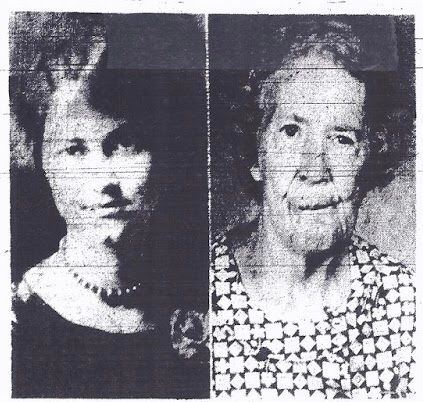
He said he and his only surviving sister, Thamer, had agreed they would “never accept this woman could be Myrle.” Still, he gave Baker a portrait of his sister. In the photo, Myrle looks slightly off camera, amused, eyes softened, lips pulled into a shy smile.
Baker hurried back to Morton. At Queenwood East, an aide named Hilda Herren, who had cared for Mary for five years, met him at the door. She looked at the portrait and began nodding yes, emphatically. She said the woman pictured was the one she had known.
Baker showed it to other nurses. They pointed to similarities: the face shape, the curls, the sharp nose, the slope of the shoulders. Baker said he wished someone had photographed Mary while she lived. To his surprise, a secretary located a picture in the records.
The image showed an older woman with short, curly gray hair. One side of her face drooped from a stroke. In Myrle’s portrait, a vaccination scar was visible on her left bicep. A nurse told Baker Mary had a vaccination scar in the exact same spot.
One nurse said she never should have been institutionalised. She had amnesia, but she was not insane. Another said that without what Bartonville did to her, Mary likely would have regained her memory quickly enough.
Baker could not visit Bartonville for a younger photo because it closed in 1973. His only remaining option was Manteno State Hospital, where Mary first appeared in 1932. Manteno kept photographs only ten years, and staff did not remember her.
The archives offered little. A Mary Doefour, the fourth doe without a name, was listed as a black woman released into state custody in the 1940s. Mary was white and never released. There were parallels with Mary Doefive, though.
That woman’s birth date was recorded as June 7, 1907, matching the estimated birth date Baker had seen on Queenwood East death records. Yet this woman was said to be from Missouri. John Steinmetz, a superintendent helping Baker with the archives, was sure it was a red herring.
Manteno’s early record keeping was sloppy, and details about the Does were frequently mixed up. Even so, Baker learned one crucial point: Manteno opened in 1932, the year Mary first appeared in its files. It was likely she had been hospitalized somewhere else since 1926.
Steinmetz believed she may have been transferred in 1932 from Kankakee State Hospital. He called Kankakee and pushed them to search old transfer records. They found a single yellowing card. In neat handwriting, it noted that an amnesic patient who could not recall her name had been transferred from Kankakee to Bartonville.
The card did not state how long she had been at Kankakee. It also did not record a name, because the Does received their assigned names only after arriving at Manteno. Baker suspected what the Kankakee files would show if he could see them.
He believed the woman had been at Kankakee since November or December 1926, weeks after Myrle vanished from Iowa. That would complete the puzzle and let him write with certainty that Mary and Myrle were the same. Yet his call to Kankakee went nowhere.
The secretary who answered told him coldly that she could not share information about former patients without consent. Baker tried bargaining, and she refused. Others he contacted later refused as well. Mary was dead, so her family would have to sue the state government.
They would need to persuade a judge they had strong reasons to access confidential medical records. Given Mary’s story and Myrle’s family’s desire to bury her properly, the odds could favor them. Baker still had to convince Harry Sizer before anything could move forward.
Hunting for one more piece of evidence, Baker brought both portraits to Professor Charles Warren, an anthropologist known for matching photographs to skeletal remains. Baker hoped Warren could identify Mary as Myrle from facial structure alone.
Warren said he would need an X ray of Mary’s skull for a definitive conclusion, but since Mary had been cremated, he only had the Queenwood East photo. He studied the two pictures side by side for several long minutes.
This kind of comparison was not exactly his specialty, and it could not be used as legal proof. Still, Baker’s story affected him, so he offered an opinion. He leaned forward, removed his glasses, rubbed his nose, and pointed at their chins.
Both women had cleft chins, though Mary’s looked less obvious because she pushed her mandible forward to hide missing teeth. Mary’s skin sagged with age and her stroke pulled one side down, yet the underlying bone structure was strikingly close.
Their cheekbones sat in nearly the same place. Their hair texture matched as well. Were they the same woman? Warren gave Baker a sad smile. His eyes suggested yes, but he said he could not prove it.
Baker tried one last time to persuade Harry Sizer that Mary was his lost sister. DNA was not an option, but if they obtained the Kankakee files, they would have the closest thing to a final proof: evidence Mary was at Kankakee from 1926 until the 1932 transfer to Bartonville.
The Peoria Journal Star, impressed by Baker’s detective work, was willing to support Harry in court. One reporter at the paper, also a licensed attorney, offered to represent him for free. Baker would report the fight and seek justice for Myrle, a victim of a barbaric mental health system.
Myrle’s ashes could be moved into a proper urn the Sizer family could keep. She could have a service and a gravestone with her true name and birthdate. People who knew her and were still alive could finally say goodbye.
Harry refused. Myrle’s disappearance had been the deepest wound his family ever carried. Without a grave to visit and without an explanation that could offer closure, he had mourned in his own way. He had buried her inside himself, keeping only the hope that she crossed gently into a place beyond pain.
Baker needed minutes to absorb what Harry said, and longer to reach into his jacket and return Anna Myrle Sizer’s portrait.
Endnotes
Rick Baker never proved that Mary Doefour and Anna Myrle Sizer were the same person.
Harry Sizer died on July 18 1979, at his home in Lisbon, Iowa, four months after Rick Baker published the final chapter of his investigation into Mary Dufour in The Peoria Journal Star.
Anna Myrle Sizer’s last surviving sister, Thamer Sizer, died on February 5, 1988, in Iowa. Rick Baker contacted her too, but she also never sued the state to access Mary Doefour’s Kankakee records.
Baker tried to locate the child Mary Doefour gave birth too, presumably at Kankakee, but he never found a record.
The urn holding Mary Dufour’s ashes was buried beneath a fir tree at Roberts Cemetery in Morton, Illinois, in a section reserved for those without money and without relatives.
Her grave reads simply “Mary Doefour — June 7 1907 — March 2 1978.”

Baker later assembled an expanded version of his series, “The Search for Mary Doefour,” into a book titled “Mary, Me — In Search of a Lost Lifetime.” It was published in 1989, and you can buy it here.
Baker died in 1988 in a car crash, convinced he had uncovered Mary Dufour’s true identity. His obituary can be read here.
Baker’s long news story, “The Search for Mary Doefour,” can be read here (includes PJS clippings).
More Peoria Journal Star clippings can be found here.