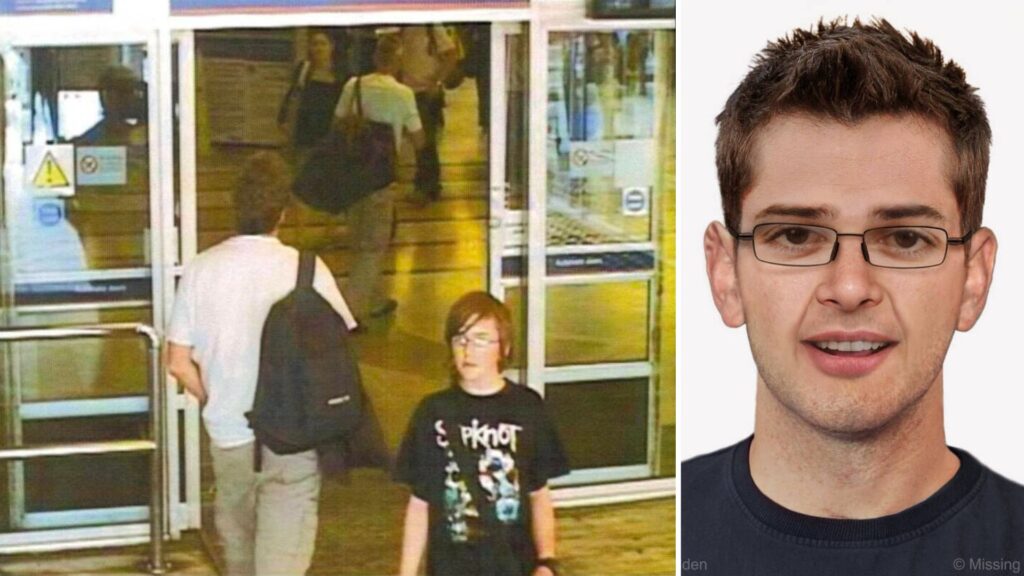
On 14 September 2007, 14-year-old Andrew Paul Gosden vanished under puzzling circumstances. That morning, he left his home in Doncaster (South Yorkshire) as usual for school – but instead withdrew £200 from his bank account, bought a one-way train ticket to London, and was last captured on CCTV emerging from London’s King’s Cross Station.
Despite extensive investigations and nationwide appeals, no confirmed trace of Andrew has ever been found since that day. His disappearance became one of Britain’s most high-profile missing persons cases, with his family relentlessly campaigning for answers over the years.
In late 2021, a potential breakthrough arose when police arrested two men on suspicion of involvement in Andrew’s disappearance, even investigating them for kidnapping and human trafficking.
However, after lengthy inquiries and forensic analysis of seized devices, those individuals were ultimately cleared of any connection to the case. As of today, more than 18 years after Andrew Gosden vanished, the case remains unsolved and open.
Below is a comprehensive timeline of the events and investigations surrounding Andrew’s disappearance, followed by an overview of key developments, theories, and the ongoing efforts to find answers – all based on confirmed facts and reputable reports.
Background on Andrew Gosden
Who was Andrew?
Andrew Gosden was, by all accounts, a quiet and intelligent boy from a loving family in Balby, a suburb of Doncaster in northern England. Born 10 July 1993, he was the youngest child of Kevin and Glenys Gosden and had an older sister, Charlotte.
At the time he went missing, Andrew was a month into Year 11 at McAuley Catholic High School. He was academically gifted – part of the government’s “Young, Gifted & Talented” program for top students – and was predicted to earn straight A’s in his GCSEs.
Teachers even considered him a potential Cambridge candidate. Despite his brilliance, Andrew was modest about school; he often “cruised” through classes and showed a neutral attitude, hoping for more challenge.
In personality, Andrew was gentle, shy, and happy in his own company. He had a small circle of friends (with whom he mostly socialized at school rather than outside).
His family described him as a “home bird” – he rarely went out, never without letting someone know where he was going. There were no clear signs of trouble in his life before he vanished: no history of depression, no indication of bullying, and he came from a stable home with caring parents.
Andrew’s interests included reading and video games; his bedroom bookshelf contained well-worn copies of The Lord of the Rings and The Hitchhiker’s Guide to the Galaxy, and he loved gaming on his console.
He was also passionate about music, especially rock and heavy metal. Among his favorite bands were Slipknot, Muse, Cradle of Filth, and Funeral for a Friend. In fact, Andrew often wore band t-shirts – on the day he disappeared, he donned a black Slipknot t-shirt, reflecting his love of goth and metal music.
At home, the Gosden family was close-knit. Kevin and Glenys were committed Anglican Christians (though they hadn’t baptized their children, preferring to let them choose later).
Andrew had attended church with them until about 18 months prior, when he lost interest and his parents did not force the issue. He had also been a Cub Scout, but quit a few months before going missing, telling his father he found it boring.
None of these changes seemed alarming at the time – just typical teenage shifts. In summer 2007, his parents had suggested he visit his grandmother in London, but 14-year-old Andrew declined, which they chalked up to normal teenage reluctance.
By all outward signs, Andrew was a normal, content teen, slightly introverted but not unhappy. His sudden disappearance that September truly came out of the blue for his family, who had “not the slightest idea” why he would want to run away.
As his sister Charlotte later reflected, “If there were problems and he was running away from something… I would have really hoped he could have spoken to me… I struggle with [the idea he had troubles he couldn’t share]”.
Timeline of 14 September 2007: The Day He Vanished
Andrew’s last known day can be reconstructed in detail from witness sightings, CCTV footage, and records uncovered in the investigation. Friday, 14 September 2007 was a school day that started off somewhat unusually for him:
1. Morning at Home: Andrew, normally punctual, had difficulty waking up that morning and seemed irritable – behavior his mother noted was out of character. He left the house at 8:05 AM in his school uniform, as if heading for the school bus.
A family friend saw him walking across Westfield Park (near his home) in the direction of his bus stop around this time. However, instead of boarding the school bus, Andrew deviated from his routine.
2. 8:30 AM – Returning Home Secretly: After his parents and sister had left for work and school, Andrew doubled back to his house. He walked to a nearby ATM at 8:08-8:10 AM and withdrew £200 – nearly all the money in his youth bank account (he had £214 available).
The cash machine limited withdrawals to £20 increments, so £200 was the maximum he could take. This withdrawal was later confirmed from bank records. A neighbor’s CCTV camera captured Andrew coming back home shortly after, indicating he returned once he was sure the house was empty.
3. Changing Clothes and Packing: At home, Andrew shed his school uniform. He placed his uniform shirt and trousers in the washing machine and hung his blazer carefully over the back of a chair. He then changed into his casual attire: a black Slipknot band t-shirt and black jeans.
Andrew also picked out his black canvas satchel (a bag adorned with patches of rock/metal bands) to take with him. Into this bag he packed a few essentials – notably his wallet, keys, and his PlayStation Portable (PSP) handheld gaming console.
Curiously, he did not take the PSP’s charger, and his father later noted Andrew hadn’t taken any kind of coat or sweater either. Andrew also left behind some personal items one might expect a runaway to grab: he did not carry his passport (suggesting he wasn’t planning to travel internationally), and despite emptying his bank account, he left about £100 in cash that he had stashed from gifts at home.
These details – leaving behind backup money, charger, and passport – puzzled investigators and family, as they could indicate he didn’t plan for a long-term escape (or wasn’t thinking things through fully).
4. Leaving Home for the Last Time: At approximately 8:30 AM, Andrew departed his house again – this time for good. The neighbor’s CCTV once more recorded him, now dressed in his casual clothes and carrying his bag, as he walked down Littlemoor Lane toward Westfield Park, in the direction of Doncaster’s main railway station. He was traveling alone and on foot.
5. Purchasing a Train Ticket: Andrew arrived at Doncaster Station sometime before 9:30 AM. He went to the ticket office and bought a one-way ticket to London King’s Cross, priced at £31.40.
The ticket seller later remembered this transaction vividly because she had offered Andrew a return (round-trip) ticket for just 50 pence more – but he insisted on a single (one-way) ticket.
This small yet significant detail, which emerged days later, suggested that Andrew did not intend to be back in Doncaster in the immediate future, though his father would later reason that Andrew knew people in London he could have stayed with if needed. With ticket in hand, Andrew headed to the platform.
6. 9:35 AM – Boarding the Train: Andrew caught the 9:35 AM GNER inter-city train from Doncaster to London King’s Cross. On board, he kept a low profile. A woman who sat next to him later came forward to say Andrew was quiet and engrossed in playing a game on his PSP during the journey.
He did not appear distressed or talkative; he simply played his video game calmly. The train ride from Doncaster to London takes roughly 1 hour 45 minutes.
7. 11:20–11:25 AM – Arrival in London: The train arrived in London around 11:20 AM, pulling into King’s Cross Station about 9 minutes behind schedule. CCTV cameras at King’s Cross captured Andrew as he exited the station at 11:25 AM, into the busy late-morning crowds of central London.
In the grainy still images later released, Andrew is seen walking out of the main concourse, identifiable by his black Slipknot t-shirt and the satchel slung over his shoulder. This footage is the last confirmed sighting of Andrew Gosden. He was 14 years old and alone, seemingly just another young visitor in the city.
After 11:25 AM – Disappearance: What Andrew did after emerging from King’s Cross is unknown. He vanished into the city and was never seen by his family again. Tragically, no CCTV beyond King’s Cross was recovered that showed Andrew’s next movements – a fact that became a source of regret and criticism in the investigation. At the time, no one in London would have known to look out for a missing boy from Doncaster, since his family didn’t even realize anything was wrong until later that evening.
It’s important to note that none of Andrew’s teachers, friends, or family knew he had skipped school and headed to London that morning. Because he left home appearing to go to school as normal, his disappearance would only come to light hours later, triggering a frantic search.
Discovery and Initial Police Response
Evening of 14 September 2007: Andrew’s family had no clue during the day that anything was amiss. That Friday afternoon, when Andrew failed to show up for school, his teachers did attempt to contact his parents – but in a twist of fate, the school dialed the wrong number and left a message with another family by mistake. Kevin and Glenys Gosden thus received no absence alert. As a result, the family remained unaware that Andrew wasn’t at school.
It wasn’t until around 7:00 PM that concern hit. The Gosdens were gathering for dinner as usual, expecting everyone to be at home. They assumed Andrew was either playing video games in the converted cellar or doing homework in his room – his typical after-school routine. When they called out for him to join dinner, he didn’t respond. Searching the house, they found no trace of Andrew. What they did find was worrying: his school blazer and tie were neatly hung over a chair, and later they discovered his shirt and trousers in the washing machine – clear evidence he had come home from his supposed commute to school. Andrew’s wallet, keys, and PSP were also missing from his room, confirming he had taken those with him. Immediately, the family sensed something was very wrong.
At first, Kevin and Glenys tried to stay calm. They thought perhaps Andrew had lost track of time with a friend or neighbor, as that was the only innocent explanation they could imagine. They began calling around to his friends’ houses. Each friend reported they hadn’t seen Andrew at all that day – in fact, he hadn’t been at school. Charlotte, Andrew’s sister, recalled the “complete panic” that set in when they realized Andrew had essentially been missing since the morning: *“We initially thought something must have happened on the way to school… When we found that he hadn’t even been to school – hadn’t even tried to go to school – that was even more worrying.”*.
By 7:00 PM, the Gosdens phoned the South Yorkshire Police to report Andrew missing. Officers arrived and, given the circumstances, an investigation began swiftly that evening. The family, however, did not sit idle. Even before the police organized formal searches, Kevin and Charlotte went out driving to scan Andrew’s route to school and the surrounding area, in case he had been in an accident or wandered somewhere. They found no sign of him. Within three hours of confirming Andrew was missing, the family had worked with police to produce a missing persons leaflet with Andrew’s description and photo. Family, friends, and neighbors joined the search, distributing flyers and combing the local area until nightfall that Friday, but nothing turned up.
Police at first considered the possibility that Andrew might have met with some mishap on his way to school. They searched the neighborhood bushes, alleys, and open areas near the Gosden home over the weekend, but found no evidence of an accident or foul play in the vicinity. It was as if Andrew had vanished into thin air.
Confirmation of the Train Trip: In the first couple of days, Andrew’s parents mentioned to police that Andrew was very capable with public transportation and had relatives in London. This raised the question – could he have traveled to London? On the third day of the search (17 September 2007), a breakthrough came. Investigators spoke to staff at Doncaster rail station and learned that a ticket seller vividly remembered selling a one-way ticket to a boy of Andrew’s description on the morning he disappeared. The detail about the boy refusing a return ticket for an extra 50p rang a bell, and CCTV from Doncaster station confirmed Andrew had been there. This was a major development: it meant Andrew intentionally went to London on his own. Kevin Gosden later said the purchase of a single ticket hadn’t initially struck him as odd only because Andrew did have family and acquaintances in London – he had options to stay over if needed. Nevertheless, the confirmation that Andrew boarded that King’s Cross train turned the focus of the search toward London.
South Yorkshire Police alerted the British Transport Police (BTP) and Metropolitan Police in London early on. According to police, within 48 hours of Andrew’s disappearance they had asked BTP to review CCTV footage at King’s Cross for any sign of him. However, BTP officers reported they “could not pick him out from the crowds” on the initial pass. It appears that amidst the sea of commuters on a busy Friday, Andrew’s image was missed at first. Only three weeks later, after South Yorkshire Police sent one of their own officers to London to assist, did a thorough review of the King’s Cross CCTV from 14 September finally spot Andrew’s figure. The timestamp was 11:25 AM, showing Andrew exiting the station’s main entrance alone. This 27-day delay in securing the crucial CCTV footage proved costly – by the time investigators knew where and when Andrew was in London, it was mid-October and any further CCTV from buses, the tube (subway), or streets in that area had long since been overwritten or erased. Consequently, no video trail beyond King’s Cross was ever recovered, a lapse that severely hampered the investigation’s early days and drew later criticism.
Once the King’s Cross still images were obtained, police released them to the media. The grainy CCTV still of Andrew in his Slipknot shirt was publicized nationwide in hopes someone in London might recall seeing him. Investigators even zoomed in on one distinguishing feature: Andrew’s right ear has a unique double-ridge shape, unlike most people’s ears. A close-up image of his ear was circulated alongside the CCTV, with appeals noting this unusual trait that could make him easier to identify. Despite these efforts, no solid leads came from the immediate publicity.
Search Efforts and Investigation in London
With confirmation that Andrew had traveled to London, the focus shifted there. In the days and weeks following his disappearance, the Gosden family themselves went to London multiple times to assist in the search. They walked the streets handing out flyers and putting up posters across key areas – especially at places Andrew loved or might have been drawn to. Andrew was a fan of museums, exhibitions, and sightseeing in London (the Gosdens often visited the capital for family trips), so Kevin and Glenys concentrated on areas like the museums district, tourist attractions, parks, and anywhere a curious teenager might wander. The family also had relatives in Chislehurst and Sidcup (suburbs of south-east London), so police initially searched those areas under the possibility Andrew might seek out family, but nothing was found there.
Possible Sightings: In any missing person case, reported sightings pour in, and Andrew’s case was no different. Within the first year, police logged over 120 possible sightings of Andrew across the UK. About 45 of those were from various locations in London, and 11 from the coastal city of Brighton, with the rest scattered around the country. The vast majority could not be substantiated. However, a few early reports stood out:
- Same-Day Sightings (14 Sept): Several people later claimed to have seen a boy matching Andrew’s description in London that very afternoon. One credible tip placed him at a Pizza Hut on Oxford Street (about 2.6 miles from King’s Cross) on 14 September. The witness described interactions that sounded like Andrew, and Andrew’s family has said they consider this Pizza Hut sighting the most plausible of all, believing he may have gone there to eat after arriving in London. Frustratingly, the family says this lead was “never investigated by police” – by the time it came to light, CCTV from that restaurant was long gone and no officers interviewed staff or patrons at the time. Another report claimed Andrew was seen later on 14 September in the Covent Garden area. In that instance, a woman approached a boy who looked like Andrew (she had seen news coverage) and asked if he was the missing boy; the boy reportedly replied “No” and walked off. This encounter happened about a month later (17 October) in Covent Garden – if it truly was Andrew, it suggests he might have still been in London weeks after disappearing. However, like the others, this sighting couldn’t be confirmed. (Police only interviewed the Covent Garden witness six weeks later, well after the trail had gone cold.)
- Mid-September 2007: On 17 September (three days after disappearance), there were additional unconfirmed sightings of a boy resembling Andrew on Oxford Street again, and the next day (18 Sept) someone reported seeing a boy sleeping in a park in Southwark (south London) who could have been Andrew. On 19 September, a witness believed they saw Andrew get off a train from Waterloo at Mortlake station in southwest London, and noted that the boy then walked up Sheen Lane and along Upper Richmond Road. Importantly, by the 19th it was noted that this boy had obtained warmer clothes (the nights were getting chilly by then) – lending a bit of credibility, since Andrew hadn’t taken a coat. Yet again, none of these sightings could be definitively verified.
- Beyond London: There were scattered reports from farther afield in later weeks: possible sightings in Streatham (South London), South Wales, Plymouth (southwest England), and Birkenhead (northwest England) among others. In 2008–2009, two separate tips claimed sightings: one outside the Natural History Museum in London, and one at a pub in Southend (Essex). Despite the sheer number of tips, not a single sighting could be confirmed as Andrew. Kevin Gosden lamented that police did not rigorously follow up many of these leads – for example, the woman who reported the Covent Garden encounter wasn’t interviewed until weeks later, as mentioned, and other leads were seemingly left dangling.
These possible sightings, while tantalizing, ultimately led nowhere. They do suggest, however, that Andrew might have spent at least a few days in London after arriving. If the Oxford Street and Southwark park reports were accurate, he was moving around the city on his own in the days right after he disappeared. But because the information was either delayed or unconfirmed, none of it brought the police tangibly closer to finding him.
Investigative Roadblocks: In those early weeks, police pursued many angles. One concern was that Andrew could have arranged to meet someone (possibly someone met through the internet or gaming). However, an extensive digital forensic sweep turned up nothing. The Gosdens did not have a computer at home that Andrew used regularly – only Charlotte’s new laptop, which Andrew barely touched. South Yorkshire Police seized computers from Andrew’s school and the local library to see if he had logged on to any accounts there; they found no trace of online communication by Andrew. Additionally, Andrew wasn’t active on social media (which in 2007 was still relatively limited for teens) and did not even have an email address, according to his dad. The family’s Xbox console and Andrew’s PSP had no online accounts or chats associated with him. Sony assisted by checking the PSP’s serial number in their network logs – it had never been used to access the internet or PlayStation Network. Furthermore, Andrew had no mobile phone with him. He’d had a couple of basic phones when younger, but kept losing them and wasn’t keen on getting a new one; in fact, when his parents offered to replace his phone, he preferred an Xbox instead. So when he left, there was no phone signal to trail. This digital dead-end led police to conclude there was no evidence Andrew was groomed or enticed online – if he arranged to meet someone, it likely wasn’t through an internet traceable method.
In the absence of obvious leads, police and family kept the case in the public eye. One year after Andrew’s disappearance, on the first anniversary in September 2008, The Times reported that 122 sightings had been reported (as noted above) and ran a feature on the case. Andrew’s school also pitched in: his head teacher led a group of students to London to hand out 15,000 leaflets to mark one year missing. The media in South Yorkshire and nationally covered Andrew’s story on and off, especially on significant anniversaries and birthdays.
Subsequent Developments (2008–2017)
Over the years, the Gosden family and investigators continued to chase down every possible lead, while also launching various public appeals. Below is a timeline of major developments and efforts in the decade following Andrew’s disappearance:
- November 2008 – Mysterious Man at Police Station: A strange incident occurred two months after Andrew went missing. An unidentified man walked into Leominster police station in Herefordshire (western England) one evening and used the intercom to tell officers he had information about Andrew. By the time an officer came to take details, the man had left, and he never returned. Later, after Andrew’s case was featured on BBC’s The One Show, the BBC received an anonymous letter from someone claiming to be that man. The letter purported that Andrew had been sighted in Shrewsbury (also in western England) around that time. It’s unclear if the letter was truly from the same person, or if the Shrewsbury information was credible. Police appealed for the Leominster tipster to come forward again, but he never did, leaving this lead unresolved.
- September 2009 – Two Years Missing: To mark two years since Andrew disappeared, the family worked with the charity Missing People to release age-progressed images of how Andrew might look at age 16. These composite images showed Andrew with slightly older features, to help the public imagine him beyond the 14-year-old photos. Around the same time, Kevin Gosden made a public appeal directed to the LGBTQ+ community. The family had considered that one possible reason for Andrew’s sudden flight might be if he was struggling with his sexual orientation and feared talking about it. Statistics show LGBT youth are more likely to run away than their peers. Kevin stressed that if Andrew was gay, it didn’t matter one bit to them – *“we are a pretty open family… If he is gay, we have no issue with it. He is loved unconditionally by both my wife and I and his sister”*. His heartfelt message, published in a November 2009 PinkNews article, pleaded: *“Andrew, just tell us you’re alive… the only thing that would await you if you returned is a lot of missed hugs.”*. This appeal was an attempt to reach Andrew (or anyone who might know him) in case this very personal issue was a factor in his disappearance. No direct response came from it, but it underscored the family’s determination to consider any and every explanation.
- May 2011 – Sonar Search of the Thames: With still no leads after nearly four years, the Gosdens took an extraordinary step: they hired a private company with specialist equipment to scan the River Thames in London, on the fear that Andrew might have ended up drowned in the river. Using high-tech sonar gear (typically used in sea rescues and body recoveries), the team searched the Thames for any sign of Andrew. Thankfully (and sadly), they did not find Andrew’s body. This brought relief in the sense that it did not confirm a tragedy, but also frustration because it meant the mystery continued. Notably, the sonar search did discover another body in the Thames – unrelated to Andrew – illustrating just how much desperation drives such efforts, and how even negative results have a grim significance.
- 2016 – National Media Appeal: In April 2016, Andrew’s parents participated in a BBC Panorama special titled “Britain’s Missing Young People”, which profiled several long-term missing cases. Kevin and Glenys gave interviews, and even the family’s local vicar (who had actually seen Andrew walking on the morning he left, not realizing anything was wrong) spoke on the program. This TV exposure was aimed at jogging memories or generating new tips as the ninth anniversary approached. The following year, September 2017 marked 10 years since Andrew vanished, and the Missing People charity chose Andrew as the face of their “Find Every Child” campaign. His image was put on billboards and digital displays across the UK, reminding the public that this boy was still missing a decade on.
- September 2017 – Fresh Police Appeal: On the 10th anniversary, South Yorkshire Police made a detailed public statement updating the case. They revealed they had pursued new lines of inquiry behind the scenes. For instance, they had been checking records for any optical prescriptions similar to Andrew’s (he had very strong eyesight prescriptions), monitoring for any applications to the Passport Office or National Insurance by someone of his age with missing history, and circulating Andrew’s DNA, fingerprints, and dental records to hospitals, morgues, and police forces. The tone of the police at that time suggested they believed it was possible Andrew was still alive, living under a different identity. They noted they conduct annual sweeps of records of unidentified patients or John Does in hospitals, just in case. Detective Chief Inspector Joanne Bates issued a public plea: if anyone out there suspects they know a man in his twenties who might actually be Andrew (for example, someone with an incomplete personal history, or the distinctive ear feature, etc.), to please come forward. She also had a direct message for Andrew: if he was out there and hearing the appeal, he could contact the police confidentially just to let them know he’s safe, and they wouldn’t reveal it publicly without his consent. This showed that, officially, the possibility that Andrew had run away to start a new life was being taken seriously ten years later.
- June 2018 – The “Andy Roo” Online Lead: In mid-2018, an intriguing but ultimately fruitless lead emerged via the internet. A person contacted the Gosden family to report an online conversation with someone using the handle “Andy_Roo” (significant because “Roo” was Andrew’s nickname in the family). This person recounted that Andy_Roo had mentioned their boyfriend had left them and they were in a bad spot, needing £200 for rent, but they didn’t have a bank account because *“I left home when I was 14.”*. The Good Samaritan found this odd and, upon noticing the user claimed to be in Lincoln (a city in eastern England) and seeing the connection to age 14 and the name “Roo,” they thought of Andrew Gosden. They offered to send money, and when Andy_Roo declined any bank transfer (supposedly due to having no account), it raised suspicions further. The tipster forwarded all this info to the Gosdens. Police investigators took it seriously enough to track down the website and attempt to identify the user, but hit a snag: the site in question had recently undergone a system overhaul that wiped or lost older user data, so they couldn’t trace the account details. The anonymity of the internet once again foiled the lead. The Gosden family even took it upon themselves to drive around Lincoln multiple times, watching for any young man who resembled Andrew (by then in his mid-20s). Nothing concrete came of this. Kevin described it as “another dead end,” delivered with an understandably *“saddest sigh”*. While this lead did not pan out, it was another example of how the family continued to chase any glimmer of hope, even a decade later.
- July 2018 – 25th Birthday & Rock Band Support: In July 2018, Andrew would have turned 25 years old. To mark this, two new age-progressed images (at age 25) were released by the family, showing how Andrew might look as a young adult. They depicted him with different hairstyles and with/without glasses, reflecting that he might use contact lenses by now (since his eyesight was very poor but correctable). Around the same time, the Gosdens got a boost from one of Andrew’s favorite bands: the British rock band Muse announced they would help publicize the search for Andrew. Muse has a large international following, and their support (via social media and at concerts) spread awareness of Andrew’s case to a broader audience of music fans. The family was grateful for this unexpected advocacy from a band whose music Andrew loved.
Throughout all these developments, Andrew’s family kept his home ready for his return. In interviews, Kevin and Glenys revealed they never changed the locks on their house after he disappeared – because Andrew had taken his key with him, and they wanted him to be able to walk back in at any moment. For years, they left his room largely untouched. (They eventually repainted and took down some band posters as time passed, but many of Andrew’s belongings – his books, his rocks and gem collection, his clothes – remained in place.) Kevin admitted that at times the family considered moving for a fresh start, but they resisted because of that lingering hope: *“He went off with your front door key… in the hope that he’s still alive and well somewhere, we’re still here – he would know where to find us if he wanted to.”*. This poignant sentiment underlines the limbo the Gosden family has lived in: caught between grief and hope, unable to mourn or move on without knowing what happened.
Theories and Possible Explanations
Over the years, numerous theories have been proposed – by family, police, journalists, and the public – to explain Andrew Gosden’s disappearance. None of these are confirmed, but each theory attempts to make sense of the few facts we know. Below, we outline the main hypotheses, along with supporting observations or counterpoints:
- 1. Voluntary Runaway (Seeking Independence or “New Life”): One theory is that Andrew left on his own accord to start a new life or experience freedom. At 14, perhaps he felt constrained or simply wanted an adventure. The fact he emptied his bank account, waited for his family to leave, and bought a one-way ticket suggests a deliberate plan to go away for more than a day. Some have likened his case to the story of The Fall and Rise of Reginald Perrin (a TV show Andrew enjoyed) – in that show, a man fakes his death to reinvent himself. Kevin Gosden himself wondered if Andrew decided to do a real-life “Reginald Perrin” and vanish to restart somewhere new. “Did he decide to reinvent himself? Or was something troubling him that he felt he couldn’t tell us? In my heart, I still think it was a spur-of-the-moment thing,” Kevin said in 2009. There were no obvious problems at home; however, puberty can bring hidden inner turmoil. If Andrew had a personal issue (whether related to mental health, academics, or identity) that he kept private, he might have chosen to run rather than seek help. On the other hand, it’s uncommon for a 14-year-old with no prior history of running away to successfully disappear without a trace. Andrew left with limited money and no change of clothes or electronics for long-term life. If his goal was truly to start fresh, he had no ID, no known alias, and left a loving family – it would be an extraordinarily difficult path for a young teen. Thus, while voluntary runaway is possible (and the family has always left open the door for him to return without judgment), it doesn’t fully explain why Andrew never contacted anyone once things got tough. Police haven’t found any evidence of Andrew establishing a new identity, but they continue to watch for any hints that he might be living off the grid somewhere.
- 2. Meeting Someone (Grooming or Lure): Given Andrew’s age, many feared that he might have been groomed or lured by an individual – possibly an older predator – who gained his trust. It’s easy to imagine a scenario where someone (maybe posing as a friend of similar age or with mutual interests, perhaps via an online forum or gaming network) convinced Andrew to come to London. However, intensive forensic checks found zero evidence that Andrew communicated with anyone online or by phone. He apparently had no email, no active social media, and his gaming devices showed no online chats. That doesn’t exclude the possibility he met someone offline – perhaps during his summer school for gifted students, or on a previous family trip to London, or even randomly. But nothing in his known recent life pointed to a new friend or secret relationship. The lack of any contact trail makes this theory harder to support. If someone groomed him, they did so without using any traceable medium, which would be unusual. Police did investigate tips like the Leominster man’s claim (which hinted an acquaintance might have seen him in Shrewsbury) but that yielded nothing solid. In the absence of evidence, the “lured by a stranger” theory remains speculative. Unfortunately, traffickers or abusers have been known to target teens at transit hubs. The arrests in 2021 (discussed below) show police have not discounted the idea that Andrew could have encountered criminals who meant him harm. Still, no definitive suspect or contact has ever been identified.
- 3. Foul Play After Arrival (Abduction or Murder): Some believe Andrew may have come to harm after reaching London – perhaps a victim of opportunity at the hands of a predator. A 14-year-old alone in a big city could be vulnerable. Over the years, retired detectives and commentators have drawn chilling parallels with other cases. Notably, Mick Neville, former head of the Metropolitan Police’s Central Images Unit, pointed out that another teen boy, Alex Sloley, disappeared in London in 2008 under similar circumstances (Alex was 16, also bright, vanished without a trace not far from King’s Cross). Neville mused, *“It raises the question of whether there is a serial killer on the prowl… the potential links between these cases need to be recognised.”*. This is a heavy implication, and no evidence has concretely tied the Gosden and Sloley cases together beyond coincidence of time/place. But Neville’s theory underscores the possibility of a unknown predator in London who might have targeted Andrew. The December 2021 arrests also fell under this foul play category: acting on a tip, police arrested two men (aged 38 and 45) on suspicion of kidnapping and human trafficking in connection with Andrew’s case. The older suspect was additionally held on child pornography charges. These arrests indicate that at least one investigative strand had developed information suggesting Andrew could have been abducted or exploited by criminals. Ultimately, after lengthy inquiries, police did not charge either man – by 2023 they stated they were *“confident the two men… played no part in Andrew’s disappearance”*. Nonetheless, the fact that such leads are pursued so many years later shows the foul play theory remains on the table. If Andrew encountered a predator upon arrival, it could explain why he never contacted home. Unfortunately, without evidence or a confession, this theory is impossible to prove or disprove at present.
- 4. Spur-of-the-Moment Adventure (Sightseeing or Concert): Andrew’s family initially considered that perhaps there was something in London he wanted to do or see for fun, and that he intended to return home after. Kevin Gosden wondered if Andrew went “sightseeing” or to hand out CVs for work experience (Charlotte had done something similar at 14). Investigators and internet sleuths have dug into events happening in London on 14 September 2007. A popular hypothesis is that Andrew traveled to attend a specific event, like a concert or a gathering. Indeed, several enticing events were happening: the American rock band Thirty Seconds to Mars had a concert in London that night; a cult progressive metal band SikTh was playing a special farewell show in Islington (walking distance from King’s Cross) that same evening; and the Finnish band HIM was doing an in-store signing event at an Oxford Street HMV the following Monday (17 Sept). Andrew was very into similar music (Slipknot, Muse, Marilyn Manson, etc.), so it’s not far-fetched that he might have been drawn to a concert or fan event. Mick Neville found the SikTh concert theory plausible enough that in 2017 he appealed for concert-goers to check old photos or videos from the gig, in case Andrew was captured in the crowd. Despite these efforts, no evidence emerged that Andrew attended any of those events, and the family wasn’t even sure he liked those particular bands. If his trip was meant to be a day out in London (visiting museums or just experiencing the city solo), something could have gone awry that prevented him from coming home. This theory doesn’t conflict with others – it could be that he intended a short adventure (as a teenager testing boundaries) but then encountered foul play or an accident. The key support for this theory is that Andrew loved London and had traveled there happily with family before, so he might have been seeking some excitement or a specific experience. The key weakness is that, if it were a simple day trip, one would expect him to resurface once the outing was over or at least eventually, which hasn’t happened.
- 5. Personal Struggle (Mental Health or Identity Issues): Another perspective is that Andrew might have been secretly struggling – perhaps with depression, anxiety, or identity (such as questioning his sexuality, as the family mentioned). If so, running away could have been seen by him as an escape or a cry for help. We know the family saw no overt signs of depression or distress in Andrew. But teenagers can internalize problems. If Andrew felt unable to express something (be it related to sexual orientation, academic pressure from being “gifted”, or any adolescent issue), he might have chosen to remove himself from the situation. The 2009 appeal to the gay community, as noted, was one reflection of this theory – the family openly stated they’d accept him no matter what, hoping that message might reach him. Sadly, if Andrew did leave due to a mental health crisis or fear of acceptance, it’s possible he harmed himself or fell into dangerous circumstances afterward. There’s no direct evidence of this, but it overlaps with both the runaway and foul play scenarios: he could have left due to internal struggles and then either started a new hidden life or met harm. Without any communication from him, his true state of mind in September 2007 remains a mystery.
- 6. Accident or Misadventure: Finally, one cannot rule out that Andrew might have died accidentally in a way that has so far evaded identification. London is a vast city with rivers, abandoned areas, and myriad ways someone could be injured or worse. If he had, for instance, fallen into the River Thames or ended up in a fatal situation, it’s conceivable his body was never found or never identified (though it’s harder to imagine in a well-monitored city). The family’s sonar search of the Thames in 2011 at least covered one such possibility and found nothing. Police also circulated Andrew’s DNA and physical records to link with any unknown remains in the country. As of the latest information, Andrew’s bank account has never been touched since that withdrawal on 14 Sept 2007, and there’s been no verified use of his identity. If he had simply had an accident shortly after arriving (like being hit by a vehicle and taken in as a John Doe, or falling unconscious somewhere), one would think he’d have been found by now. Yet, with 3,000+ people in the UK missing over 10 years, it’s not impossible that Andrew is among those whose fate is still hidden.
Each of these theories has been considered in the investigation. In truth, multiple theories could intersect – for example, Andrew might have run away to attend something and then fallen victim to foul play, or he might have intended to start fresh due to personal issues and then been exploited by someone. The lack of concrete evidence means the case is essentially a puzzle with key pieces missing. Andrew’s family has remained remarkably open-minded yet realistic. Kevin Gosden has said *“You go round and round in circles thinking, ‘Probably they’ve been murdered, maybe they committed suicide, perhaps they are alive and well somewhere’ – it might just depend on what day of the week it is (which scenario you believe). It’s psychologically impossible to deal with.”*. This painful uncertainty fuels their continued advocacy to find even a sliver of truth.
Media Coverage and Public Appeals
Andrew’s disappearance has been extensively covered in British media and has resonated with the public due to the baffling nature of the case. The story has been featured on numerous platforms aimed at raising awareness:
- In 2008 and 2009, newspapers like The Times, Yorkshire Post, and Telegraph ran feature stories on Andrew’s case, highlighting the family’s plight and the lack of answers. These early articles painted a picture of a “perfect son, model family” and questioned what could have made him run.
- A 2009 Sky TV documentary in the series Missing Children: Lorraine Kelly Investigates devoted an episode to Andrew’s case. This would have been around the two-year mark, keeping his story in the national dialogue.
- The BBC daytime show Missing (formerly Missing Live) covered Andrew’s case in 2011, including interviews with officers who worked on it. Such programs often generate new tips from viewers, though in Andrew’s case no breakthrough came from it.
- As mentioned, BBC Panorama (July 2016) did an in-depth segment on Andrew as part of a broader look at missing young people. This high-profile coverage on a respected current affairs program helped re-emphasize the case to a wide audience nine years on.
- Andrew’s family has appeared on talk shows and news segments. In late 2018, for example, the ITV talk show Loose Women featured the Gosdens, discussing Andrew’s story and appealing for information.
- In 2019, the BBC released a podcast episode on their platform “The Next Episode” which discussed Andrew’s case and included an interview with Kevin Gosden.
- The case has also been highlighted on crime appeal shows like BBC’s Crimewatch (Crimewatch Live). In March 2020, Crimewatch Roadshow aired a segment including an appeal by South Yorkshire Police and an appearance by Kevin Gosden, once again urging anyone with knowledge to come forward.
Additionally, Andrew’s disappearance is often recalled by true-crime blogs, forums (like Reddit and Websleuths), and YouTube documentaries which dissect the timeline and theories. A 2018 article in VICE titled “The Strange Disappearance of Andrew Gosden” brought international attention to the case with a detailed narrative and interview with Kevin. And every year on the anniversary (14 September) or on Andrew’s birthday (10 July), local media in Yorkshire typically publish an update or a renewed call from the family, ensuring the public doesn’t forget.
Throughout all this, the Missing People charity has been a constant ally. They host Andrew’s profile on their website and facilitated several poster campaigns. In 2017, their “Find Every Child” billboard campaign prominently featured Andrew’s face and details across the UK. The charity’s 24/7 hotline is also a point of contact for any tips (they’ve noted that any information can be given confidentially, which might encourage someone reluctant to speak directly to police).
The Gosden family also maintain the website “Help Us To Find Andrew” (a weebly site) and social media accounts (Twitter: @andrew_gosden) where they share news and appeals. Kevin Gosden has written blogs (including one on the Missing People charity site) about memory and hope, to keep the search alive. These efforts underscore that for the family, no amount of time will diminish the drive to find Andrew or at least learn what became of him.
Recent Developments: 2021–2023
For many years, Andrew’s case saw no major breaks. But in late 2021, a significant development emerged:
- Arrests in December 2021: Acting on new information, on 8 December 2021 South Yorkshire Police, with assistance from the Met Police, arrested two men (aged 38 and 45) in London in connection with Andrew’s disappearance. The older man was arrested on suspicion of kidnapping, human trafficking and possession of indecent images of children, while the younger man was held on suspicion of kidnapping and trafficking only. Police did not publicly reveal what specific link these men were suspected of or what tip led them to the arrests (later, in 2023, police hinted it came from an anonymous tip-off that had not been previously disclosed). The news of these arrests, announced in January 2022, stunned those following the case – it was the first time anyone had been arrested in the 14-year investigation. Detectives interviewed both men extensively and seized numerous electronic devices from their homes to forensically examine for any evidence. They warned that analyzing those devices could take six months to a year, given the volume of data. The Gosden family was informed of the arrests before the public. Kevin Gosden posted a carefully worded statement on Twitter expressing that the development had “intensified” an already emotional time. He noted they “had carried the burden of not knowing for many years” and now faced a period of even more anxious waiting while investigations continued. The family consciously chose to stay quiet about the arrests at first so as not to prejudice the inquiry. When the news broke publicly, Kevin thanked the media, public, and Missing People charity for the support and asked for privacy as they awaited results. It was clear that while this turn of events offered a glimmer of hope for answers, it also reopened wounds – the prospect that Andrew may have indeed met with criminal harm was painful to confront.
- Ongoing Investigation and No Charges: Both arrested men were released under investigation (not charged) while police sifted through the evidence. Months passed with no updates. In January 2023, a year later, police stated the men remained under investigation and the device examinations were still in progress. Then, on 20 September 2023, South Yorkshire Police made an announcement that brought both relief and frustration: after a thorough inquiry, both suspects were released with no further action – essentially *“eliminated from the inquiry”*. Detective Chief Inspector Andy Knowles (the lead investigator) said, “We’re confident the two men arrested played no part in Andrew’s disappearance”, while emphasizing that the case remains open and active. The devices and accounts the men provided did not incriminate them; whatever suspicion existed, it ultimately did not lead to any charges. In a statement following this development, Andrew’s parents responded with empathy: *“Our hearts go out to the men who have been exonerated… We feel profoundly sorry for the inevitable distress that such allegations will have caused.”*. Kevin and Glenys expressed gratitude to the police for being thorough, but also admitted this outcome “intensified [our] sense of living in limbo” – after nearly 16 years, they found themselves *“no closer to discovering what has happened to Andrew.”*. It was a stark reminder that even leads which seem promising can turn into heartbreakingly empty results.
- Current Status (2025): As of the latest updates, Andrew Gosden is still classified as a missing person. He would be 32 years old now. Law enforcement continues to treat the case as an open investigation. DCI Andy Knowles has urged that even though 16+ years have passed, people’s circumstances and loyalties can change, and implored anyone with information – even if it seems small – to come forward now. The police have stressed that they follow up every tip and that, until there is evidence of Andrew’s fate, they will keep looking. They regularly compare unidentified remains or hospital patients to Andrew’s records, and any time a possible sighting is submitted, they evaluate it.
The Gosden family, meanwhile, keeps Andrew’s memory alive. They continue to mark his birthday and the anniversary of his disappearance with public messages. They’ve said they will never give up searching, but they also acknowledge the toll. Over the years, Kevin has candidly spoken about battling anxiety, depression, PTSD, and even suicidal thoughts stemming from the trauma of not knowing. Charlotte has said she still talks about Andrew in the present tense “because that’s the assumption until we know otherwise”, though *“it becomes harder with every passing year”*. The family’s resilience and openness have won them much public admiration and sympathy.
Anyone with information that might shed light on the case is urged to contact South Yorkshire Police (UK) or the independent charity Missing People, even anonymously. After all these years, even the smallest clue could finally crack this case and provide the Gosden family the answers they so desperately need.
Sources:
- BBC News – “Andrew Gosden: The boy who disappeared” (Oliver Wright & Tom Airey, 14 Sep 2017)
- VICE – “The Strange Disappearance of Andrew Gosden” (James McMahon, 30 Aug 2018)
- The Guardian – “Andrew Gosden’s family speak out after two men arrested over disappearance” (Damien Gayle, 11 Jan 2022)
- ITV News – “Men arrested over Andrew Gosden disappearance ‘eliminated from inquiry’” (Calendar, 20 Sep 2023)
- South Yorkshire Police / Press Releases via Sky News – “New age-progression image of boy who went missing in 2007” (28 Oct 2019)
- PinkNews – “Family appeals to gay community to find missing son” (Jessica Geen, 20 Nov 2009)
- Wikipedia – “Disappearance of Andrew Gosden” (summarizing facts and references, accessed 2025)