Ben McDaniel arrived at Vortex Spring early on Wednesday, August 18, 2010, planning a full day in the water. The temperature pushed around 90 degrees. Staff later said security cameras showed him chatting in the dive shop before he began.
He completed two dives by late morning and early afternoon. After the second, cameras captured him returning to the shop to refill tanks. Other divers noticed him lingering along the water afterward, testing equipment, making notes, and sitting for long stretches.
By that afternoon, some believed he was waiting for the place to quiet down. Vortex Spring typically closed around 5 or 6 p.m., but divers could stay later with the right pass. The suspicion was that he wanted fewer eyes around.
At about 6:30 p.m., he called his mother. It was the last contact with his family. He also left a friend a voicemail that sounded upbeat about the third dive he had been building toward all day.

As the sun began to drop, he suited up for the final push. Around 7:30 p.m., he swam through the basin and into the main cavern, heading toward the cave entrance and then deeper, toward the locked gate far below.
Inside the cave, the last confirmed sighting is tight and specific. Two Vortex Spring employees, Eduardo Taran and Chuck Cronin, were on their own end of day recreational dive when they came upon McDaniel near the gate.
The gate blocks access to the most hazardous section. McDaniel did not have the certifications required to rent the key from the dive shop. According to this account, the employees saw him tampering with the barrier, trying to get past.
That moment produced the decision that still hangs over the case. Taran believed McDaniel, alone and late, could get tangled at the gate or overexert himself trying to force it. At depth, wasted effort can become wasted air.
Taran turned back and unlocked the gate. The reasoning was blunt. An open passage meant less snagging, less wrestling with metal and locks, and a few more minutes of breathing time if something went sideways deeper inside.
The account suggests Taran estimated that opening the gate might save five or six minutes of air. Those minutes mattered because problems underwater rarely arrive one at a time, and they rarely arrive politely.
Divers in this case pointed to the basic list of what can go wrong. A line can tangle. Gear can snag. A diver can lose orientation. Sediment can cloud visibility. A panicked breathing rate can drain a tank fast.
There was also the human factor in being caught. The account suggests McDaniel may have felt a rush of anxiety when he realized he was not alone in the cave. A sudden spike in stress can translate into faster, shallower breaths.
Cave divers train for that. They rehearse drills meant to control breathing under pressure and to keep decision making stable when the mind starts sliding toward fear. This account argues there is no replacement for structured training.
Taran and other divers suspected McDaniel had been working at the gate before August 18. The belief was that the late hour was part of the plan, giving him time to slip past the barrier after most of the day’s divers were gone.
Taran also believed locking the gate again would not stop him. In that view, if McDaniel was going to try anyway, the safest move available in that moment was to remove the gate as a physical trap.
After opening it, Taran and Cronin left McDaniel to continue. They surfaced, tended to their gear, and went for coffee. They did not stay to watch for bubbles that might indicate the last diver was decompressing below.
A note in the account explains why that detail stood out. Taran was hired as a commercial and technical diver to vacuum sand and silt so the cave stayed passable, not to police guests. He also often stayed late, watching for bubbles.
On August 18, he had plans with Cronin. He also believed the owner at the time, Lowell Kelly, was staying late that night. That made it easier to leave without confirming McDaniel’s return to the surface.
Thursday, August 19, arrived with more heat and more activity around the spring. Around 10 a.m., Taran noticed McDaniel’s truck still in the lot but did not panic. By then, the truck was familiar.
In the months before the disappearance, McDaniel had logged hundreds of dives. This account says more than 250 entries appeared in his dive log over roughly four months. Employees and regulars were used to seeing him constantly.
It was also normal for him to arrive early. His parents’ beach home was about an hour away, and he often got to the resort before some employees. He would spend all day there, and sometimes linger after others left.
There was a financial reason to stretch the day. The daily diver fee was around $25. Regulars said McDaniel made the most of his time, prepping for long dives and treating the spring as an all day routine.
The water’s clarity also played into timing. Vortex Spring could look stunningly clear early, then grow murkier as swimmers and divers churned the bottom. Busy summer days meant visibility could change hour by hour.
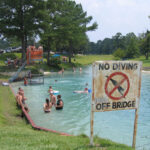
A designated swimming area sat downstream, and the cave entrance was meant to remain off limits to swimmers. Still, the account describes occasional conflicts when swimmers drifted too close to the diver area, stirring arguments and stirring silt.
For someone trying to focus on deep dives, arriving before crowds had practical value. It is one reason some divers said McDaniel might have preferred early mornings, and also why his presence the next day did not register as strange.
Friday, August 20, is when the stillness turned into alarm. Taran arrived around 10 a.m. and saw the same truck in the same spot again. This time, he asked around. Nobody had seen McDaniel since Wednesday night.
With that, he called police and reported McDaniel as overdue. While waiting for law enforcement to arrive, the account says Taran was the first to suit up and go searching, using his familiarity with the cave.
The idea was to locate any sign of a drowned diver, then mark the location. If he found a body, he intended to tie a rope line to help recovery divers return to the spot quickly, rather than wasting time in a hazardous area.
While police waited at the surface, another diver surfaced and gave an immediate, unsettling detail. The diver told law enforcement the gate was open. He said he had gone down to the gate and did not see McDaniel.
Law enforcement notified McDaniel’s family in Memphis that a drowning was likely. His father Shelby, his mother Patti, and his girlfriend Emily Greer began the drive south, a trip described as about seven hours.
As the family traveled, local divers with cave and recovery training were contacted. Rotating teams were assembled to search the system. It was a steep challenge because the training requirements are rare and the environment punishes mistakes.
The case was assigned to Captain Harry Hamilton in Holmes County, according to this account. He believed police divers did not have the specialized cave training required, and he discovered quickly that qualified volunteers were limited.
Hamilton contacted a diver named Jeff Loflin for help locating experienced cave recovery personnel. Loflin reached out through dive shops and contacts and helped pull together a group of trained divers who could attempt the search.
The plan became three rotating teams. One team made the first push. Another replaced them to push farther. A third staged extra tanks and covered the shallower areas in the basin and near the cavern as the deeper teams worked.
Early in the effort, the first physical evidence linked to McDaniel appeared in an odd way. Three stage tanks were located, mismatched, with McDaniel’s name written on them, according to this account.
Stage tanks are extra tanks divers place along a route on long and complex dives, creating backup air supplies for the return and for emergencies. The account says the locations and condition of these tanks raised immediate questions.
Team after team surfaced without a body. The picture at the waterline was grim. McDaniel’s family paced the edge or sat at picnic tables, exhausted and watching divers disappear below, hoping each return would bring certainty.
Divers searched cracks, seams, and every place a body might lodge, shining lights into tight corners. The best assumption was that McDaniel had gone beyond the gate, because that was where he had been last seen and where the risk was highest.
To understand why the search became so dangerous so quickly, the cave itself needs to be pictured clearly. From above, Vortex Spring is a resort built around a bright pool and run off that feeds into Blue Creek.


The spring’s water stays around 69 degrees Fahrenheit year round and produces enormous flow, described here as roughly 28 million gallons daily. That flow affects movement inside the system and makes some restrictions harder to pass.
Under the surface is a wide, bowl shaped basin, roughly 250 feet across. Open water certified divers can explore deeper sections of the basin, with rocky slopes funneling down to a sandy and rocky bottom.
The basin is also home to fish, including bluegills, catfish, carp, bass, koi, and eels deeper in the system. Divers in this account are described as sometimes feeding fish, treating the basin as a training and recreation playground.
Man made features also appear underwater. The basin includes platforms used for instruction, along with small caverns, boulders, outcroppings, arches, and submerged trunks that divers swim around and through as part of routine dives.

One feature described repeatedly is the talkbox. It is an open bottom box that holds a pocket of air about 28 feet down. Divers can lift their heads into it to speak, coordinate plans, and sometimes check for impairment.
Divers are asked to add a couple puffs of air into the talkbox on exit to reduce carbon dioxide buildup. The site does not provide fresh air into it, in part to discourage inexperienced divers and free divers from lingering.

Beyond the basin is the main cavern, an overhead environment where rock sits above and sunlight fades as divers move deeper. A buoyed nylon line leads down, past warning signage, toward the cavern area on the southwest side.

Swimming to the back of the main cavern, where natural light no longer reaches, leads to the cave entrance. One common misunderstanding is that the gate blocks the cave entrance. In this account, the entrance sits deeper behind the cavern.
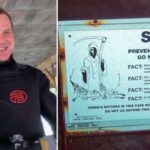
The mouth of the cave is described as about 58 feet down, behind warning signs that include a stop sign and a grim reaper image. The message is repeated in blunt terms, telling divers there is nothing inside worth dying for.


Past those warnings lies a named chamber, the Piano Room. It is described as larger than surrounding passages and known for distinctive sounds created by exhaled bubbles. Rope lights sometimes illuminate the area in a thin guiding string.
Near the Piano Room, the account mentions a grated tunnel that, at the time, was impassable and full of silt. It did not have a locking door with a rentable key. A quick check found no disturbed sediment and no sign of recent entry.

From there, the passage flattens as it approaches the gate. The gate sits around 115 feet below the surface and is made of welded rebar. The door is in the middle, opening from the left, and is marked with signs and a flow indicator.
The search of the basin, cavern, Piano Room, and the gate area came up empty. That forced divers into the section beyond the gate, where restrictions tighten and where the search becomes a matter of inches.
The account explains that beyond the gate, divers often use side mounted tanks to fit. In some places, they must remove tanks, push them ahead, then pull their bodies through. At the tightest points, even head position becomes an issue.
The spring is natural, but parts of the cave were shaped by human excavation, according to this account. The original owners excavated portions to open the system, and a pipe was installed for dredging sediment to keep water clearer.
The cave floor is described as sandy with patches of clay silt. The system can experience occasional collapses. At the time McDaniel vanished, the cave is described as having a single main passage, rather than multiple branching routes.
Many Florida caves have complex branching structures and numerous side routes. This cave is described as more like a long tube, with one main way in and one main way out, and relatively few spots that could hide a body without trace.
The first restriction beyond the gate is described as a tightening to roughly a 4 to 5 foot wide opening around three feet tall, dropping into a small room. A fissure sits above and right, and a dead end passage sits down to the left.
Past that lies the second restriction, known among divers as the backmount squeeze. It is described as a long, flat passage with very low clearance, pushing divers into a belly down position and requiring strong technique and careful movement.
Some divers use a specialized handle like tool that sinks into the sand so they can pull themselves through the restriction. It is a tiring section that can increase air consumption and raises the stakes for anyone who entered without full training.
Beyond the second restriction is a space described as the T Room, leading upward into a more upright area dubbed Max Headroom, and downward into the third restriction, called the champagne bottleneck, a name that reflects its narrowing shape.
The third restriction is described as a long skinny tube so tight divers must remove tanks and push them through first. The spring flow pushes outward, so divers must work against current as they slide down the narrow channel.
After the third restriction, the passage does not open up in any comforting way. A small pocket allows a diver to pause and prepare for the fourth restriction, where gear taller than about 20 centimeters must be shed to fit the profile.

The fourth restriction is described in this account as a low, long horizontal crawl where clearance drops sharply. The diver becomes belly down again, and as the squeeze tightens, turning around becomes impossible unless the diver fully clears it.
If a diver cannot clear the restriction, the only way out is backward, an idea that sounds manageable until silt lifts and visibility disappears. Even a small movement can cloud the water. In a tight passage, that can collapse orientation fast.
The clearance described here drops from around 12 inches to 10 inches, then to a narrowest point around two feet wide and eight inches tall. The account notes that an average head is wider than eight inches, requiring careful head turning.
Beyond that choke point is a small room dubbed the trash room. It is described as long enough to allow two divers to turn, with dimensions around 20 feet long, about four feet wide, and roughly five feet tall, depending on the area.
Beyond the trash room is the end of the line, described as a vertical fissure, a crack that does not open into another chamber. The account suggests a smaller diver might press into it slightly, but turning around would be physically impossible.
Divers who have gone that far describe even fitting a camera into the fissure as difficult. It is presented as a boundary where exploration stops, and where anyone who pushed into the crack would be choosing a point of no return.
All of that mattered when search divers asked what recovery would even look like. This account lays out a brutal scenario, recovering a large adult plus heavy gear while reversing through every restriction, possibly in zero visibility, at deep depth.
As the search continued, some divers urged the county to call in Edd Sorenson, described here as one of the world’s most experienced cave recovery specialists. He was out of the country when contacted and ended his trip early to help.
Sorenson’s reputation is emphasized through an anecdote included in this account. In another cave near his shop, an uncertified group kicked up so much sediment that visibility dropped to zero, leaving a diver trapped in an air pocket.
Sorenson suited up quickly, entered the cave, followed lines in zero visibility, located the woman barely keeping her face above a small trapped air space, shared air with a rescue regulator, and led her out without sight.
At Vortex Spring, Sorenson used an underwater scooter to move quickly toward the back, conserving time and air for the search itself. He also brought smaller tanks so he could fit through the tightest restriction described as the eight inch squeeze.
He went all the way to the end of the line fissure, checking cracks in the farthest reachable area. This account says the trash room and the end fissure were not even on earlier maps, and Sorenson was among the few to reach them.
Sorenson reported finding the deepest section pristine. He did not see scuff marks in the silt, scratches on the ceiling, or disturbances that would indicate a diver had passed through recently. In his view, the area looked untouched.
He also emphasized the difficulty for a body sized like McDaniel’s. Sorenson is quoted describing his own size and the smaller tanks required, saying he barely made it through, and arguing that a larger diver would leave marks and disruptions.
Another quote attributed to Sorenson describes extended dives in a cave that is often explored quickly, and points to a bacterial growth on the roof that flakes off when brushed. He said he did not find the exposed rock that contact would create.
The account addresses a common counterargument, diver panic. Panic can produce frantic movement that wedges a person into spots they would not calmly choose. It can also drive a diver into cracks while fighting for air near the end.
In this cave, the account argues, gear limits the theory. A person might be compressible under extreme pressure, but hard equipment is not. It also notes a specific constraint, an eight inch space is smaller than the helmet described here.
Recovery divers reported finding none of McDaniel’s gear in or near the deepest restrictions, and they did not see scrape marks from equipment that would suggest exploration. Without gear clues, the panic wedging explanation looked weaker to them.
McDaniel’s family remained convinced he was in the cave, deeper than divers were willing to go. The account describes miscommunication early in the search, when scuffing from the first teams was later noticed and interpreted as hopeful evidence.
When Sorenson returned from his deepest pushes and said he did not believe McDaniel was inside, the parents were upset. They have said they believe Sorenson’s conclusion was wrong, keeping the dispute alive long after the search slowed.
After Sorenson’s statement, divers began dropping out. The lead diver Jeff Loflin is quoted saying he had looked everywhere he knew to look and did not find McDaniel. Another recovery diver, Kevin Carlisle, emphasized certainty about where he was not.
With the diver teams fading, the family pushed for more options. They asked about a remotely operated vehicle, an ROV. Law enforcement was concerned it would be lost or damaged in the cave, and set a condition for its use.
The county required the McDaniels to pay the reported $54,000 replacement cost if the ROV was lost. The family agreed, saying they would pay anything to find their son. Divers carried the ROV down and attempted to deploy it.
The effort produced another dead end. The ROV made it about 700 feet into the cave before its attached cables became too heavy and limited its movement. Even if it had gone farther, the account notes it would not fit in tight restrictions.
Shelby McDaniel explored other ideas, including devices built for tracking fish, but the account says they were too large. Suggestions surfaced around underwater drones and metal detection methods, but none had been deployed in a way that changed the case.
The family also sought out Steve Keene, described as the diver who surveyed the cave in 2003 and reached the deepest zones early on. Keene made several dives into the far reaches during the search, but also found nothing.
With conventional methods failing, the family offered a reward, first at $10,000, then increased to $30,000 when no one accepted. The account describes intense backlash from the diving community, which saw the offer as dangerous pressure.
The tension worsened after an uncertified diver later drowned in a restricted part of the cave. The account suggests the death may have been linked to someone trying to claim the reward. It added another tragedy to an already charged scene.
Around this period, Jill Heinerth contacted the family, according to the account. She is described as a leading cave diver and documentary maker. She hoped filming a full dive to the back could prove McDaniel was not there and end the reward.
During that filmed push, her dive partner and cameraman Paul Heinerth found a fold up shovel in the back of the cave, believed at first to match one associated with McDaniel. The discovery raised hopes and then collapsed into disappointment.
The shovel turned out to belong to Steve Keene from earlier mapping work. The account calls it a red herring, even though it appeared in later media coverage. It reinforced a theme, objects can surface, but answers still do not.
As the search evolved, divers began looking for indirect signs of a body rather than the body itself. The account focuses on decomposition, arguing that even in cool freshwater, a body would produce clear indicators over time.
Divers described odor or taste through regulators as one telltale sign, an unpleasant presence linked to gases and fluids from decomposition. This account says none of the divers reported detecting that smell or taste during the search.
The spring’s wildlife was also considered. Carp, bluegills, bass, koi, and eels inhabit the water, with eels living deeper in the cave. The account says divers saw no sign of scavenging or feeding behavior tied to remains.
Water testing was another approach. The account says more than 30 lab tests were run during the 36 day search, looking for bacteria consistent with decomposition. Those tests reportedly came back negative each time.
With no body, no gear, no disturbed silt in the farthest sections, and no biological signs in the water, some divers concluded the cave did not hold McDaniel. Yet the open gate, the stage tanks, and the last sighting keep pulling the case back.
Part 3 continues with the search above the water and the scrutiny around McDaniel’s training and gear, including questions raised by the stage tanks.