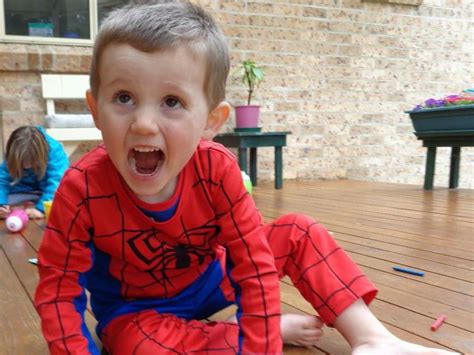
On a spring morning in Kendall, three year old William Tyrrell sat on a verandah with crayons, dressed as Spider Man. Photos taken that day show him grinning, legs splayed on timber boards, minutes before he disappeared.
The home sat on Benaroon Drive, with the Kendall State Forest across the road and thick bush nearby. It was the kind of quiet edge of town where a child’s voice can carry, then stop.
Just after 10.30am on Sept. 12, 2014, William was outside playing with his sister while his foster mother and foster grandmother supervised. When his foster mother stepped inside to make tea, the sound of play dropped away.
When she came back out, William was gone. Adults checked the yard and the house, then moved faster, calling out and scanning the driveway and the street as if he had simply wandered around a corner.
The initial alarm pulled in neighbours and then emergency services. Within hours, hundreds of local residents and search crews were pushing through bush, checking creeks, and scanning paddocks and tracks around the township.
William had asthma, a detail that made the first night feel urgent in a different way. Police brought in motorcycles and helicopters as volunteers searched overnight, hoping for any sign that he was lost nearby.
By the second and third days, police divers were searching waterways and dams while more people combed rugged terrain near the house. Specialist police, including officers linked to sex crimes work, were brought into the investigation early.
Five days in, authorities were speaking publicly about how baffling the disappearance looked. AAP reporting in the Guardian described police saying sniffer dogs and cadaver dogs had found no trace, and investigators were keeping an open mind about abduction.
The search radius expanded, then expanded again. In the ABC’s account of the early timeline, police said that after five days they had been unable to find leads and it was no longer possible William could still be alive if he was lost in bushland.
The first hours become a theory
NSW Police later said the speed and coordination of that local search pushed them quickly toward a darker conclusion. They formed the view early that William had been kidnapped, and a dedicated strike force was established under the Homicide Squad.
That strike force became Strike Force Rosann, the team that has carried the case for years. Its work stretched far beyond Kendall, pulling in investigators across NSW as the file grew from a missing child report into a long running homicide level investigation.
From the start, detectives hunted for details that should not have mattered but did. In 2015, police asked anyone within a kilometre of the area on the day William disappeared to come forward, tightening the focus to who was close enough to see something.
They also started asking about vehicles. The ABC timeline records repeated appeals for information about cars seen near Benaroon Drive that morning, including vehicles parked across the road and a four wheel drive reported speeding nearby.
A narrow window seemed to define the mystery. A criminal profiler working with police told the ABC in 2015 that an opportunistic kidnapping would leave only a small slice of time to act, and that such impulsive crimes often produce mistakes.
Public attention turned the case into a national story, and with that came sightings from everywhere. In 2016, police said Crime Stoppers received thousands of reports and more than a thousand possible sightings, forcing investigators to sort signal from noise.
That same year, the NSW government announced a 1 million dollar reward for information. The reward was framed as unique, tied to the recovery of William rather than requiring an arrest and conviction, and police urged anyone who knew something to come forward.
A case shaped by what could be said
For years, legal restrictions shaped the public’s view of William’s life before Kendall. Those limits centred on the fact that he was in out of home care, and media were constrained in how they could identify family circumstances.
In 2017, a court ruling shifted that boundary. SBS reported that a judge found the fact William was in foster care at the time of his disappearance was a matter of legitimate public interest, and the case became a window into child protection accountability.
When the coronial inquest began in 2019, it pulled back more layers. The ABC reported that William’s biological parents gave evidence about why they had hidden him from authorities for weeks when he was a baby, fearing he would be placed into care.
The same ABC report described the inquest hearing that the parents were in a troubled relationship when William was born, with a history of substance abuse and domestic violence mentioned in evidence. Their identities remained legally protected even as details emerged.
Those details mattered because they explained why the case carried extra scrutiny. A child disappeared while in state supervised care, and that fact placed the investigation under two spotlights at once, one for policing and one for the system around him.
The witness who said he saw a car
On the fifth anniversary, the NSW Coroner released five new photos taken by William’s foster mother on the day he disappeared. The same release included a transcript of a long police interview with Kendall resident Ronald Chapman.
Chapman told police he believed he saw William being driven away in a vehicle shortly after the disappearance. In the transcript, he described seeing a child in a Spider Man suit with hands up at the window, and said the driver was a woman.
He also described a second car following behind, driven by a man. Detectives asked more than a thousand questions over hours, and the transcript captured moments where Chapman’s certainty held, and moments where his memory seemed to slip.
By 2019, memory itself had become part of the case file. In a small town, people replayed that morning for years, yet the inquest kept running into the same problem: the further time moved, the harder it was to lock down exact sequences.
The inquest years
The coronial inquest began in March 2019 under Deputy State Coroner Harriet Grahame. The ABC later summarised that she heard evidence from William’s birth parents and his foster family, alongside material gathered by police about what happened.
Proceedings stretched, then stalled. The ABC reported the inquest was interrupted by the pandemic, and the long pauses left witnesses returning to the stand years after they first spoke to police, asked to recall minutes from a morning long gone.
In August 2019, hearings moved to Taree, about 40 kilometres from Kendall, and the atmosphere was tense in a different way. The ABC described delays, technical glitches, lawyers being unavailable, and repeated fights over closed court orders.
Inside the courthouse, frustration became a theme. The ABC quoted Grahame acknowledging the feeling in the public gallery and saying the inquest was only scratching the surface, even after weeks of evidence.
One key witness was Paul Savage, a man who lived across the road from the Kendall home. The ABC reported he struggled to recall parts of the morning and that disputes emerged over timing gaps, with relatives contesting when they arrived that day.
The inquest also heard about another wrinkle that day: sightings of two boys in Spider Man suits in Kendall. The ABC said police could not confirm whether such sightings related to William, but they added to the fog around what people thought they saw.
Wrong turns and collateral damage
Another name became entangled early, then unraveled in court years later: William “Bill” Spedding, a washing machine repairman. The ABC timeline noted forensic teams searched his home in January 2015, draining a septic tank and seizing items.
In 2023, the ABC reported NSW lost an appeal over damages after Spedding sued the state. Appeal judges described the prosecution against him for unrelated historical offences as a severe case of malicious prosecution and improper use of police power.
The Guardian reported the payment ultimately reached 1.8 million dollars plus legal costs. A judge had found police used allegations against Spedding as leverage in the Tyrrell investigation, a strategy that the court condemned in blunt terms.
The controversy also touched the investigation’s leadership. In early 2019, the ABC reported that lead investigator Gary Jubelin was stood down while an internal probe examined allegations including that he recorded someone without a warrant.
None of it brought William closer to being found. What it did show was how a high profile case can generate pressure that bends decisions, narrows vision, and leaves damage behind, even while the core mystery remains untouched.
Persons of interest and the sawmill searches
Over the years, investigators pursued other people living near the mid north coast corridor. The ABC reported that in June 2020, riot police and SES crews searched bushland at Herons Creek, near an old sawmill, assisted by sniffer dogs.
That search zone was linked to Frank Abbott, a convicted paedophile who lived nearby in a caravan at the time William disappeared. The ABC reported Abbott remained a person of interest, had never been arrested or charged over William, and could listen to inquest evidence from custody.
In March 2020, the ABC described inquest testimony from people who knew Abbott through work. A former employer said Abbott spoke about a “peculiar smell” near bushland, claiming he could tell the difference between a dead animal and a dead human.
The same ABC report said another witness described Abbott making a strange comment when police searched Spedding’s property, suggesting they were searching in the wrong spot. These accounts landed in open court, but they did not deliver physical evidence.
Other testimony circled back to sound and distance in the bush. In 2020, the Guardian reported a woman told the inquest she heard a child scream in bushland near Herons Creek, and that she later reported it after learning Abbott lived nearby.
The searches that kept coming back
In June 2018, NSW Police launched a large scale forensic search of Kendall bushland. The ABC described riot squad officers raking through terrain while dogs worked alongside them, looking for evidence four years after William disappeared.
Early in that search, investigators collected a toy and other bags of potential evidence, though links were uncertain at the time. The search moved across difficult ground, with police adjusting zones based on information they said they had held for some time.
Each renewed operation carried the same tension: the hope that something small, something overlooked, might still exist in bush that floods, burns, and changes. Yet each time, public statements ended the same way, with the case still open.
In November 2021, police returned with a different tone. The ABC reported detectives said they had new evidence, were acting on behalf of the coroner, and were conducting high intensity searches at three locations around Kendall.
Detective Chief Superintendent Darren Bennett told reporters they were looking for William’s remains. He said it was highly likely that if they found something it would be a body, and he stressed the operation was based on evidence, not speculation.
The ABC also detailed the forensic tools brought into the operation. Officers used cadaver dogs, luminol, ground penetrating radar, drones, sifters and metal detectors, and the Australian Federal Police joined with specialist capabilities.
That forensic piece added one detail from the earliest days that still stands out. Police dogs were brought in shortly after William disappeared in 2014, and they detected his scent only within the boundaries of the property.
When the theory shifted
For years, the working assumption leaned toward abduction. Then, in late 2021 and into later court proceedings, a different possibility began to dominate official questioning: an accident at the Kendall home, followed by concealment.
In November 2023, the ABC reported a court heard police had cleared William’s foster father of involvement in the disappearance. Under cross examination, a detective conceded Strike Force Rosann did not know what happened to William that day.
The same ABC report said police had asked the Director of Public Prosecutions to consider potential charges against the foster mother, including interfering with a corpse and perverting the course of justice. The court heard those charges were based on “one of the possibilities.”
In court transcripts from the Crime Commission hearing, the ABC reported the foster mother was directly asked whether she found William’s body under the verandah after a fall from a balcony, then chose to hide him rather than risk losing another child in her care.
She denied it. The ABC reported she was told investigators accepted she loved William and would not intentionally harm him, while pressing the idea that accidents happen, and that her actions after an accident were the focus.
Around the same time, the foster parents faced unrelated charges tied to another child, not William. In 2022, the ABC reported the foster mother was found not guilty of knowingly giving false or misleading evidence at a Crime Commission hearing about an alleged assault.
That case also revealed the extent of surveillance used in the broader investigation. The ABC reported police obtained warrants to plant listening devices in two locations and intercepted phone calls, with audio played in court as part of the separate matter.
Evidence aired in 2024
In November 2024, the ABC reported the coronial inquest resumed to hear two more weeks of evidence. The hearing was expected to cover the police theory that William died in an accident at his foster grandmother’s home, and that his foster mother disposed of his body.
The Guardian reported the police position more bluntly as it was aired in court. Counsel assisting told the court police now believed William fell from a balcony and died, and that the foster mother disposed of his body, a theory she tearfully rejected.
The Guardian also reported details from a video played in court from 2021 questioning. The foster mother denied dumping William’s body, described panic after noticing him missing, and was questioned about a nearly 20 minute gap before the emergency call.
Within that same reporting, the Guardian noted the lack of forensic evidence and eyewitnesses supporting the theory. The case was framed as an argument of inferences built from movements, timing, and what investigators believe fits the day.
Then a witness complicated it. On the third day, the Guardian reported truck driver Peter Bashkurt told the inquest he saw a dark Toyota Camry acting suspiciously twice that day, first in Kew and later in Kendall, behaviour that caught his attention.
Bashkurt’s account did not match the police theory described in court, which involved a grey Mazda 3 linked to the foster grandmother. The Guardian reported this contradiction directly, as counsel and witnesses wrestled with competing timelines inside the same hearing.
Experts also spoke about the bush itself. The Guardian reported a forensic anthropologist said she could not state with certainty whether William’s remains would be preserved in the areas searched, and dog handlers testified the surrounding vegetation was impassable for a child.
By early 2025, the shape of the endgame was clearer, even if the answer was not. AAP reporting carried by 9News said the deputy state coroner ordered written submissions, with final responses due by mid June, before a date would be set for findings.
That same AAP update said the coroner noted the lack of proof that anyone was seen moving William’s remains, while admitting a report on the possibility wild dogs could have moved a body if one had been left in bushland.
The New Daily carried the same AAP details, including the deadlines for submissions and the plan for the coroner to later set down a date to deliver findings. It also repeated the core tension: a theory alleged in court, and a denial that has not shifted.
What is confirmed, and what remains disputed
Certain points are fixed in every official retelling. William was last seen around 10.30am on Sept. 12, 2014, at his foster grandmother’s home on Benaroon Drive in Kendall, wearing a Spider Man costume, and he has never been found.
The early search was massive, then the case shifted into a strike force investigation. Police have said the speed of that first day search led them quickly to view kidnapping as likely, even as they kept appealing for any tip that could change everything.
What remains disputed sits on top of that foundation. Over years, investigators examined abduction scenarios, focused on multiple persons of interest, and ran repeated ground searches, then later presented an accident and concealment theory that still lacks physical confirmation.
The inquest has been both a search for answers and a public audit of how the search unfolded. It exposed fading memories, contested witness accounts, and investigative choices that played out under scrutiny, with William’s name fixed at the centre.
As of the latest reporting, the 1 million dollar reward remains in place for information that leads to William’s recovery. The coroner’s findings are expected to shape what happens next, including whether any prosecution is ever attempted.
If one detail explains why the case still grips people, it is the simplest one. There were adults nearby, a small child in bright red and blue, and a stretch of minutes where the world kept moving while he disappeared.