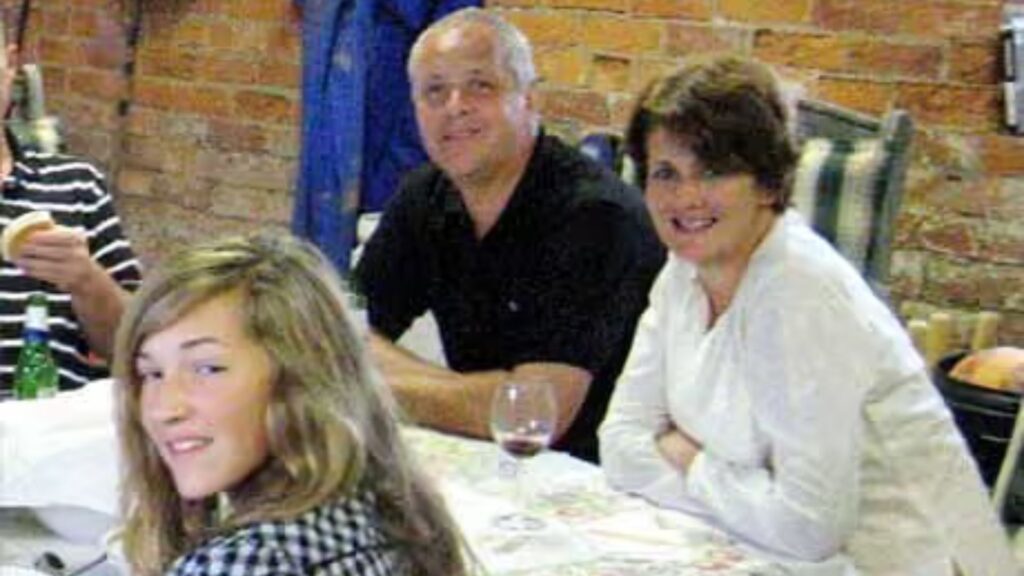
Firefighters heading into Maesbrook before dawn on Aug. 26, 2008, ran into a strange obstacle at the gates of Osbaston House. A horsebox sat across the entrance, its tyres flattened, turning a routine approach into a forced delay as the property burned.
Inside the 17th century house and its outbuildings, flames took hold in more than one place, a detail investigators later treated as deliberate. By the time crews could work, the blaze had already become a destructive force that consumed rooms, roofs, and the evidence of what happened.
At first, the case carried the confusing shape of a missing persons search wrapped around a suspicious fire. Christopher Foster, 50, his wife Jill, 49, and their daughter Kirstie, 15, were unaccounted for, and early questions focused on whether anyone had made it out.
Within days, the focus shifted from absence to remains. Search teams working through unstable rubble found bodies in the wreckage, then more remains in a space below where Kirstie’s bedroom had been, the inquest later heard. Each recovery narrowed the mystery while darkening the story.
By the time the coroner closed the case the following spring, the official narrative was blunt. John Ellery recorded unlawful killing for Jill and Kirstie, and ruled that Christopher Foster killed himself, dying from smoke inhalation rather than a gunshot.
The details that made the case travel far beyond Shropshire were the ones that sounded staged for maximum finality. Investigators said the family’s dogs and horses were shot, and the property was set alight with fuel, leaving little untouched.
The village that liked success stories
Maesbrook sits close to the Welsh border, the kind of rural setting where large houses and long driveways keep private lives mostly private. Osbaston House stood on an estate measured in acres, with stables, garages, and space for animals and hobbies.
Neighbours and local reporting described a family that, from the outside, looked comfortably settled. They kept horses, dogs, and a collection of vehicles, and they were seen doing ordinary things for people with extraordinary money, like hosting friends and attending barbecues.
The image of wealth was not subtle. The Guardian reported that Jill Foster drove a 4×4 with a personalised number plate, “JILL40,” a detail that neighbours noticed because it was meant to be noticed, a rolling signal that the Fosters had arrived.
Friends later told reporters that Christopher Foster liked nice holidays and good cars, and that he seemed committed to the idea that success should look like success. When business went well, the spending followed, and when business went badly, the lifestyle did not immediately shrink.
The Guardian’s Jon Ronson, writing months after the fire, described Foster’s world as one built on presentation, speed, and appetite. Ronson reported a list that included Porsches, an Aston Martin, a tractor for the estate, and a tendency to buy as if the bill would never come.
The “gossipy” part of the story, repeated in British tabloid coverage and referenced in Ronson’s reporting, involved Foster’s private life as much as his finances. Ronson reported that Jill’s sister later claimed Foster had “at least eight” mistresses, and that Jill knew.
That claim sits in the case file as context rather than cause, a detail about a marriage that may have been strained even while the family posed as intact. It also fed a broader picture of a man who wanted admiration and resisted limits.
The product that made money, and the debts that ate it
Foster’s rise was tied to an industrial niche far from the manicured lanes of Maesbrook. He ran Ulva Ltd, a company linked to insulation technology for oil rigs, and he moved in circles where patents, contracts, and distribution rights mattered as much as cash.
Ronson reported that an accountant described Foster as an ordinary salesman before a breakthrough idea in the late 1990s, and that Foster patented a formula he called UlvaShield. The story, as told to Ronson, cast Foster as a man who believed invention entitled him to the big life.
Yet the public record that emerged later showed a different side, one with judges, liquidators, and unpaid bills. Court documents cited by The Guardian said Ulva went into liquidation and owed more than £1 million to a supplier and about £800,000 in tax.
In that same reporting, a High Court judge branded Foster “bereft of the basic instincts of commercial morality” after finding he had stripped Ulva of assets and transferred them to a new firm. The language was scathing, and it landed months before the fire.
The legal trouble was not abstract. TIME reported that Foster had been forbidden to sell his home without the liquidator’s permission, and that creditors and tax authorities were pressing in, a bureaucratic tightening that threatened the one thing he displayed most, the house.
For people around him, the danger did not always show. The Guardian reported that neighbours were shocked to learn he had money trouble, describing him as genial and devoted to his family. The gap between what the village saw and what the paperwork showed became part of the case.
As the end approached, practical enforcement also hovered. The Independent reported that bailiffs arrived at the property as fire crews struggled with the blaze, an almost surreal collision of financial collapse and physical destruction, with the house turning to ruin as officials came to seize.
Cyprus, courtrooms, and the stories he told police
Money trouble rarely stays neatly in spreadsheets, and Foster’s dealings spilled into criminal allegations years before the fire. At the inquest, the court heard that Foster told police in December 2005 that a former accountant was blackmailing him over a joint property deal in Cyprus.
Two defendants were prosecuted and found not guilty at Shrewsbury Crown Court in November 2006, according to coverage of the inquest. The result did not end the whispers around Foster’s business life, but it mattered because it showed he already felt targeted.
In early coverage after the fire, the case attracted a more lurid set of claims. The Independent reported a former associate, Leo Dennis, saying he had been offered £50,000 to murder Foster, and that Foster had once asked him to act as a personal bodyguard.
Dennis’s account was a claim, not a finding, and it carried the tone of someone trying to frame a dead man’s life in the language of “shady people.” Police ultimately treated the deaths as a domestic crime, not a hit, but the rumours lingered.
The inquest itself heard another set of allegations that investigators did not accept. The Independent reported that claims were raised about kidnap threats, including letters threatening to abduct Kirstie and cut off her fingers, which police dismissed.
Even as those stories circulated, authorities kept returning to what they could prove, the financial collapse and the physical evidence at the scene. The “kidnap” talk, like the “hit” talk, stayed in the file as allegation, not conclusion, an echo of panic around a wealthy man falling.
Warnings that sounded like suicide, and a life that kept moving
By spring 2008, Foster had started telling people he was breaking. The Guardian reported that his GP, William Grech, said Foster spoke about not sleeping and feeling intermittently suicidal because of business difficulties, and that he declined counselling.
Grech prescribed an anti depressive sedative, the paper reported, and encouraged him to speak with his wife. A week later, Foster told the doctor he still felt occasionally suicidal, and the doctor tried again to push him toward sharing the burden at home.
The GP’s last appointment with Foster carried a chilling normality. According to The Guardian’s inquest coverage, Grech said Foster appeared rational, made plans for the future, and did not express an intention to harm anyone else, a detail that later framed the gaps in the system.
Friends heard similar signals. The Guardian reported an associate recalling a phone call in which Foster said one option was to disappear and “do myself in,” then asked the friend to promise to look after his wife and daughter, language that sounded both desperate and controlling.
A text message exchange captured the same downward arc. The Guardian reported that on Aug. 11, 2008, a friend checked in and Foster replied: “Not good at all. Things coming to a head for me,” a brief line that read like a man counting down.
At the inquest, the coroner heard that Foster also told friends he was owed millions by Russians, an almost fantastical idea in the middle of liquidation and creditor pressure. It sounded like the kind of story people tell when reality is too humiliating to name.
The same inquest heard Foster say his wife and daughter were used to a certain quality of life, and that they would not cope with “a few backward steps.” It was a self serving logic, presented as concern, and it anchored the financial motive in his own words.
A barbecue, a Bebo chat, and the hours before the fire
On the last evening of their lives, the Fosters did what people in that social circle did on a holiday Monday. Reporting described them spending the day at a friend’s barbecue, with a clay pigeon shoot, and nothing that seemed to alarm anyone.
The ordinariness is what made the aftermath so hard for neighbours to process. Maesbrook, with its big houses and self made money, was used to private dramas, but not to police cordons and international headlines, not to a murder inquiry at a burned mansion.
Back at Osbaston House, Kirstie was online. The Guardian reported that police examined her computer after learning she had been chatting with friends, and that communication ceased abruptly at about 1 a.m., hours before the fire brigade was called.
TIME noted that Kirstie’s social networking page remained, preserving a teenage life in the frozen language of best friends and casual affection. Her horses even had names that read like a child’s choices, details that later sat beside charred photographs.
CCTV, grainy but decisive, became the spine of the official timeline. At the inquest, the coroner was shown footage between 3.12 a.m. and 3.49 a.m. that placed Foster moving between stables and house, carrying items and preparing fires.
Ellery told the court it was most likely Jill and Kirstie were shot as they slept, and said Foster acted “quickly and methodically,” suggesting pre planning. The coroner’s language was careful, grounded in sequence, but it carried a heavy implication of intent.
The footage showed moments that investigators treated as functional rather than emotional. The Guardian reported that Foster was seen carrying buckets of kerosene, and at one stage carrying the bodies of dead dogs, a grim task focused on control, not hesitation.
It also showed the manoeuvre at the gates. Reuters reported that CCTV captured a horsebox being driven down the driveway to block the main entrance, matching what firefighters encountered. The act looked designed to buy time, turning a private crime into a delayed response.
When the fire took hold, it did so violently. At the inquest, a forensic scientist described the fire starting in the ground floor of the older part of the house, and evidence pointed to fuel soaked materials laid out to ensure ignition and spread.
Ellery said three fires were involved, two outside and one started in the library. The image was of a property attacked from within, a home turned into a set of burn points, each one a step in the same plan.
Firefighters later told the court that the intensity made rescue impossible. The blaze was already too advanced, and the scene too dangerous, by the time crews could work. What remained was containment, then recovery, then the slow process of telling families what was found.
What forensics could prove in the ash
In the first week, investigators moved between the language of arson and the language of homicide. Police recovered firearms evidence and treated the scene as suspicious, while public speculation spiralled, sometimes imagining escape plots, sometimes imagining enemies.
As bodies were recovered, identification became a grim administrative task. Reuters reported that Jill Foster’s death was linked to a shotgun wound to the head, and that the condition of the remains made other determinations slower, with tests expected to take time.
At the inquest, pathologist Dr Alexander Kolar described Jill dying from a gunshot wound to the back of the head, with no sign she was alive during the fire. The court also heard that Foster’s body was found lying on top of hers beneath their bedroom.
Kirstie’s case carried the same terrible pattern, according to testimony. The Independent reported the pathologist saying she was shot in the back of the head by a .22 rifle before the fire started, and that her body was found below where her bedroom had been.
A rifle fitted with a silencer was part of the evidence described in multiple accounts of the inquest. The Guardian reported the coroner saying the rifle used had been fitted with a silencer, and The Independent described a German made rifle recovered with ammunition near the kennels.
Christopher Foster’s death did not match the common assumption of a self inflicted gunshot. Kolar told the inquest he found no evidence of gunshot wounds and concluded Foster died from inhalation of combustion products, meaning he was alive as the fire took hold.
The inquest also heard alcohol was found in Foster’s urine, indicating he may have been drinking. It was a small forensic fact that added to the picture of a man moving through the night with a plan, and perhaps with blurred judgment.
The animals became part of the case record, too. Reuters and other reporting described three horses and four dogs shot dead, a detail that mattered because it showed the violence extended beyond what might be framed as “family,” into the entire household.
In early coverage, police said a rifle legitimately owned by Foster was found near the bodies. In the end, the inquest narrative treated the guns as tools he possessed legally, and used privately, without any last minute external attacker entering the story.
The motive the coroner could name, and the motive he could not
By April 2009, the case had moved from the spectacle of a burned mansion to the controlled setting of Shrewsbury Magistrates Court. There, the inquest laid out a story built from CCTV, financial records, medical testimony, and the physical remains.
Ellery’s conclusion framed the night as both impulsive and prepared. He said Foster acted “quickly and methodically,” and that the pattern suggested planning, even though friends had seen him acting normally at the barbecue hours earlier.
The coroner and witnesses returned repeatedly to money. The Guardian reported that Foster had debts of about £2 million, and that creditors were due to repossess the home the morning of the fire. It was not just embarrassment, it was an imminent takeover.
Other reporting later described debts in the same bleak category, “millions,” sometimes citing higher figures. The point, across accounts, was that Foster saw a cliff edge, and he moved as if the only way to avoid public collapse was private destruction.
The inquest did not turn into a courtroom drama about villains beyond the gates, even though rumours tried. It acknowledged the Cyprus blackmail case as part of background, and it heard but did not adopt claims about kidnaps or men loitering.
Instead, the narrative stayed close to what Foster said and did. The Guardian reported he told a friend the family could not cope with lifestyle changes, a line that exposed pride more than love, and framed his thinking as fear of “backward steps.”
The case also raised a quieter institutional question, one that felt less dramatic than flames but more enduring. Ellery recommended that firearms licensing authorities communicate with GPs, and that doctors be able to flag changes relevant to gun ownership.
Outside court, the Foster family issued a statement expressing shock at how different branches of public service failed to connect information when preventing loss of life was the goal. Their words added a civic coda to a story otherwise dominated by private decisions.
What remained after Osbaston House disappeared
After the inquest, the physical site became its own kind of wound for Maesbrook. Local reporting described trespassers drawn to the abandoned land and the notoriety attached to it, as if tragedy, once public, had a way of inviting more disruption.
Shropshire Star reported that planning permission was granted in 2009 to demolish the remains and make way for a replacement luxury home, and that the 16 acre site went up for sale in 2012. The bank owned the land, handled like an asset.
Neighbours interviewed years later spoke about wanting the village to be known for its beauty rather than the fire. Their comments captured a simple truth, that the community did not choose this story, yet lived inside its shadow whenever Osbaston House was mentioned.
For Kirstie’s relatives, memory took a different form. The Shropshire Star reported that Foster’s brother Andrew announced a trophy in Kirstie’s name for Riding for the Disabled championships, and described fundraising in her memory, a gesture built around what she loved. Andrew later revealed that when they were young brothers, Christopher had sexually abused him. The brothers hadn’t spoken for years.
It is easy, in cases like this, for the narrative to freeze at the moment of violence, the blocked gates, the fuel, the footage of a man moving across his own property with a plan. The public remembers the spectacular ending because it is visible.
The paper trail tells a longer story, one made of liquidations, court judgments, and the slow tightening of creditors. It also tells of a man obsessed with status, a household built around animals and display, and a family living inside his appetite.
What the inquest could say, it said plainly. Jill and Kirstie were unlawfully killed, almost certainly while asleep, and Christopher Foster set the fires and died in the smoke. The rest, the motives he never wrote down, stayed locked inside a burned house.