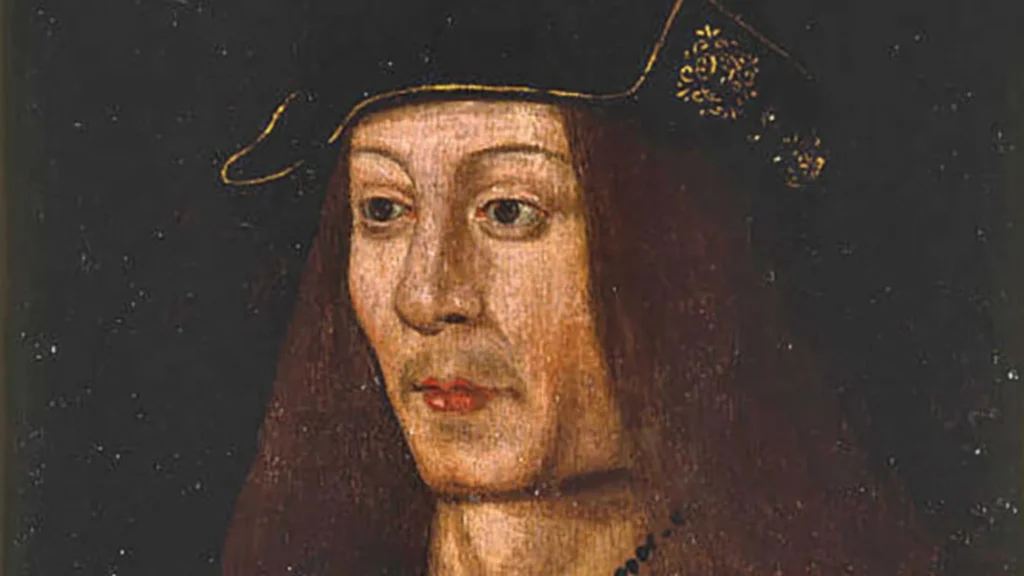
On a small island in the Firth of Forth, the story goes, a king tried to make silence speak. Two infants, cut off from ordinary conversation, would grow up and reveal the language humans carried from the beginning.
The king was James IV of Scotland, a Renaissance minded ruler with a court that prized learning, debate, and spectacle. In this tale, curiosity turns into a test, and a nursery becomes a kind of laboratory.
The goal sounded simple. If children heard almost nothing of human speech, would a first language appear on its own, clean and unchanged, like a fossil lifted from deep ground.
The problem sits in the sources. Nearly everything people repeat about the experiment comes from a chronicler writing long after the moment, turning a rumor into a memorable scene.
Inchkeith, 1493, and a story that arrives late
The fullest version appears in a history by Robert Lindsay of Pitscottie, who wrote decades after James IV’s reign. He placed the episode around 1493 and framed it as a royal attempt to discover an original tongue.
Pitscottie described two infants sent to Inchkeith with a woman who could not speak. Supplies and care kept them alive, while speech remained restricted, so the children’s first words would carry the answer.
In the chronicler’s punch line, the children eventually spoke “good Hebrew.” For an audience shaped by biblical ideas, that result fit a familiar belief that Hebrew carried ancient authority and closeness to Eden.
Yet James IV’s government also produced records, letters, and accounts for many ordinary matters, and this experiment leaves a thin paper trail. That gap makes the Inchkeith story hard to anchor in the period.
Historians often treat it as a moral anecdote more than a documented event, shaped by a later writer’s tastes and by older tales circulating through Europe. The details remain vivid, while verification stays elusive.
Even as legend, the story preserves a real question: language feels natural, yet it requires other people. The Inchkeith plot tests that tension in its most extreme form, then claims a tidy, ancient result.
The tale also reveals how rulers used children as symbols. Infants carried political meaning as heirs and subjects, and here they also become instruments, asked to deliver proof about human origins before they can choose anything.

A much older template from Egypt
Long before Scotland, a similar experiment appears in Herodotus’s account of Egypt. He wrote that Pharaoh Psammetichus I sought the oldest language by isolating infants from ordinary speech.
In Herodotus’s version, a shepherd raised two babies with strict limits on spoken words around them. The children’s first utterance, supposedly “bekos,” arrived as a surprise and became a clue to linguistic ancestry.
Advisers said “bekos” meant bread in Phrygian, and Psammetichus concluded Phrygian preceded Egyptian. The narrative turns one uncertain sound into a sweeping historical claim, offered with the confidence of a good story.
The method relies on details that invite doubt even on the page. A shepherd still lives among animals and routines, and infants absorb sounds broadly, so the boundaries of silence stay difficult to police.
Yet Herodotus’s anecdote mattered. It gave later writers a ready made framework for kings and emperors who wanted origins, and it supplied an ending that felt conclusive, even when the path there stayed fragile.
Frederick II and the medieval nursery of silence
Another version gathers around Frederick II, the Holy Roman Emperor known for learning and ambition. A Franciscan chronicler, Salimbene, later reported that Frederick ordered infants raised with care but under strict speech limits.
In the account, caretakers fed, washed, and handled the babies, yet they withheld ordinary talk and comfort. The emperor’s aim resembled earlier tales: he wanted to see which language would emerge first.
Salimbene claimed the children failed to thrive. They could not develop normal speech, and the experiment ended badly, presented as a warning about what happens when a ruler treats human growth as a puzzle.
The chronicler’s motives matter. Medieval writers often shaped stories into lessons about pride, cruelty, or divine order, and Frederick served as a convenient figure for cautionary narratives in hostile circles.
Still, the reported outcome aligns with something basic. Babies learn language through interaction, and speech grows alongside attention, play, and responsive caregiving, all of which shrink when silence becomes policy.
Akbar and the “silent house” at court
In South Asia, Emperor Akbar appears in another cluster of stories about language and isolation. Accounts describe a controlled setting where children were raised by attendants who stayed quiet, aiming to see whether speech would arise naturally.
The details vary across retellings, but the direction stays consistent. Children grew up using gestures and simple sounds rather than fluent speech, and the experiment supported Akbar’s view that language depends on hearing others.
That fits Akbar’s broader court culture. He hosted debates among scholars, invited foreign visitors, and invested in cataloging knowledge, so a test about speech and learning matches the intellectual atmosphere around him.
These accounts also show how a court could turn curiosity into a display of power. A ruler could command silence in a space, then point to the results as proof, folding childhood development into imperial authority.
The shift from royal myths to modern observation
By the late eighteenth and early nineteenth centuries, the “first language” quest began shifting. Instead of staged royal trials, researchers faced real children shaped by isolation, abandonment, disability, and social exclusion.
Victor, the so called wild boy of Aveyron in France, became one of the best known cases. Found living on the margins of society, he drew intense interest from doctors and educators seeking to understand language development.
Jean Marc Gaspard Itard worked with Victor for years, trying to build speech through training, routine, and attention. Victor learned some communication and social habits, yet fluent spoken language remained limited.
The lesson people took from Victor changed over time, but one point stayed central. Early childhood carries a sensitive window for speech, and delayed exposure often leaves lasting gaps in grammar and complex expression.
Genie and the costs of learning from harm
In 1970, social workers in California found a teenager later called Genie, who had experienced extreme isolation and deprivation. Researchers studied her progress as she entered care, hoping to learn how language grows after delayed exposure.
Genie gained vocabulary and could communicate needs and ideas, yet her grasp of grammar stayed limited, especially in complex sentence structure. The case became a reference point for the idea of a critical period in language learning.
The story also raised hard questions about research ethics, care, and exploitation. Multiple adults had roles in her life, and disputes over responsibility followed, showing how vulnerable children can become sites of competing agendas.
Unlike the royal legends, Genie’s case carried extensive documentation, interviews, and follow up reporting. It also carried a human cost that shaped every finding, reminding readers that language research can arise from tragedy rather than design.
Experiments that crossed species lines
Some twentieth century researchers tried a different approach. In the 1930s, Winthrop and Luella Kellogg raised a chimpanzee, Gua, alongside their infant son, Donald, tracking behavior and early learning in the same household.
Gua adapted quickly to many human routines, yet spoken language never arrived in a human way. Donald, in turn, began copying some of Gua’s sounds, and the study ended early as the family worried about his development.
Later projects taught apes sign systems or symbol boards, including studies involving Washoe and Nim Chimpsky. These animals learned many signs and could request objects, yet researchers debated whether their sequences showed grammar or trained patterns.
These projects did not chase an original human language like James IV supposedly did. They tested boundaries, asking what parts of language come from biology, what parts come from culture, and where communication shifts into syntax.
When a new language formed in community
One of the clearest modern lessons came from Nicaragua, where deaf children brought together in schools during the late twentieth century developed a shared sign system. Over time, that system grew into a full language studied by linguists.
The process unfolded across cohorts. Younger children took existing signs and added structure, making patterns more consistent and expressive, showing how children can shape language when they share a community and daily interaction.
This story differs from the island nursery. It shows language emerging through contact, imitation, and innovation among peers, not through isolation, and it illustrates how grammar can build across generations in a short span.
It also reframes the old royal question. A first language may never be recoverable through a single child in silence, yet language creation remains visible when children gather, need each other, and build a system that supports real life.
What the silence experiments really reveal
James IV’s Inchkeith tale, Psammetichus’s shepherd story, Frederick II’s reported trial, and Akbar’s silent house share a structure. Power creates an artificial silence, then waits for a miracle of origins to appear.
Across centuries, the results point in a steadier direction than the legends admit. Speech grows through human exchange, and when adults remove that exchange, children lose more than words, they lose a path into shared life.